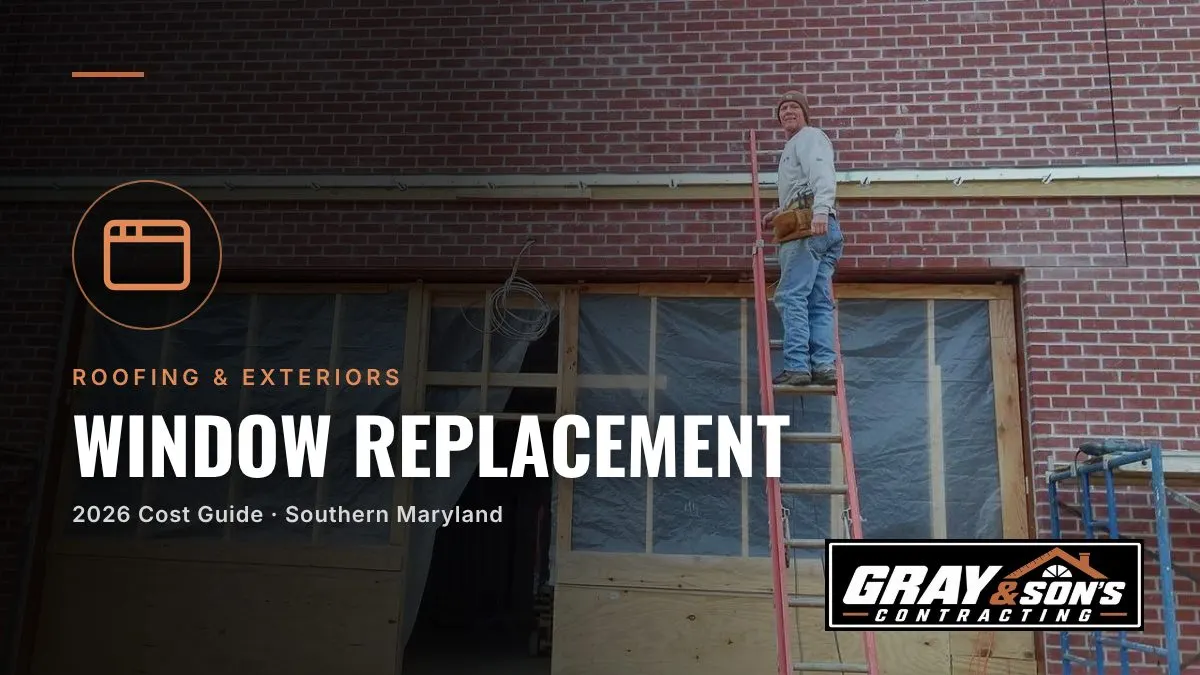
A single window replacement in Southern Maryland costs $375 to $1,200 installed in 2026, with most homeowners paying $500 to $850 per window for a mid-range double-hung vinyl unit with Low-E glass. A full-house replacement, 15 to 20 windows on a typical Calvert, St. Mary's, or Charles County home, runs $7,500 to $18,000, and sometimes higher for larger homes or premium materials.
Those numbers cover a wide range because windows are not one product. A basic vinyl double-hung in a standard opening is a fundamentally different job from a custom wood-clad casement in a non-standard size. This guide breaks down what drives the cost, what makes sense for Southern Maryland's climate specifically, and how to tell whether replacement is the right move for your house right now.
What Window Replacement Costs in 2026
By Window Type
| Window Type | Cost Per Window (Installed) | Notes |
|---|---|---|
| Single-hung vinyl | $300 to $600 | Budget option. Only the bottom sash opens. |
| Double-hung vinyl | $375 to $850 | The most common choice. Both sashes tilt in for cleaning. |
| Casement (vinyl) | $400 to $900 | Crank-operated, excellent seal when closed. |
| Sliding window (vinyl) | $350 to $750 | Good for wide openings. |
| Bay window | $1,500 to $4,500 | Three-panel unit that projects from the wall. |
| Bow window | $2,000 to $5,500 | Four or five panel curved unit. |
| Picture window (fixed) | $300 to $800 | No opening mechanism. Maximum glass, minimum cost. |
| Awning window | $400 to $900 | Hinged at top, opens outward. Good for ventilation in rain. |
| Double-hung wood | $700 to $1,500 | Traditional material, higher maintenance. |
| Double-hung fiberglass | $600 to $1,200 | Premium material, excellent durability. |
| Double-hung wood-clad | $800 to $1,800 | Wood interior, aluminum or fiberglass exterior. |
By Material
The frame material is the biggest single factor in window cost, and it affects maintenance, lifespan, and energy performance differently.
Vinyl ($300 to $900 per window). The most popular choice in Southern Maryland by a wide margin. Low maintenance, decent energy performance, 20 to 30 year lifespan. Will not rot, does not need painting, and handles humidity well. The downside is limited color options (mostly white and almond, though some manufacturers offer darker colors and exterior laminate finishes) and vinyl frames expand and contract with temperature more than other materials.
Fiberglass ($500 to $1,200 per window). Stronger and more dimensionally stable than vinyl. Excellent energy performance. Can be painted. Longer lifespan, 30 to 50 years. Higher upfront cost but lower lifetime cost if you plan to stay in the house. Handles the temperature swings in Southern Maryland better than vinyl because it expands at nearly the same rate as glass.
Wood ($600 to $1,500 per window). The traditional choice and still the best-looking option for historic homes and high-end renovations. Excellent insulator. But wood windows require regular painting or staining, and in Southern Maryland's humidity they are more prone to rot and swelling than in drier climates. Interior-only wood (wood-clad) is the compromise most homeowners choose.
Aluminum ($300 to $700 per window). Strong, thin frames that maximize glass area. But aluminum conducts heat rapidly, which makes it a poor insulator. Not ideal for energy efficiency. In waterfront communities along the Bay and Patuxent, Solomons, Chesapeake Beach, North Beach, St. George Island, aluminum frames also corrode in salt air unless anodized or powder-coated.
Wood-clad ($700 to $1,800 per window). Wood interior for aesthetics, aluminum or fiberglass exterior for weather resistance. The best of both worlds for homeowners who want the look of wood without the exterior maintenance. Popular on higher-end homes in Huntingtown, Dunkirk, and Leonardtown.
By Glass Package
The glass matters as much as the frame for energy performance, and in Southern Maryland's climate, hot humid summers and cold winters, the glass package is where the real energy savings come from.
Double-pane with Low-E coating is the current standard. Low-E (low emissivity) is a microscopically thin metallic coating that reflects infrared heat while letting visible light through. In summer, it keeps solar heat out. In winter, it keeps radiant heat in. This is the minimum you should install in any replacement window.
Triple-pane adds a third layer of glass and a second insulating air space. It provides better insulation (lower U-factor), better noise reduction, and less condensation on cold mornings. The cost premium is typically 15 to 25 percent over double-pane. Worth considering for north-facing windows that take the brunt of winter wind, bedrooms where noise reduction matters, and any home where energy bills are a primary concern.
Argon gas fill between the panes insulates better than air. Standard on most quality double-pane and triple-pane windows. It does slowly leak out over 15 to 20 years, but the performance reduction is gradual and modest.
Low-E with solar heat gain coefficient (SHGC) tuning. In Southern Maryland, the Energy Star recommendation for Climate Zone 4 is a U-factor of 0.30 or lower and an SHGC of 0.40 or lower. That balances winter heat retention with summer heat rejection. Ask for these numbers when comparing windows, they matter more than the brand name.
What Drives the Cost Up (and Down)
Standard sizes vs. custom. A standard 36 by 60 inch double-hung fits most openings built since the 1970s. If your openings are non-standard, common in older homes in Chesapeake Ranch Estates, the older neighborhoods of Leonardtown, and pre-1960 homes throughout the region, custom-sized windows add 20 to 40 percent to the cost.
Full-frame replacement vs. insert (pocket) replacement. An insert fits a new window into the existing frame, which is faster and cheaper but only works if the existing frame is in good condition. Full-frame replacement removes everything down to the rough opening, which costs more but is necessary when the frame is rotted, damaged, or out of square. Most homes built before 1990 in Southern Maryland benefit from full-frame replacement because decades of humidity have taken a toll on the original wood frames.
Number of windows. Per-window cost drops on larger jobs because the setup, cleanup, and mobilization costs are spread across more units. Replacing 15 windows at once is meaningfully cheaper per window than replacing 3.
Floor and accessibility. Second-floor windows cost more to replace because the work requires scaffolding or long ladders. Third-floor and hard-to-reach locations (above a roof, over a porch, or surrounded by landscaping) add more.
Trim and interior finishing. Replacement often reveals rotted sills, damaged drywall, or outdated trim that the homeowner wants updated while the opening is exposed. This is not included in the base window price but it is the most common source of "scope creep" on a window project. Budget 10 to 20 percent above the window cost for finishing and trim work.
Permit fees. Window replacement in Maryland typically requires a building permit when changing the size of the opening, adding or removing a window, or making structural changes to the wall. A same-size replacement into the same opening may not require a permit in all jurisdictions, but this varies by county. Calvert, St. Mary's, and Charles County each have their own permitting offices and fee schedules. A permit typically runs $50 to $200.
Signs Your Windows Need Replacement
Not every drafty window needs to be replaced. Some can be repaired, weatherstripped, or have the glass unit replaced without touching the frame. But these signs point toward full replacement.
Visible rot in the frame or sill. Once the wood is soft and crumbling, patching is temporary. The rot will come back because the conditions that caused it, water infiltration, poor flashing, missing drip cap, have not changed.
Condensation between the glass panes. A foggy window means the seal between the panes has failed and the insulating gas has leaked out. The glass unit can sometimes be replaced without replacing the whole window (a "sash replacement"), but if the window is more than 15 years old and multiple units have failed, full replacement is usually more cost-effective.
Drafts you can feel with your hand. Hold your hand near the window edges on a cold day. If you feel air movement, the weatherstripping has failed, the sash no longer seats tightly, or the frame has shifted enough to create gaps. Weatherstripping can be replaced on some windows, but on single-pane windows or older double-pane units, the draft problem usually means the window is past its useful life.
Single-pane glass. If your home still has single-pane windows, common in homes built before 1980, which includes a large share of the housing stock in Lusby, Prince Frederick, California, and Lexington Park, replacement with modern double-pane Low-E glass will cut your heating and cooling costs measurably. Single-pane glass has an R-value of about 1. A modern double-pane Low-E window has an R-value of 3 to 4. That is a significant difference on every heating and cooling bill.
Difficulty opening, closing, or locking. Windows that stick, jam, or will not lock properly are a security and safety issue as well as a comfort problem. Painted-shut windows on upper floors are an egress code violation, in a fire, you need to be able to open them.
High energy bills relative to comparable homes. If your heating and cooling costs seem high for the size of your house, windows are one of the most likely culprits. Windows account for 25 to 30 percent of residential heating and cooling energy use, according to the Department of Energy.
Energy Savings and Payback Period
Replacing single-pane windows with Energy Star double-pane Low-E windows saves an estimated $126 to $465 per year on energy bills for a typical home, according to the Energy Star calculator for Climate Zone 4 (which includes all of Southern Maryland). The range depends on how many windows you replace, how bad the old ones were, and your fuel source.
At $500 to $850 per window for a mid-range replacement, the payback period on energy savings alone is typically 12 to 20 years. That is a long payback, and it is important to be honest about it, window replacement is rarely a pure financial investment. The real return is comfort (eliminating drafts, reducing noise, evening out room temperatures), appearance (updating the look of the house), and home value. Buyers notice new windows, and appraisers credit them.
Maryland tax credits and incentives. Maryland's Energy Efficiency Standards Act and the federal Inflation Reduction Act may offer tax credits for qualifying energy-efficient window installations. The federal credit for Energy Star Most Efficient windows can offset a portion of the cost. Check the current program requirements before purchasing, the qualifying criteria and credit amounts change periodically.
Window Replacement for Southern Maryland's Climate: What Matters Most
Humidity and Moisture
Southern Maryland's average humidity runs 60 to 80 percent for much of the year. That means condensation on cold glass, moisture in wall cavities around the window opening, and a constant test of the window's weatherstripping and frame integrity. Choose windows rated for high-humidity environments, and insist on proper flashing and moisture barriers during installation. A perfectly good window installed without proper flashing will fail the wall behind it.
Chesapeake Bay Exposure
Homes in Chesapeake Beach, North Beach, Solomons, Piney Point, Scotland, and St. George Island face salt spray and higher wind loads. Vinyl and fiberglass frames handle salt air well. Aluminum does not, unless the finish is specifically rated for coastal exposure. Hardware (locks, hinges, balances) should be stainless steel or corrosion-resistant coated in these areas.
Wind and Storm Resistance
Southern Maryland is in Wind Zone 1 under the International Building Code, but waterfront and open-terrain properties near the Bay experience higher effective wind loads during nor'easters and tropical remnants. Impact-rated or laminated glass is not code-required here the way it is in hurricane zones, but it is available as an upgrade for homeowners who want extra storm protection and noise reduction.
Maryland Energy Code Requirements
As of the most recent Maryland energy code adoption (based on the 2021 IECC), new and replacement windows in Climate Zone 4 must meet minimum performance standards. For replacement windows, the requirement is a U-factor of 0.30 or lower. Most Energy Star-qualified windows meet this. If your window installer is not pulling a permit and verifying code compliance, that is a red flag.
How to Choose a Window Contractor in Southern Maryland
Get three written quotes that itemize materials and labor separately. A quote that just says "$12,000 for 15 windows" tells you nothing about what you are getting. You need to see the manufacturer, model, glass package, frame material, and whether it is insert or full-frame, per window.
Ask about installation warranty vs. manufacturer warranty. The manufacturer warranty covers the window itself (glass seal, frame, hardware) and is typically 10 to 25 years depending on the manufacturer. The installation warranty covers the labor, flashing, sealing, trim, and how the window was set into the opening. Installation problems cause more window failures than manufacturing defects. Insist on a minimum 2-year installation warranty.
Check the MHIC license. In Maryland, any contractor performing home improvement work must hold a Maryland Home Improvement Commission (MHIC) license. Verify at the Maryland Department of Labor website or call the MHIC at 410-230-6231.
Ask who is doing the actual installation. Some companies sell windows and subcontract the installation to crews the homeowner never meets. There is nothing wrong with subcontracting, but you should know who is doing the work and confirm they are licensed and insured.
The Bottom Line
Window replacement in Southern Maryland is a comfort and durability investment more than a pure energy savings play. The energy savings are real but the payback is long. What you get immediately is a house that is warmer in winter, cooler in summer, quieter, easier to maintain, and worth more at resale.
If your windows are single-pane, rotted, fogged, or drafty, replacement pays for itself in ways the energy calculator does not capture. If they are functional double-pane units that are 10 or 12 years old and working fine, you have time.
The worst financial decision is waiting until the frame rot spreads to the wall framing or the sill damage requires structural repair. A $700 window replacement becomes a $3,000 window-plus-wall-repair when water has been getting into the structure for years.
Considering new windows before winter? Gray & Sons Contracting replaces windows across Calvert, St. Mary's, and Charles County. We will measure, quote, and install, and we will tell you which windows actually need replacement and which ones do not. Get a Free Estimate