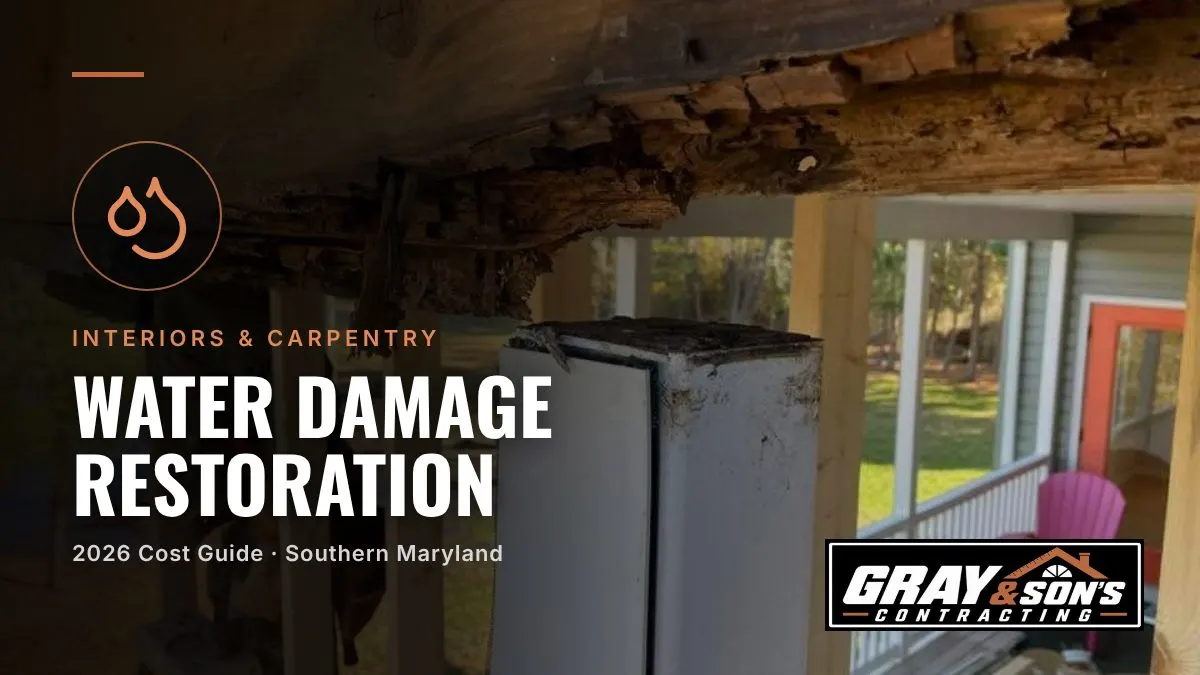
Water damage restoration in Southern Maryland costs $1,300 to $5,400 for most homeowners in 2026, with the national average landing around $3,250 for a professional restoration that includes water extraction, structural drying, damaged material removal, and repairs. The full range runs from $400 for a minor localized incident, a small pipe leak that damaged a section of drywall and flooring in one room, to $20,000 or more for a major flood event that affects multiple rooms, saturates the subfloor and wall cavities, requires extensive mold remediation, and demands replacement of flooring, drywall, insulation, and potentially structural framing. At the low end, extracting clean water from a contained bathroom overflow and drying the affected area runs $400 to $800. At the high end, restoring a home after a basement flood with contaminated water, including water extraction, antimicrobial treatment, drywall demolition, insulation removal, structural drying, mold remediation, and complete reconstruction, pushes the project to $15,000 to $90,000 depending on the extent of the flooding and the contamination level.
Fall and winter are the seasons when water damage risk escalates in Southern Maryland. October through March brings the nor'easters, heavy rains, and coastal flooding that can overwhelm drainage systems, flood basements, and drive wind-blown rain through compromised roofing and siding. The first hard freeze of the season, typically arriving in late November or December in the tri-county area, introduces the risk of burst pipes in unheated spaces, crawl spaces, and exterior hose bibs that were not properly winterized. Ice dams on roofs during January and February cold snaps can force water under shingles and into attic spaces, ceiling cavities, and wall interiors. Understanding the costs of water damage restoration before an event occurs helps homeowners make informed decisions quickly when time is critical, because with water damage, every hour of delay increases the cost of restoration.
This guide covers the complete cost picture for water damage restoration in Southern Maryland: pricing by damage classification and water category, room-by-room cost breakdowns, the restoration process and timeline, equipment and labor cost analysis, regional factors specific to the tri-county area, insurance coverage considerations, prevention strategies, and answers to the questions we hear most from homeowners across Waldorf, Prince Frederick, Leonardtown, and the surrounding communities.
Cost by Damage Class
The Institute of Inspection Cleaning and Restoration Certification (IICRC) classifies water damage into four classes based on the extent and rate of evaporation required. This classification system determines the scope of restoration work and directly influences cost.
| Damage Class | Typical Cost | Description | Drying Equipment Needed | Timeline |
|---|---|---|---|---|
| Class 1, Minor | $150 to $400 | Small area affected; minimal absorption into materials; part of one room | 1 to 2 air movers; 1 dehumidifier | 1 to 2 days |
| Class 2, Moderate | $500 to $1,000 | Entire room affected; water has wicked into walls up to 12 inches; carpet and pad saturated | 3 to 5 air movers; 1 to 2 dehumidifiers | 3 to 5 days |
| Class 3, Significant | $1,000 to $3,000 | Water has saturated walls, ceilings, subfloor, and insulation; may involve multiple rooms | 5 to 10 air movers; 2 to 4 dehumidifiers; specialty drying equipment | 5 to 7 days |
| Class 4, Severe | $20,000 to $90,000 | Long-standing water; deep saturation into concrete, hardwood, plaster, and structural members; extensive demolition and reconstruction required | Full drying array; potential structural drying; commercial dehumidifiers | 7 to 14+ days (drying); weeks to months (reconstruction) |
Class 1, Minor Damage: $150 to $400
Class 1 water damage involves a small area of one room where water has not significantly absorbed into the surrounding materials. Common Class 1 scenarios include a toilet overflow that is caught and stopped within minutes, a small appliance leak (dishwasher or washing machine) that deposits water on a tile or vinyl floor where it is cleaned up promptly, or a dripping pipe that wets a small section of ceiling drywall before being repaired.
At this level, restoration involves water extraction (mopping, wet vacuuming, or portable extraction equipment), placement of one or two air movers and a small dehumidifier, and monitoring of moisture levels for one to two days until the affected materials reach acceptable moisture content. Drywall that has been wet but has not lost structural integrity may be dried in place rather than removed. Flooring materials vary, tile and vinyl floors dry without damage, while carpet and pad may need to be pulled back, dried, and relaid.
The cost of $150 to $400 reflects a single service call, initial extraction, equipment placement, and one to two days of equipment rental and monitoring. This is the best-case water damage scenario, the kind that results from catching a leak early and responding immediately.
Class 2, Moderate Damage: $500 to $1,000
Class 2 damage involves an entire room where water has saturated the carpet and pad (if present) and wicked into the base of the walls up to 12 inches above the floor. This level of damage typically results from a pipe burst that ran for an hour or more before being discovered, a water heater failure that flooded a utility room and adjacent hallway, or a heavy rain event that forced water through a basement wall or window well.
The restoration scope includes professional water extraction with truck-mounted or portable extraction units, removal and disposal of saturated carpet pad (the pad cannot be effectively dried and must be replaced), drying of the carpet itself (which can often be saved if extracted and dried promptly), installation of multiple air movers positioned to circulate air across the wet floor surface and up the wet wall surfaces, and commercial dehumidifiers to remove the moisture from the air as it evaporates from the materials.
The walls present a critical decision point at Class 2. Drywall that has been wet to 12 inches from the floor may or may not be savable depending on how long it was wet and whether the paper facing has begun to delaminate. If the drywall has been wet for more than 24 to 48 hours, the standard practice is to cut and remove the bottom 12 to 24 inches of drywall (a "flood cut"), dry the wall cavity and studs behind it, and replace the removed drywall section after drying is complete. This flood-cut approach adds $200 to $500 to the project but ensures that the wall cavity dries completely and prevents mold growth behind intact drywall that may be trapping moisture.
Class 3, Significant Damage: $1,000 to $3,000
Class 3 damage involves water that has saturated walls from floor to ceiling, soaked through the subfloor, and may have entered the ceiling cavity from above (a second-floor leak that drains through the ceiling of the room below). Carpet, pad, and any absorbent flooring are saturated throughout. Multiple rooms may be affected. This level of damage results from a major pipe burst that ran for hours, a roof leak during a heavy storm that flooded interior rooms, a sump pump failure during a heavy rain event, or a water heater catastrophic failure.
The restoration involves aggressive water extraction, extensive material removal (all carpet and pad, damaged drywall, wet insulation), structural drying with multiple air movers, commercial dehumidifiers, and potentially specialty drying equipment (drying mats for hardwood floors, injection drying systems for wall cavities, thermal drying equipment for concrete), antimicrobial treatment of exposed framing, and moisture monitoring over five to seven days.
The $1,000 to $3,000 cost covers the restoration phase, extraction, demolition of damaged materials, and drying. The reconstruction phase, replacing removed drywall, installing new flooring, painting, and finishing, adds significant additional cost that varies widely based on the materials selected and the scope of reconstruction. A Class 3 event in a single room with basic materials may total $3,000 to $6,000 including both restoration and reconstruction. A Class 3 event affecting multiple rooms with hardwood flooring and custom finishes can total $8,000 to $15,000 or more.
Class 4, Severe Damage: $20,000 to $90,000
Class 4 is the most destructive water damage classification. It involves long-standing water (flooding that was present for days before restoration begins), deep material saturation (water absorbed into concrete slabs, hardwood subfloors, plaster walls, masonry), and typically involves contaminated water (sewage backup or floodwater). Class 4 events include basement flooding from a multi-day storm event, sewer line backup that filled a basement with contaminated water, or extended flooding from a major plumbing failure in an unoccupied home (a vacation home, a home whose owner was traveling, or a home in foreclosure).
The restoration scope at Class 4 is essentially a controlled demolition followed by a complete rebuild of the affected areas. All absorbent materials, carpet, pad, drywall, insulation, paneling, ceiling tiles, are removed and discarded. Structural members (studs, joists, subfloor sheathing) are evaluated for structural integrity and replaced if compromised. All surfaces are treated with antimicrobial agents. Commercial drying equipment runs for one to two weeks or more to draw moisture from concrete, masonry, and structural wood. Mold remediation is almost always required.
The cost range of $20,000 to $90,000 reflects the enormous variation in scope. A finished basement with 500 square feet of space may cost $20,000 to $40,000 for complete restoration and reconstruction. A whole-house flooding event affecting 1,500 or more square feet across multiple levels can exceed $50,000 to $90,000, costs that are driven primarily by the reconstruction phase rather than the initial restoration.
Cost by Water Category
The source of the water, and its contamination level, has a major impact on restoration cost because contaminated water requires more extensive safety measures, personal protective equipment, antimicrobial treatment, and material removal than clean water.
| Water Category | Per Square Foot Cost | Common Sources | Safety Level |
|---|---|---|---|
| Category 1, Clean Water | $3.00 to $4.00 | Broken supply line; faucet overflow; rainwater through clean surface | Low risk, water originates from a sanitary source |
| Category 2, Gray Water | $4.00 to $7.00 | Washing machine overflow; dishwasher leak; toilet overflow (urine, no feces); aquarium | Moderate risk, water contains contaminants that can cause illness |
| Category 3, Black Water | $7.00 to $7.50 | Sewage backup; floodwater; standing water (over 48 hours any category becomes black) | High risk, water contains pathogens; strict safety protocols required |
Category 1, Clean Water: $3.00 to $4.00 Per Square Foot
Category 1 water originates from a sanitary source and poses no substantial risk to human health at the time of contact. Clean water sources include broken water supply lines, overflowing sinks or tubs where the overflow was from the supply (not a drain backup), melting ice or snow entering through a window or door, and rainwater entering through a roof leak onto a clean surface.
The restoration cost of $3.00 to $4.00 per square foot reflects the most straightforward restoration process, extract the water, dry the materials, and repair or replace what was damaged. No special decontamination, antimicrobial treatment, or biohazard disposal is required. Materials that can be dried to acceptable moisture levels can generally be saved and reused, drywall (if caught within 24 to 48 hours and still structurally sound), carpet (if extracted and dried promptly), and hardwood flooring (if dried with controlled, gradual moisture removal to prevent cupping and warping).
An important IICRC guideline: Category 1 water that is not extracted within 48 hours automatically escalates to Category 2 or Category 3 as microbial growth begins in the standing water. This time-dependent escalation is why rapid response is so important, clean water that could be restored at $3 to $4 per square foot becomes gray or black water at $4 to $7.50 per square foot if left standing for two or more days.
Category 2, Gray Water: $4.00 to $7.00 Per Square Foot
Category 2 gray water contains significant contamination that can cause discomfort or illness if ingested or exposed to skin. Common gray water sources include washing machine overflows (which contain detergent, dirt, and bacteria from clothing), dishwasher leaks (food particles, detergent, grease), toilet overflows involving urine but not feces, and sump pump discharge that has picked up soil bacteria.
The higher cost of $4.00 to $7.00 per square foot reflects the additional safety measures and treatment required. Restoration workers use personal protective equipment (gloves, masks, eye protection). All affected porous materials must be carefully evaluated, carpet and pad saturated with gray water are generally discarded rather than cleaned. Drywall, insulation, and other absorbent materials that have absorbed gray water are removed rather than dried in place. Affected hard surfaces (tile, concrete, sealed wood) are cleaned with antimicrobial agents before drying.
The most expensive gray water damage involves hardwood flooring, which costs $10 to $15 per square foot to restore or replace when contaminated with gray water. The wood absorbs the contaminated water, and unlike clean water that can be dried from the wood over several days, gray water contaminants remain in the wood fibers even after drying, requiring removal and replacement of the affected boards.
Category 3, Black Water: $7.00 to $7.50 Per Square Foot
Category 3 black water is grossly contaminated and contains pathogenic agents, bacteria, viruses, and other microorganisms that can cause severe illness or death. Black water sources include sewage backup from a failed sewer line or septic system, floodwater that has entered the home from outside (which is always classified as black water because it has contacted soil, sewage, chemicals, and animal waste), and any standing water that has been present for more than 48 hours (regardless of its original source, it has become a growth medium for pathogenic bacteria).
The restoration cost of $7.00 to $7.50 per square foot reflects the most stringent safety protocols. Restoration workers use full personal protective equipment including Tyvek suits, respirators, and eye protection. All porous materials contacted by black water, carpet, pad, drywall, insulation, particleboard, OSB, fabric, paper, must be removed and disposed of as contaminated waste. No porous material contacted by black water is salvageable. Hard surfaces (concrete, tile, metal, sealed wood) must be thoroughly cleaned and treated with EPA-registered antimicrobial agents. Structural wood (studs, joists, subfloor sheathing) contacted by black water must be cleaned, treated, and evaluated, if the wood has begun to soften or delaminate, it must be replaced.
Sewage backup, the most common black water event in Southern Maryland homes, is particularly expensive because it typically affects basements, which contain large volumes of material (finished walls, flooring, furniture, stored belongings) that must all be removed and disposed of when contacted by sewage. Removing one inch of clean water from a basement costs $500 to $1,500. Removing two feet of sewage-contaminated water from the same basement, including contaminated material demolition and antimicrobial treatment, costs $3,000 or more before reconstruction begins.
Cost by Affected Area
Different areas of the home present different restoration challenges based on the materials present, the accessibility of the affected structures, and the volume of water involved.
| Affected Area | Typical Restoration Cost | Notes |
|---|---|---|
| Bathroom (fixtures, floor, walls) | $150 to $800 | Often a contained area; tile floors limit absorption; quick response reduces cost |
| Single Room, Carpet and Drywall | $500 to $1,500 | Carpet pad usually replaced; drywall may need flood cut; standard drying |
| Ceiling (from above-floor leak) | $350 to $1,300 | Must locate and repair the source first; ceiling drywall removal and replacement |
| Kitchen (flooring, cabinets, appliance area) | $500 to $2,500 | Cabinet toe kicks trap water; dishwasher and refrigerator leaks reach under cabinets |
| Hardwood Flooring (per room) | $200 to $700 | Controlled drying essential; cupping and warping require sanding or replacement |
| Drywall (per room, including replacement) | $300 to $850 | Flood cuts at $1.50 to $3.00 per sq ft; full wall replacement for severe saturation |
| Basement, Minor (clean water, contained) | $500 to $1,500 | Sump pump failure; minor seepage; limited finished area affected |
| Basement, Major (flood or sewage) | $3,000 to $90,000 | Extensive demolition; contamination treatment; complete reconstruction |
| Foundation (water damage to structure) | $2,000 to $10,000 | Structural assessment; drainage correction; crack repair; waterproofing |
| Roof (leak damage to interior) | $400 to $1,700 | Roof repair + interior ceiling/wall restoration; must address source before interior |
Bathroom Water Damage: $150 to $800
Bathrooms are designed for water, tile floors, waterproof surrounds, sealed fixtures, so bathroom water damage is often the least expensive to restore. A toilet overflow, a burst supply line under the vanity, or a shower pan leak typically deposits water on tile or vinyl flooring that does not absorb moisture, limiting the damage to the immediate area around the leak.
The lower end of the $150 to $800 range covers a contained overflow on a tile floor, water extraction, drying, and perhaps repair of any drywall or baseboard that was contacted. The upper end covers a more extensive leak, a burst supply line that ran for hours, saturating the bathroom floor, the subfloor, the vanity cabinet, and the wall cavity behind the vanity. At the upper end, restoration includes water extraction, removal of the vanity to access the wall cavity, drywall flood cuts, subfloor drying, antimicrobial treatment, and reconstruction.
The hidden risk in bathroom water damage is the subfloor. Bathrooms on upper floors deliver water directly to the ceiling of the room below through the subfloor, a bathroom leak that seems minor from above may be causing extensive ceiling and wall damage in the room below. Bathrooms on slab foundations trap water between the tile and the slab, creating a slow-drying environment that can harbor mold for months if not properly identified and dried.
Basement Water Damage: $500 to $90,000
Basement water damage has the widest cost range of any area because basements range from simple utility spaces with bare concrete floors (minimal to restore) to fully finished living spaces with carpet, drywall, entertainment systems, and bedrooms (extremely expensive to restore). The source of the water, clean water from a pipe burst versus black water from a sewage backup or flood, adds another multiplier to the cost.
At the low end ($500 to $1,500), the scenario is a minor water intrusion in an unfinished or minimally finished basement, a small amount of clean water from a sump pump failure, wall seepage, or a leaking pipe that affected the concrete floor and perhaps some stored items. Extraction and drying are straightforward, and reconstruction costs are minimal because there are few finished materials to restore.
At the high end ($20,000 to $90,000), the scenario is a major flood or sewage backup in a fully finished basement. The entire finished space, carpet, drywall, trim, cabinets, electrical outlets, HVAC ducts below the flood line, must be demolished and reconstructed. If the water was contaminated (sewage or floodwater), every porous material must be disposed of as contaminated waste, and all surfaces must be treated with antimicrobial agents before reconstruction begins. The reconstruction cost to rebuild a finished basement, new drywall, new flooring, new trim, painting, new electrical outlets, and HVAC duct cleaning or replacement, can easily equal or exceed the cost of the original basement finishing.
Hardwood Flooring Damage: $200 to $700 Per Room
Hardwood flooring requires specialized restoration when water-damaged. Hardwood absorbs water and responds by expanding, causing the boards to push against each other, creating cupping (edges higher than center), buckling (boards lifting away from the subfloor), and crowning (center higher than edges, which occurs when the surface dries faster than the bottom). Improper drying, either too fast or too slow, can permanently damage hardwood floors that could have been saved with correct technique.
The restoration cost of $200 to $700 per room covers the controlled drying process: placement of drying mats on the floor surface that draw moisture from the wood at a controlled rate, dehumidifiers to remove the evaporated moisture from the air, and daily moisture measurements to track the drying progress. The entire drying process takes three to seven days for typical hardwood water damage.
After drying, the floor is assessed for permanent damage. Minor cupping often resolves on its own as the wood equalizes with the room's humidity. Moderate cupping or crowning may require sanding and refinishing ($3 to $5 per square foot). Severe buckling or boards that have been saturated with contaminated water require replacement of the affected boards ($8 to $15 per square foot for matching and replacing individual boards in an existing floor).
The Restoration Process and Timeline
Understanding the restoration process helps homeowners know what to expect and why professional restoration follows a structured sequence.
Phase 1: Emergency Response and Assessment (Hours 0 to 4)
The restoration company arrives, identifies and stops the water source (if not already stopped), assesses the extent of damage using moisture meters and thermal imaging cameras, classifies the damage (Class 1 through 4) and the water category (1 through 3), documents the damage with photos and measurements for insurance purposes, and begins water extraction. For emergency calls outside business hours, expect an emergency response fee of $100 to $200 on top of the standard restoration cost. Many restoration companies do not charge emergency fees, ask when calling.
Phase 2: Water Extraction (Hours 2 to 8)
Standing water is removed using truck-mounted or portable extraction equipment. Carpet and pad may be pulled back for extraction from beneath. Extraction from hard surfaces (tile, concrete, sealed wood) is straightforward. Extraction from porous surfaces requires specialized equipment, weighted extraction tools for carpet, slot extraction tools for crevices and edges, and submersible pumps for standing water in basements.
Phase 3: Demolition of Unsalvageable Materials (Hours 4 to 24)
Saturated materials that cannot be effectively dried or that have been contaminated are removed: carpet pad (almost always discarded), damaged drywall (flood cuts or full removal), wet insulation, saturated baseboard and trim, and any other porous materials that have absorbed contaminated water. This demolition creates space for air circulation and exposes wall cavities and subfloor for drying.
Phase 4: Structural Drying (Days 1 to 7)
Air movers, dehumidifiers, and specialty drying equipment are placed throughout the affected area. The restoration technician calculates the number and placement of air movers based on the volume of wet material, the drying rate required, and the airflow patterns in the space. Dehumidifiers remove the moisture from the air as it evaporates from wet surfaces. The technician monitors moisture levels daily, in the walls, floors, subfloor, and air, and adjusts equipment placement as areas dry at different rates. Drying is complete when all affected materials reach their target moisture content (typically 12 to 15 percent for wood framing, less than 1 percent for drywall).
Phase 5: Antimicrobial Treatment (Days 3 to 7, concurrent with drying)
After materials reach target moisture levels, exposed surfaces are treated with EPA-registered antimicrobial agents to prevent mold growth. This is especially critical in wall cavities, subfloor undersides, and any area where moisture may have promoted microbial growth. For Category 2 and Category 3 water events, antimicrobial treatment is mandatory throughout the affected area.
Phase 6: Reconstruction (Days 7 to 30+)
After drying and treatment are complete, the reconstruction phase begins, replacing removed drywall, installing new flooring, reinstalling trim, painting, and restoring the home to its pre-damage condition. The reconstruction timeline varies enormously based on the scope: a single room with minor drywall replacement may take two to three days. A full basement reconstruction takes two to four weeks or longer.
Regional Factors for Southern Maryland
Several factors specific to the Calvert, St. Mary's, and Charles County area affect water damage risk, restoration requirements, and costs.
Chesapeake Bay Storm Exposure and Coastal Flooding
Southern Maryland's proximity to the Chesapeake Bay and its tributaries, the Patuxent River along Calvert County's eastern shore, the Potomac River along St. Mary's and Charles County's southern and western borders, creates elevated flood risk during nor'easters, tropical systems, and heavy rain events that coincide with high tides. Waterfront and low-lying communities, Solomons, Chesapeake Beach, North Beach, Scotland, Piney Point, Ridge, Cobb Island, and the low-lying areas along the Wicomico and St. Mary's rivers, are particularly vulnerable to coastal and tidal flooding.
Floodwater is always classified as Category 3 (black water) regardless of its visual clarity, because it has contacted soil, sewage systems, agricultural runoff, and animal waste. This means that any home flooded by rising water from the Bay or its tributaries faces the most expensive restoration classification, all porous materials contacted by floodwater must be removed, and the full antimicrobial treatment protocol applies.
Homeowners in flood-vulnerable areas should verify their flood insurance coverage. Standard homeowner's insurance does not cover flood damage, a separate flood insurance policy through the National Flood Insurance Program (NFIP) or a private flood insurer is required. The FEMA flood maps for Southern Maryland identify Special Flood Hazard Areas (Zone A and Zone AE) where flood insurance is required for federally backed mortgages, but flooding can and does occur outside these designated zones, particularly during major storm events.
High Water Table and Basement Water Intrusion
Much of Southern Maryland sits on clay-heavy soils with a relatively high water table, conditions that promote basement water intrusion through hydrostatic pressure. When the water table rises during heavy rain events, or during the sustained wet periods that occur in fall, winter, and spring, groundwater pushes against the basement walls and floor from the outside, forcing water through any crack, joint, or porous area in the concrete. This hydrostatic water intrusion is a chronic problem in many homes throughout the tri-county area, particularly in the older neighborhoods of Waldorf, La Plata, Mechanicsville, Charlotte Hall, and Leonardtown where homes were built before modern waterproofing standards.
Homes with recurring basement water intrusion face a choice: address the symptom (restore the water damage each time it occurs) or address the cause (install a perimeter drain system, sump pump, and interior or exterior waterproofing). The cost of a one-time water damage restoration ($500 to $3,000 for a typical basement intrusion event) may be acceptable for a rare occurrence, but recurring events quickly make the cost of permanent waterproofing ($5,000 to $15,000 for a comprehensive perimeter drain and sump pump system) the more cost-effective long-term solution.
Septic System Prevalence and Sewage Backup Risk
A large percentage of homes in the rural and semi-rural areas of all three counties, Mechanicsville, Charlotte Hall, Hollywood, Chaptico, Avenue, Bushwood, Lusby, St. Leonard, and many other communities, rely on private septic systems rather than municipal sewer connections. Septic system failures, from a saturated drain field, a full tank, tree root infiltration, or structural collapse, can cause sewage to back up into the home through the lowest drain (typically a basement floor drain or a first-floor toilet).
Septic-related sewage backup is Category 3 (black water) and is among the most expensive and hazardous water damage events. The contamination level requires full PPE for restoration workers, complete removal of all contacted porous materials, EPA-registered antimicrobial treatment of all surfaces, and careful disposal of contaminated materials. The emotional toll is significant as well, a sewage backup in a finished basement destroys not just the building materials but personal belongings, stored items, and the sense of the home as a clean, safe space.
Preventing septic-related backups through regular maintenance, pumping the tank every three to five years, inspecting the drain field, addressing slow drains promptly, is far less expensive than restoring the damage from a backup event. A septic tank pumping costs $300 to $600; a sewage backup restoration costs $3,000 to $30,000 or more.
Burst Pipe Risk During Winter Freezes
Southern Maryland's winter climate, with typical overnight lows in the 20s and 30s and periodic cold snaps that bring temperatures into the single digits and teens, creates burst pipe risk in homes with plumbing in vulnerable locations. Pipes in unheated crawl spaces, exterior wall cavities without adequate insulation, unheated garages, and outdoor hose bibs are all at risk of freezing and bursting when temperatures drop below 20°F for extended periods.
A burst pipe that occurs while the homeowner is home and responds immediately may result in a Class 1 or Class 2 damage event costing $500 to $2,000. A burst pipe that occurs while the homeowner is away, on vacation, at work, or during a holiday trip, can run for hours or days before discovery, resulting in a Class 3 or Class 4 event costing $5,000 to $50,000 or more. The difference is entirely about response time.
Pipe burst prevention measures, insulating exposed pipes, maintaining heat in the home above 55°F during cold snaps, opening cabinet doors to allow warm air to reach under-sink pipes, draining and disconnecting outdoor hoses, and installing frost-proof hose bibs, cost $50 to $500 for the entire home and prevent damage that can cost thousands or tens of thousands of dollars.
Insurance Coverage Considerations
Understanding what your homeowner's insurance covers, and what it does not, is essential for managing the financial impact of water damage.
Generally covered by standard homeowner's insurance: - Sudden and accidental water damage from burst pipes, appliance failures, and plumbing malfunctions - Water damage from ice dams and the weight of ice and snow on the roof - Rain damage that enters through a storm-damaged opening in the roof or walls - Cleanup and restoration costs including demolition, drying, and reconstruction - Temporary living expenses if the home is uninhabitable during restoration
Generally NOT covered by standard homeowner's insurance: - Flood damage (requires separate flood insurance policy) - Gradual water damage from long-term leaks (maintenance issues) - Sewer and drain backup (requires a separate endorsement on most policies, typically $50 to $100 per year) - Mold damage (limited or excluded on many policies; may require separate mold endorsement) - Damage from lack of maintenance (a roof that leaked because shingles were never replaced, pipes that burst because the home was not heated)
Key insurance tips for Southern Maryland homeowners: - Add sewer and drain backup coverage to your policy if you do not already have it, this endorsement costs $50 to $100 per year and covers the most common and most expensive non-flood water damage event (sewage backup), which is not covered by a standard policy. - Purchase flood insurance if your home is in or near a flood zone, and consider it even if your home is not in a mapped flood zone, since 25 to 30 percent of flood claims come from outside designated flood areas. - Document your home's contents with photos or video, stored in the cloud, not in the home, before any damage event occurs. This documentation dramatically speeds the insurance claims process. - Call your insurance company before calling a restoration company (unless the situation is an emergency requiring immediate intervention). Many insurance companies have preferred restoration vendors and the claim process is smoother when their preferred vendor is used.
Prevention: Protecting Your Home from Water Damage
The most cost-effective approach to water damage is prevention. Here are the most impactful prevention measures ranked by cost-effectiveness.
| Prevention Measure | Cost | Protects Against |
|---|---|---|
| Inspect and maintain gutters and downspouts | $100 to $200/year | Foundation water intrusion; basement flooding; exterior wall damage |
| Install or maintain a sump pump with battery backup | $800 to $2,000 (installed) | Basement flooding during storms and power outages |
| Insulate exposed pipes in crawl spaces and exterior walls | $100 to $400 | Burst pipes during winter freezes |
| Install water leak detection sensors | $50 to $300 | Early detection of any leak; minimizes damage by alerting homeowner |
| Maintain septic system (pump every 3 to 5 years) | $300 to $600 | Sewage backup into home |
| Waterproof basement (interior or exterior) | $5,000 to $15,000 | Chronic basement water intrusion; hydrostatic pressure |
| Replace aging water supply lines | $200 to $2,000 | Burst supply lines; slow leaks in walls |
| Install a whole-house water shut-off valve with smart control | $200 to $500 | Automatic shut-off when a leak is detected; protection during travel |
Frequently Asked Questions
How quickly should I respond to water damage? Immediately. Every hour that water sits increases the damage, the restoration cost, and the risk of mold growth. Category 1 (clean) water that is not addressed within 48 hours automatically escalates to Category 2 or 3 as bacteria begin growing in the standing water. Mold can begin growing on wet surfaces within 24 to 48 hours in Southern Maryland's warm, humid climate. The fastest, cheapest restoration is the one that starts within the first few hours.
Can I handle water damage cleanup myself? For small, contained clean water events, a toilet overflow on a tile floor, a small appliance leak on vinyl, DIY cleanup is appropriate. Extract the water immediately with towels, a wet vacuum, or a mop. Place fans to circulate air across the wet area. Run a dehumidifier in the room. Monitor for moisture over the next 24 to 48 hours. For anything larger, multiple rooms, carpet saturation, wall saturation, any gray or black water, professional restoration is strongly recommended. Professionals have the extraction equipment, drying equipment, moisture monitoring instruments, and antimicrobial products that ensure thorough restoration and prevent mold growth that DIY efforts often miss.
Will water damage cause mold? If wet materials are not dried within 24 to 48 hours, mold growth is likely, especially in Southern Maryland's warm, humid climate where ambient moisture levels support rapid mold colonization. Professional restoration companies monitor moisture levels throughout the drying process and apply antimicrobial treatments to prevent mold growth. If mold has already begun growing by the time restoration begins, mold remediation is added to the project scope at an additional cost of $1,100 to $3,400 (national average $2,200) depending on the extent of the mold growth.
Does water damage restoration include repairs, or just drying? Most restoration companies handle both phases, the initial restoration (extraction, demolition of damaged materials, drying, treatment) and the subsequent reconstruction (replacing drywall, installing flooring, painting, reinstalling trim). Some companies specialize in one phase or the other. When hiring, confirm whether the company handles both restoration and reconstruction, or whether you will need to hire a separate contractor for reconstruction. Working with a single company for both phases simplifies the process, maintains continuity of responsibility, and often costs less than hiring separately.
How long does the entire restoration process take? The timeline depends on the damage class and scope. A minor Class 1 event may be fully restored (dried, repaired, and finished) within three to five days. A moderate Class 2 event takes one to two weeks. A significant Class 3 event takes two to four weeks. A severe Class 4 event, particularly one involving contaminated water and extensive reconstruction, can take one to three months from initial response to completed reconstruction.
What should I do while waiting for the restoration company to arrive? Stop the water source if possible (shut off the supply valve, turn off the water main, or plug the leak). Remove furniture, rugs, and valuables from the wet area if you can do so safely. Do not enter an area with standing water if electrical outlets or appliances are submerged, shut off the electricity to the affected area at the breaker panel first. Begin extracting water with towels, buckets, or a wet vacuum if you have one. Open windows and run fans if the weather permits. Take photos and video of the damage before beginning any cleanup, this documentation is essential for insurance claims.
Is water damage restoration covered by a home warranty? Home warranties typically cover the repair of the system that failed (the pipe, the appliance, the water heater) but do not cover the resulting water damage to the home. The restoration of the water damage itself is covered by homeowner's insurance (for sudden and accidental events) or paid out of pocket (for maintenance-related or flood events not covered by insurance).
Dealing with water damage? Gray & Sons Contracting provides professional water damage restoration and repair throughout Calvert, St. Mary's, and Charles County, from emergency water extraction and structural drying in Waldorf, La Plata, and Lexington Park to basement flood restoration in Prince Frederick, Leonardtown, and Solomons, to burst pipe repair and drywall reconstruction in Dunkirk, Huntingtown, and California (MD), to comprehensive restoration and mold remediation in Mechanicsville, Charlotte Hall, Hollywood, Chaptico, Avenue, Lusby, Chesapeake Beach, and North Beach. We respond quickly, work with your insurance company, and handle the complete process, from initial extraction through final reconstruction, with honest pricing and the expertise to restore your home to its pre-damage condition. Get a Free Estimate