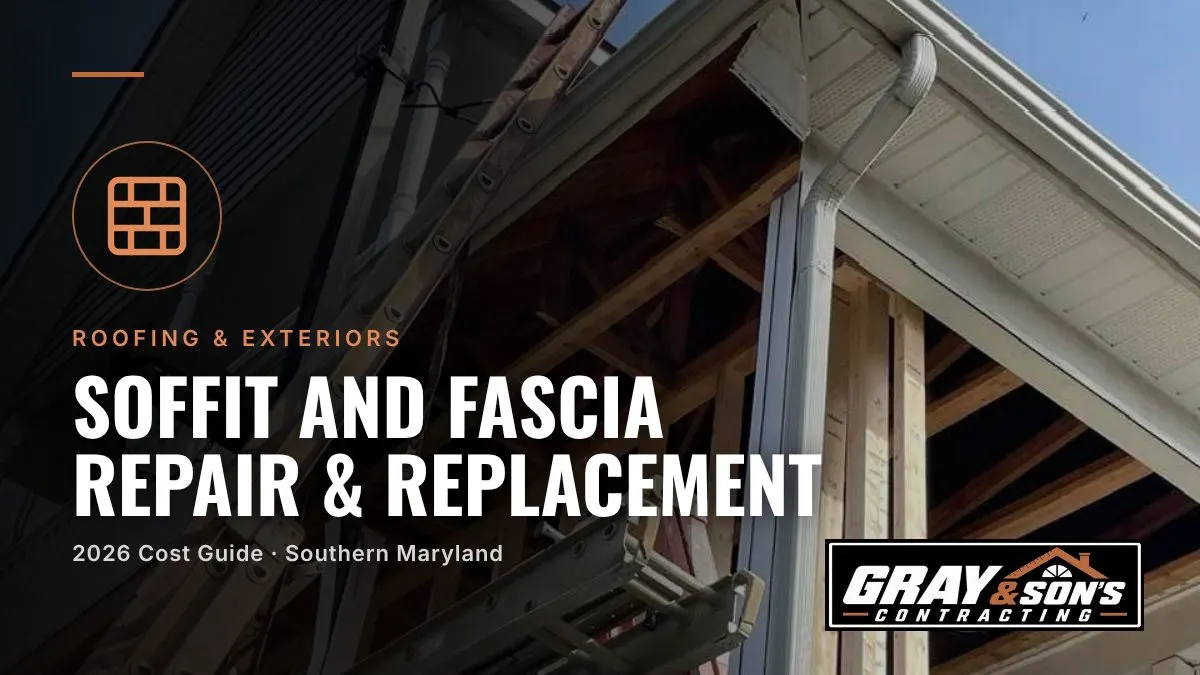
Soffit and fascia replacement in Southern Maryland costs $2,500 to $6,800 for most homeowners in 2026, with the national average landing around $4,200 for a complete soffit and fascia replacement on a standard single-story home. The full range runs from $600 for a partial fascia repair on one side of the house to $12,000 or more for a complex two-story home with multiple rooflines, dormers, and custom trim work using premium fiber cement materials. At the low end, repairing a single 20-foot section of rotted fascia board and patching the adjacent soffit panel costs $600 to $1,800 in materials and labor. At the high end, a full soffit and fascia replacement on a 2,500-square-foot colonial with wrap-around porches, multiple gable ends, and fiber cement materials installed by a two-person crew over three to four days pushes the project to $8,000 to $12,000 when the scope includes structural rot repair to rafter tails, removal and reinstallation of gutters, and custom bending of aluminum trim to match complex roofline profiles.
Mid-October is the ideal time to address soffit and fascia issues in Southern Maryland. The summer heat that makes working on ladders and scaffolding uncomfortable has broken, but the freezing rain, ice storms, and nor'easters that define winter in the tri-county area have not yet arrived. Damaged soffits and fascia boards, whether rotted, cracked, sagging, or separated from the roofline, create direct entry points for wind-driven rain, ice, pests, and cold air into the attic and wall cavities. A rotted fascia board that seems like a cosmetic annoyance in September becomes a serious structural liability when a December nor'easter pushes rain horizontally under the roof edge and into the attic, soaking insulation, staining ceilings, and promoting mold growth that compounds through the winter months. Addressing these issues now, while contractors have availability between the summer rush and the holiday slowdown, protects your home through the harshest months of the year and prevents the cascading water damage that turns a $1,500 fascia replacement into a $5,000 attic remediation project.
This guide covers the complete cost picture for soffit and fascia repair and replacement in Southern Maryland: pricing by project type and scope, material comparisons with installed cost per linear foot, home size and style cost variations, equipment versus installed cost analysis, regional factors specific to the Calvert, St. Mary's, and Charles County area, DIY versus professional installation, real-world project scenarios with itemized costs, how to identify soffit and fascia problems before they cause interior damage, and answers to the questions we hear most from homeowners across Waldorf, Prince Frederick, Leonardtown, and the surrounding communities.
Cost by Project Type
The scope of your project, spot repair, partial replacement, or full replacement, is the primary factor that determines your total cost. Here is what you can expect to pay for each project type in 2026.
| Project Type | Typical Cost | Scope | Timeline |
|---|---|---|---|
| Spot Fascia Repair (under 20 linear ft) | $300 to $800 | Replacing one or two rotted fascia boards on a single section of roofline | 2 to 4 hours |
| Spot Soffit Repair (under 20 linear ft) | $250 to $700 | Replacing damaged or sagging soffit panels on one section | 2 to 4 hours |
| Partial Replacement, One Side (40 to 80 linear ft) | $600 to $1,800 | Removing and replacing all soffit and fascia on one elevation of the home | Half day to full day |
| Full Replacement, Single-Story Ranch (120 to 200 linear ft) | $2,500 to $4,500 | Complete soffit and fascia replacement around the entire home | 1 to 2 days |
| Full Replacement, Two-Story Colonial (180 to 300 linear ft) | $4,500 to $8,000 | Complete replacement including second-story access with ladders or scaffolding | 2 to 3 days |
| Full Replacement, Complex Rooflines (250+ linear ft) | $7,000 to $12,000+ | Replacement on homes with dormers, wrap-around porches, multiple gable ends, and custom trim | 3 to 4 days |
Spot Fascia Repair: $300 to $800
Spot fascia repair is the most common and most affordable soffit and fascia project. This covers replacing one or two individual fascia boards where rot, storm damage, or pest damage has compromised a single section of the roofline. The most typical scenario is a 6- to 16-foot fascia board on the north-facing or shaded side of the home, the side that stays damp longest after rain and is most prone to rot in Southern Maryland's humid climate.
At the lower end of the $300 to $800 range, the repair involves removing a single rotted fascia board, inspecting the underlying rafter tails for rot (and treating or sistering any compromised rafter tails), installing a new fascia board to match the existing material and profile, priming and painting to match the house, and reinstalling the gutter section that was temporarily removed. At the upper end, the repair involves multiple boards, difficult access (second-story gable ends or sections above a porch roof), or the discovery of rafter tail rot that requires structural repair before the new fascia can be attached.
Most contractors have a minimum service charge of $250 to $400 for soffit or fascia repair work, regardless of how small the damaged section. This minimum covers mobilization, ladder setup, material acquisition, and cleanup. For homeowners in the more rural areas of St. Mary's and Calvert County, Solomons, Ridge, Scotland, St. Inigoes, this minimum may run slightly higher to account for travel time from where most exterior contractors are based in the Waldorf, La Plata, and Prince Frederick corridor.
Spot Soffit Repair: $250 to $700
Spot soffit repair replaces damaged, sagging, or deteriorated soffit panels on one section of the home's overhang. Soffit damage often results from moisture trapped against the underside of the overhang by clogged gutters, from pest intrusion (squirrels, raccoons, and birds that chew or peck through soffit panels to access the attic), or from physical impact damage during storms.
The repair process involves removing the damaged soffit panel or section, inspecting the underlying framing (lookout rafters and subfascia) for rot or pest damage, installing new soffit material to match the existing panels, and ensuring that any soffit ventilation, the perforated or vented sections that allow attic airflow, is properly restored. Blocking soffit vents during repair is a common DIY mistake that restricts attic ventilation and accelerates moisture problems in the attic space.
Soffit repairs that reveal active pest nesting or extensive framing damage escalate beyond the $250 to $700 range. Pest exclusion work (sealing entry points, installing pest-proof soffit vents) adds $100 to $300. Rafter or lookout framing repair adds $200 to $600 per section depending on the extent of the rot.
Full Replacement, Single-Story Ranch: $2,500 to $4,500
A full soffit and fascia replacement on a single-story ranch home is the most straightforward full-replacement project. Ranch homes, the most common home style in the older subdivisions of Waldorf, Mechanicsville, Charlotte Hall, and California (MD), typically have 120 to 200 linear feet of roofline perimeter with consistent eave heights of 8 to 10 feet. This accessible, uniform roofline allows a two-person crew to work efficiently from standard extension ladders without scaffolding.
The replacement process involves removing the existing gutters (which are attached to the fascia), removing the old soffit panels and fascia boards, inspecting and repairing any underlying structural damage (rafter tails, lookout rafters, subfascia), installing new soffit panels with proper ventilation, installing new fascia boards, priming and painting any wood components, and reinstalling the gutters. If the existing gutters are also at the end of their lifespan, many homeowners choose to replace gutters simultaneously, a bundled soffit, fascia, and gutter replacement saves the cost of a second gutter removal and reinstallation ($200 to $500).
The $2,500 to $4,500 range for a single-story ranch reflects the variation in perimeter length, the material selected (vinyl at the lower end, fiber cement at the upper end), the condition of the underlying structure, and whether the project includes any structural repair or gutter work.
Full Replacement, Two-Story Colonial: $4,500 to $8,000
Two-story homes add 20 to 35 percent to the labor cost of soffit and fascia replacement compared to single-story homes of similar perimeter. The second-story roofline sits 18 to 22 feet above grade, beyond the comfortable and safe reach of standard extension ladders for many tasks. Two-story work requires longer ladders, ladder jacks, or scaffolding; more time spent repositioning access equipment; and slower, more deliberate work at height.
Colonial-style homes, abundant throughout the subdivisions built in the 1980s and 1990s across Waldorf, La Plata, Hughesville, and Prince Frederick, also have more complex roofline geometry than ranch homes. The front and rear eaves, the gable ends on both sides, and the returns where the eave meets the gable all require precise fitting and finishing. Colonials with dormers, bump-outs, or bay windows add additional roofline transitions that increase both material waste (more cuts, more custom pieces) and labor time.
Cost by Material Type
The material you select for your new soffit and fascia affects the upfront cost, the appearance, the maintenance requirements, and the expected lifespan. Here is a comparison of the four most common materials for residential soffit and fascia.
| Material | Material Cost (per linear ft) | Installed Cost (per linear ft) | Best For | Maintenance | Expected Lifespan |
|---|---|---|---|---|---|
| Vinyl | $2 to $5 | $8 to $14 | Budget-friendly replacement; low-maintenance homes | None, wash periodically | 20 to 30 years |
| Aluminum (pre-finished) | $3 to $7 | $10 to $18 | Mid-range durability; coastal/humid environments | None, factory finish resists corrosion | 30 to 40 years |
| Wood (cedar, pine, fir) | $4 to $9 | $12 to $22 | Traditional appearance; historic homes; custom profiles | Prime, paint, and repaint every 5 to 8 years | 15 to 25 years (with maintenance) |
| Fiber Cement (HardieSoffit/HardieTrim) | $6 to $12 | $15 to $25 | Premium durability; fire resistance; authentic wood appearance without wood maintenance | Paint every 10 to 15 years | 40 to 50+ years |
Vinyl: $8 to $14 Per Linear Foot Installed
Vinyl soffit and fascia is the most affordable option and the most popular choice for budget-conscious homeowners. Modern vinyl soffit panels are available in solid and vented configurations, in a range of whites, beiges, and grays, and in smooth and wood-grain textured finishes. Vinyl is lightweight, easy to cut and install, impervious to rot and insect damage, and requires no painting, just periodic washing with a garden hose to remove dirt and mildew.
The limitations of vinyl are its appearance (it looks like vinyl, the texture and sheen are noticeably different from painted wood or aluminum), its susceptibility to impact damage in extreme cold (vinyl becomes brittle below freezing and can crack from a ladder strike or a falling branch), and its tendency to warp or sag in extreme heat when installed without adequate support. In Southern Maryland's climate, with summer temperatures regularly exceeding 95°F and winter temperatures dropping below 20°F, vinyl's thermal performance is adequate but not exceptional. Properly installed vinyl soffit with support channels every 12 to 16 inches performs well; vinyl installed with inadequate support begins to sag within five to ten years.
For homeowners prioritizing cost over aesthetics and longevity, vinyl is a practical choice. The installed cost of $8 to $14 per linear foot makes a full vinyl soffit and fascia replacement the most accessible price point for the project.
Aluminum: $10 to $18 Per Linear Foot Installed
Aluminum soffit and fascia is the most common choice in Southern Maryland and the material we recommend for most homeowners in the tri-county area. Pre-finished aluminum combines the low-maintenance benefits of vinyl (no painting, rot-proof, insect-proof) with superior durability, a cleaner appearance, and better performance in temperature extremes.
Aluminum soffit panels are available in solid, vented, and fully perforated configurations to match any attic ventilation requirement. Pre-finished aluminum comes in a wider color range than vinyl, and the factory-applied finish is more durable and more UV-resistant than vinyl's through-color pigmentation. Aluminum does not warp in heat or become brittle in cold, it maintains its dimensional stability across the full temperature range experienced in Southern Maryland.
The one maintenance consideration for aluminum is that it can dent from impact. A ladder placed carelessly against an aluminum fascia cover leaves a visible dent that cannot be repaired, only replaced. This is a practical rather than structural concern, and most homeowners accept the occasional cosmetic dent as the trade-off for decades of maintenance-free performance.
Custom-bent aluminum fascia covers, bent on-site by the installer using a portable brake to match the exact profile of your existing fascia boards, provide a seamless, precision-fitted appearance that is not achievable with pre-cut stock lengths. Custom bending adds $2 to $4 per linear foot to the installed cost but delivers a noticeably cleaner finished appearance.
Wood (Cedar, Pine, Fir): $12 to $22 Per Linear Foot Installed
Wood soffit and fascia boards deliver the traditional, authentic appearance that no synthetic material fully replicates. Cedar is the premium wood choice, its natural oils provide inherent rot resistance and insect deterrence, and its tight, straight grain takes paint and stain beautifully. Pine and fir are less expensive wood options that provide the same traditional appearance but require more diligent maintenance to prevent rot in Southern Maryland's humid environment.
The maintenance burden is wood's primary drawback. Wood soffit and fascia must be primed, painted, and maintained on a regular cycle, typically every five to eight years in Southern Maryland's climate, and more frequently on the north-facing and shaded sides of the home where moisture exposure is highest. Deferred paint maintenance allows moisture to penetrate the wood, starting the rot cycle that eventually requires full replacement. Many of the rotted soffit and fascia boards we replace in homes across the tri-county area are original wood installations from the 1980s and 1990s where paint maintenance was deferred for a decade or more.
Wood is the right choice for homeowners who value traditional aesthetics, who are committed to the ongoing paint maintenance schedule, and who are willing to pay the premium for natural material. It is also the required or preferred choice for historic homes and homes in communities with design standards that prohibit vinyl or aluminum.
Fiber Cement: $15 to $25 Per Linear Foot Installed
Fiber cement soffit and fascia, most commonly the HardieSoffit and HardieTrim products from James Hardie, represents the premium tier for residential soffit and fascia replacement. Fiber cement combines Portland cement, sand, and cellulose fibers into a material that is dimensionally stable, rot-proof, insect-proof, fire-resistant (Class A fire rating), and indistinguishable from painted wood in appearance.
The installed cost of $15 to $25 per linear foot reflects the material's weight (fiber cement is significantly heavier than vinyl, aluminum, or wood, requiring more robust fastening and potentially structural reinforcement of older framing), the specialized cutting tools required (fiber cement generates silica dust that requires dust-control cutting methods), and the higher skill level needed for proper installation. Fiber cement soffit and fascia is not a DIY-friendly material, the weight, the cutting requirements, and the precision fastening make professional installation essential.
The return on this premium investment is a 40- to 50-year expected lifespan with minimal maintenance. Factory-primed fiber cement requires one initial paint application after installation and repainting every 10 to 15 years, roughly half the paint maintenance frequency of wood. For homeowners who plan to stay in their home long-term and want the best combination of appearance, durability, and low maintenance, fiber cement is the superior long-term value despite the higher upfront cost.
Cost by Home Size and Style
Your home's roofline perimeter, height, and complexity directly determine the total project cost. Here are typical cost ranges by home type for a full soffit and fascia replacement using mid-range aluminum.
| Home Type | Typical Perimeter | Typical Eave Height | Typical Installed Cost (Aluminum) |
|---|---|---|---|
| Single-story ranch (1,200 to 1,600 sq ft) | 120 to 160 linear ft | 8 to 10 ft | $2,500 to $3,800 |
| Single-story ranch (1,600 to 2,200 sq ft) | 160 to 220 linear ft | 8 to 10 ft | $3,200 to $4,800 |
| Split-level (1,400 to 1,800 sq ft) | 140 to 180 linear ft | 8 to 16 ft (varies by section) | $3,000 to $5,200 |
| Two-story colonial (1,800 to 2,400 sq ft) | 160 to 240 linear ft | 18 to 22 ft | $4,500 to $7,000 |
| Two-story colonial (2,400 to 3,200 sq ft) | 220 to 300 linear ft | 18 to 24 ft | $6,000 to $8,500 |
| Cape Cod with dormers | 140 to 200 linear ft + dormer perimeters | 8 to 20 ft | $3,800 to $6,500 |
| Raised rancher / bi-level | 140 to 200 linear ft | 12 to 16 ft | $3,200 to $5,500 |
The split-level homes common throughout Waldorf and La Plata present unique pricing challenges because the roofline transitions between the split sections create additional inside and outside corners, different eave heights on different sections, and transitions that require precise material fitting. These transitions add 10 to 20 percent to the labor cost compared to a simple rectangular ranch with the same perimeter length.
Equipment vs. Installed Cost Breakdown
Here is a detailed breakdown of every cost component in a professional soffit and fascia replacement project.
| Cost Component | Typical Cost Range |
|---|---|
| Materials | |
| Vinyl soffit panels (per linear ft) | $2 to $5 |
| Aluminum soffit panels (per linear ft) | $3 to $7 |
| Wood fascia boards, cedar (per linear ft) | $4 to $8 |
| Aluminum fascia cover stock (per linear ft) | $3 to $6 |
| Fiber cement soffit/fascia (per linear ft) | $6 to $12 |
| J-channel, F-channel, utility trim (per linear ft) | $0.50 to $1.50 |
| Soffit vent strips or individual vents | $2 to $8 each |
| Stainless steel or aluminum nails/screws (per box) | $8 to $20 |
| Caulk, exterior grade (per tube) | $5 to $8 |
| Primer and exterior paint (if wood or fiber cement) | $30 to $80 per gallon |
| Total materials, 150 linear ft aluminum | $900 to $1,800 |
| Labor | |
| Tear-off and disposal of existing soffit/fascia | $300 to $600 |
| Installation labor, single-story (per linear ft) | $5 to $9 |
| Installation labor, two-story (per linear ft) | $7 to $13 |
| Custom aluminum bending (per linear ft) | $2 to $4 |
| Scaffolding rental (two-story, per day) | $75 to $200 |
| Add-On Costs | |
| Rafter tail repair, minor (per rafter) | $50 to $150 |
| Rafter tail repair, sistering (per rafter) | $100 to $250 |
| Subfascia board replacement (per linear ft) | $3 to $6 |
| Structural rot repair, extensive (per section) | $500 to $2,000+ |
| Gutter removal and reinstallation (per linear ft) | $1.50 to $3.50 |
| Gutter replacement (bundled, per linear ft) | $5 to $12 |
| Pest exclusion, sealing entry points (per area) | $100 to $300 |
| Permits (if required by jurisdiction) | $50 to $200 |
| Dumpster rental (full replacement, debris disposal) | $250 to $400 |
| Total installed, single-story ranch, aluminum | $2,500 to $4,500 |
| Total installed, two-story colonial, aluminum | $4,500 to $8,000 |
Labor: 55% to 65% of Total Project Cost
Labor is the dominant cost component in soffit and fascia work, accounting for 55 to 65 percent of the total project cost. The labor intensity reflects the nature of the work, every linear foot of soffit and fascia requires working at height on ladders or scaffolding, removing old materials, inspecting and repairing underlying structure, measuring and cutting new materials to precise lengths, installing with proper fastening and alignment, and finishing seams, joints, and transitions.
Labor rates in Southern Maryland for exterior trim and soffit work range from $45 to $65 per hour for a skilled carpenter or siding installer. A typical two-person crew completes a single-story ranch in one to two days and a two-story colonial in two to three days, depending on the complexity of the roofline and the condition of the underlying framing.
The labor cost difference between single-story and two-story work is significant. Working at 8 to 10 feet on a single-story ranch allows efficient movement along the roofline with frequent ladder repositioning. Working at 18 to 22 feet on a two-story colonial requires longer ladder setup times, more careful movements at height, and, on complex rooflines, scaffolding that must be erected, repositioned, and eventually disassembled. These access factors add 20 to 35 percent to the per-linear-foot labor cost for second-story work.
Regional Factors for Southern Maryland
Several factors specific to the Calvert, St. Mary's, and Charles County area affect soffit and fascia conditions, replacement costs, and the urgency of addressing roofline issues in homes across the region.
Humidity and Moisture-Driven Rot
Southern Maryland's climate, with average summer humidity of 70 to 85 percent and annual rainfall of 42 to 48 inches, creates an aggressive environment for wood soffit and fascia. The combination of high ambient moisture, frequent rain events, and limited drying between rain events keeps wood components in a perpetually damp state that accelerates fungal rot. North-facing soffits and fascia boards that receive little direct sunlight are particularly vulnerable, they can remain damp for days after a rain event, creating ideal conditions for wood-decay fungi to colonize and progressively destroy the wood fiber.
Homes without adequate soffit ventilation compound this problem. When attic air cannot circulate freely through soffit vents and out through ridge or gable vents, moisture from the attic condenses on the underside of the roof sheathing and drips onto soffit panels and fascia boards from the interior side. This interior moisture attack, combined with exterior rain and humidity, rots wood soffit and fascia from both sides simultaneously, dramatically shortening the lifespan of wood installations.
We see wood soffit and fascia in Southern Maryland fail in as little as 12 to 18 years, well short of the 20- to 25-year lifespan expected in drier climates. Aluminum soffit and fascia eliminates this moisture vulnerability entirely, which is why we recommend aluminum over wood for most homes in the tri-county area.
Storm Exposure and Wind Damage
Southern Maryland sits in the path of tropical storms, hurricanes, and nor'easters that bring sustained high winds and wind-driven rain. The tri-county area experienced direct impacts from multiple significant storm events in recent years, and the exposed location along the Chesapeake Bay and Patuxent River corridors means that homes in Solomons, Lusby, Chesapeake Beach, North Beach, Scotland, Ridge, and the waterfront communities of all three counties receive higher wind loads than inland homes.
Wind damage to soffit and fascia typically manifests as lifted or torn soffit panels (wind catches the edge of a loose panel and peels it back like a lid), fascia boards pulled away from rafter tails (the gutter assembly acts as a sail that transfers wind load to the fascia), and water intrusion through gaps opened by wind displacement. Even moderate tropical storm winds (40 to 60 mph) can exploit existing weaknesses in old, poorly fastened, or partially rotted soffit and fascia and escalate minor damage into significant roofline exposure.
Proper installation technique is the primary defense against wind damage. Soffit panels that are fully engaged in their receiving channels, fascia boards that are securely fastened to every rafter tail with corrosion-resistant fasteners, and all seams and transitions properly caulked and sealed resist wind uplift far better than loose or partially fastened installations. A professional replacement that addresses fastening details and structural integrity is an investment in storm resilience for your home.
Age of Housing Stock
The building boom of the 1980s and 1990s that created the suburban communities throughout Charles County (Waldorf, La Plata, Hughesville, Indian Head, Bryans Road) and the growth corridors of Calvert County (Prince Frederick, Dunkirk, Huntingtown, Chesapeake Beach) and St. Mary's County (Leonardtown, California, Lexington Park, Mechanicsville, Charlotte Hall) produced thousands of homes that are now 30 to 45 years old. The original wood or early-generation vinyl soffit and fascia on these homes has reached or exceeded its expected service life.
These aging installations are the primary source of the soffit and fascia replacement work we perform throughout the tri-county area. The original wood fascia boards on a 1988 colonial in Waldorf, the first-generation vinyl soffit panels on a 1992 ranch in Mechanicsville, the painted pine soffit boards on a 1985 Cape Cod in Prince Frederick, all have been exposed to three to four decades of Southern Maryland's humidity, rain, sun, wind, and temperature cycling. Most show visible signs of failure: peeling paint over soft, punky wood; yellowed, cracked, or warped vinyl; gaps between panels where thermal expansion has displaced material from receiving channels; and staining that traces water pathways from the roofline into the wall cavity.
Replacing the deteriorated soffit and fascia on these homes with modern aluminum or fiber cement materials resets the clock with products engineered to last 30 to 50 years, potentially the last soffit and fascia replacement the home will ever need.
DIY vs. Professional Replacement
Soffit and fascia work involves working at height, removing and installing materials on the roofline, and potentially discovering and addressing structural issues. The DIY feasibility depends entirely on the project scope, the home's height, and the homeowner's comfort and experience working from ladders.
When DIY Is a Reasonable Option
| Situation | Why DIY Can Work |
|---|---|
| Replacing a single soffit panel on a single-story home | Accessible from a stepladder; simple snap-in installation; one panel and a utility knife |
| Patching a small section of fascia at ground-floor eave height | Basic carpentry; one board; accessible work area |
| Recaulking and repainting existing wood soffit and fascia | Maintenance task; no removal or structural work; standard painting skills |
| Replacing soffit vent covers or individual vent inserts | Small components; no structural modification; accessible from a ladder |
DIY materials for a small soffit or fascia repair cost $30 to $150 depending on the material type and the length of the repair section. Vinyl soffit panels are the most DIY-friendly material, they snap into J-channel and F-channel trim pieces with no special tools required beyond a utility knife, a measuring tape, and tin snips. Aluminum and fiber cement are progressively more difficult for DIY installation due to the cutting requirements (aviation snips or a circular saw with a metal-cutting blade for aluminum; fiber cement requires special scoring shears or a circular saw with a dust-reducing blade).
The most common DIY mistakes in soffit and fascia work are leaving gaps between panels that allow pest entry, failing to properly engage soffit panels in their receiving channels (leading to panels that fall or blow out in wind), cutting fascia boards too short and leaving exposed gaps at joints, failing to apply adequate caulk at seams and transitions (allowing water intrusion), and blocking soffit ventilation during repair (leading to attic moisture problems).
When Professional Replacement Is the Clear Choice
| Situation | Why Professional Is Better |
|---|---|
| Any work above single-story eave height (above 10 to 12 ft) | Fall risk; ladder and scaffolding safety; insurance and liability |
| Full soffit and fascia replacement | Efficiency; consistency; proper sequencing with gutter removal and reinstallation |
| Work involving rafter tail or structural repair | Structural carpentry; load-bearing assessment; proper sistering technique |
| Aluminum fascia covers requiring custom bending | Portable brake operation; precision measurement; experience with material behavior |
| Fiber cement installation | Heavy material handling at height; silica dust management; specialized fastening |
| Discovery of rot, pest damage, or water intrusion | Assessment scope; remediation decisions; coordination with other trades |
Professional soffit and fascia replacement at $2,500 to $8,000 delivers consistent, code-compliant results with proper material selection, structural inspection and repair, precise installation with correct fastening and ventilation, and a finished product that withstands decades of Southern Maryland weather. The safety factor alone, avoiding ladder falls that cause over 500,000 injuries annually in the United States, makes professional installation the responsible choice for any project beyond a simple ground-level panel swap.
Sample Project Scenarios
These scenarios represent common soffit and fascia projects in the tri-county area. All costs reflect 2026 pricing for materials and professional installation.
Scenario 1: Full Aluminum Soffit and Fascia Replacement on a Ranch in Mechanicsville, $3,250
A homeowner in a 1990-built ranch in Mechanicsville has original wood soffit boards and painted pine fascia that are deteriorating throughout the home. The north side has visible rot in the fascia, the west side has two soffit boards that have fallen away entirely, and the entire perimeter shows peeling paint and early-stage wood decay. The home has 160 linear feet of roofline perimeter with consistent 8-foot eave heights. The homeowner selects pre-finished white aluminum soffit and custom-bent aluminum fascia covers.
| Item | Cost |
|---|---|
| Tear-off and disposal, existing wood soffit and fascia, 160 linear ft | $400 |
| Rafter tail inspection and minor repair, 4 rafter tails with surface rot | $250 |
| Aluminum soffit panels, fascia stock, and all trim (material) | $900 |
| Custom fascia bending on-site | $320 |
| Gutter removal and reinstallation, 160 linear ft | $320 |
| Installation labor: 1.5 days, two-person crew | $1,060 |
| Estimated total | $3,250 |
The crew completes the tear-off on day one, discovering four rafter tails on the north side with surface rot that is sanded, treated with wood hardener, and reinforced with sister boards. New aluminum soffit panels with integrated ventilation are installed throughout, and custom-bent aluminum fascia covers provide a clean, seamless finish. The existing gutters are carefully removed and reinstalled over the new fascia. The homeowner moves from peeling, rotting wood to maintenance-free aluminum that will not need painting or replacement for 30 to 40 years.
Scenario 2: Partial Fascia Replacement with Rot Repair in Lusby, $1,350
A homeowner in a 1987-built Cape Cod near Lusby, within a mile of the Chesapeake Bay, has significant fascia rot on the rear (east-facing, bay-facing) elevation and the north gable end. The remainder of the home's aluminum soffit is in acceptable condition. The damaged section totals 65 linear feet of fascia that needs replacement, with three rafter tails showing advanced rot from years of water intrusion behind the deteriorated fascia boards.
| Item | Cost |
|---|---|
| Tear-off and disposal, rotted fascia, 65 linear ft | $130 |
| Rafter tail repair, 3 rafters sistered with treated lumber | $350 |
| Aluminum fascia materials and custom bending | $280 |
| Gutter removal and reinstallation | $140 |
| Installation labor: 5 hours, two-person crew | $450 |
| Estimated total | $1,350 |
The rafter tail repair is the most critical component of this project. The three compromised rafters are sistered with pressure-treated lumber to restore structural integrity before the new fascia is installed. Without the sistering, the new fascia would be attached to rotted wood that would continue to deteriorate, a repair that fails within two to three years. The bay-facing exposure of this Lusby home means the new aluminum fascia will endure salt air, high winds, and intense storm exposure, conditions where aluminum's corrosion resistance is essential.
Scenario 3: Full Fiber Cement Soffit and Fascia on a Colonial in Waldorf, $7,400
A homeowner in a 2,200-square-foot, two-story colonial in Waldorf is replacing the original wood soffit and fascia as part of a comprehensive exterior update that includes new fiber cement siding. The home has 230 linear feet of roofline perimeter at an 18- to 20-foot eave height on the second story. The homeowner selects HardieSoffit panels and HardieTrim fascia boards to match the new siding, with a factory-primed finish to be painted with the rest of the exterior.
| Item | Cost |
|---|---|
| Scaffolding setup and rental, 3-day project | $450 |
| Tear-off and disposal, existing wood soffit and fascia, 230 linear ft | $500 |
| Structural inspection and minor rafter repair, 6 rafter tails | $400 |
| HardieSoffit panels and HardieTrim fascia, 230 linear ft (material) | $1,800 |
| Trim, channels, flashing, and fasteners | $250 |
| Gutter removal and reinstallation, 230 linear ft | $500 |
| Installation labor: 3 days, two-person crew at $60/hr per person | $2,880 |
| Primer and first coat of exterior paint (soffit and fascia only) | $350 |
| Debris disposal | $270 |
| Estimated total | $7,400 |
This premium project delivers the highest-quality, longest-lasting result available. The fiber cement soffit and fascia will match the new fiber cement siding in appearance and performance, creating a unified exterior with a 40- to 50-year expected lifespan. The paint will need refreshing in 10 to 15 years, but the material itself will never rot, warp, crack, or require structural repair.
Scenario 4: Soffit Repair and Pest Exclusion in Charlotte Hall, $875
A homeowner in a 1995-built rancher in Charlotte Hall has noticed squirrels entering the attic through a damaged section of vinyl soffit on the back of the house. Investigation reveals that squirrels have chewed through two soffit panels (approximately 8 linear feet) and have been nesting in the attic insulation. The homeowner needs the soffit panels replaced and the entry points permanently sealed against future pest intrusion.
| Item | Cost |
|---|---|
| Remove damaged panels, inspect framing | $60 |
| New vinyl soffit panels and trim materials | $45 |
| Pest exclusion, steel mesh at vents and junctions | $150 |
| Full-perimeter pest-proofing inspection and sealing | $250 |
| Labor: 3.5 hours, two-person crew | $370 |
| Estimated total | $875 |
The pest exclusion work is as important as the soffit panel replacement. Without galvanized steel mesh behind the soffit vents and at every potential entry point, the squirrels will return, they are persistent and can chew through vinyl and wood but not steel mesh. The full-perimeter inspection identifies and seals other potential entry points before the squirrels find them. This investment prevents the far more expensive problem of ongoing pest nesting that destroys attic insulation ($1,500 to $3,000 to replace) and creates fire hazards from gnawed electrical wiring.
Signs Your Soffit and Fascia Need Repair or Replacement
Knowing when soffit and fascia have failed, versus when they simply need cleaning or repainting, helps homeowners address issues before they cause expensive interior and structural damage.
Peeling, bubbling, or flaking paint on fascia boards. Paint failure on wood fascia is the earliest visible sign that moisture is penetrating the wood. The paint lifts because moisture absorbed by the wood pushes outward against the paint film. Once paint fails, the exposed wood absorbs moisture even faster, accelerating the rot cycle. Repainting over failed paint without addressing the moisture source postpones but does not prevent rot.
Soft, spongy, or punky wood. Press your thumb firmly against the fascia board or wooden soffit. If the wood compresses, feels spongy, or crumbles under moderate pressure, fungal rot has compromised the wood fiber. This wood has lost its structural integrity and cannot support gutter weight, resist wind loads, or prevent water intrusion. Replacement is the only remedy for rotted wood.
Visible gaps between soffit panels and the wall or fascia. Gaps indicate that soffit panels have shifted, warped, or fallen out of their receiving channels. These gaps allow rain, wind, insects, birds, squirrels, and bats direct access to the attic and wall cavities. Even a one-inch gap is sufficient for mice, wasps, and bats to enter. Address gaps immediately to prevent pest infestation and water damage.
Sagging or wavy soffit panels. Soffit panels that sag between their support points, creating a wavy, uneven appearance along the underside of the overhang, indicate either inadequate original support spacing, material degradation from heat and UV exposure (common in older vinyl), or moisture damage to the support channels that allow the panels to drop. Sagging soffits trap moisture, attract pests, and eventually fall.
Water stains on soffit panels or along the fascia-to-wall junction. Brown, gray, or black staining on the underside of soffit panels or at the point where the fascia meets the wall sheathing traces active water pathways. This water is coming from somewhere, a leaking gutter, a failed drip edge, ice dam backup, or condensation from inadequate attic ventilation, and is damaging the structure behind the soffit and fascia. The stain is the symptom; the water source is the problem that must be identified and corrected during the repair.
Pest activity, chewing marks, nesting material, droppings, or animal sounds in the attic. Damaged soffit and fascia are the primary entry points for pests accessing the attic. Squirrels chew through wood and vinyl. Birds and bats enter through gaps as small as half an inch. Wasps and carpenter bees bore into soft or rotted wood. Once pests are established in the attic, the damage compounds rapidly, destroyed insulation, gnawed wiring, accumulated droppings, and structural damage from nesting activity.
Visible daylight from inside the attic at the eave line. If you can see daylight through gaps in the soffit or at the fascia-to-wall junction when standing in the attic, water and pests can enter through those same gaps. This is a clear sign that the soffit and fascia are no longer providing the weather seal they are designed to maintain.
Frequently Asked Questions
What is the difference between soffit and fascia? Fascia is the vertical board that runs along the lower edge of the roof, covering the ends of the roof rafters and providing the mounting surface for gutters. Soffit is the horizontal panel that covers the underside of the roof overhang, the area between the fascia board and the exterior wall of the house. Together, soffit and fascia enclose the eave area, protecting the rafter tails and roof structure from weather, pests, and moisture while providing a finished appearance to the roofline and (through vented soffit panels) allowing airflow into the attic for proper ventilation.
How long does soffit and fascia replacement take? A full soffit and fascia replacement on a single-story ranch home typically takes one to two days for a two-person crew. A two-story colonial takes two to three days. Complex rooflines with dormers, multiple levels, or custom trim extend the timeline to three to four days. Partial repairs and single-section work are typically completed in a half day to a full day.
Should I replace soffit and fascia at the same time as gutters? If your gutters are also near the end of their lifespan (20 to 30 years for aluminum gutters), replacing them simultaneously with soffit and fascia is the most cost-effective approach. The gutters must be removed to access the fascia during replacement, bundling gutter replacement with fascia replacement eliminates the $200 to $500 cost of removing and reinstalling old gutters that will need replacement in a few years anyway. We recommend this bundled approach whenever gutters are more than 15 years old.
Do I need a permit for soffit and fascia replacement? In most cases, a like-for-like soffit and fascia replacement, replacing existing materials with new materials of similar type and size, does not require a building permit in Calvert, St. Mary's, or Charles County. However, work that involves structural repair (sistering rafters, replacing subfascia, modifying eave framing) may require a permit depending on the scope. Your contractor should advise you on permit requirements based on the specific scope of your project. Permit costs, when required, are typically $50 to $200.
Can I replace just the fascia without replacing the soffit? Yes. Fascia and soffit are separate components and can be replaced independently. Fascia-only replacement is common when the fascia boards have rotted or been damaged but the soffit panels are still in good condition. The reverse, soffit-only replacement, is less common but also possible. When both components are showing signs of age or deterioration, replacing both simultaneously is more cost-effective than two separate projects because the labor savings from doing the work in one mobilization outweigh the material cost of replacing the less-damaged component.
What is the best material for soffit and fascia in Southern Maryland? For most homeowners in the tri-county area, pre-finished aluminum is the best combination of cost, durability, and performance. Aluminum resists the humidity, moisture, salt air (for waterfront homes), and temperature extremes that characterize the Southern Maryland climate, requires no painting or maintenance, and lasts 30 to 40 years. For homeowners seeking the premium option with the longest lifespan, fiber cement offers 40 to 50 years of service with the appearance of painted wood and minimal maintenance. We recommend against wood soffit and fascia for most Southern Maryland homes unless historic preservation or community design standards require it, the humidity-driven maintenance demands of wood in this climate make it the highest-maintenance and shortest-lifespan option.
Will new soffit and fascia improve my home's energy efficiency? Properly installed soffit with adequate ventilation improves attic airflow, which reduces heat buildup in summer (lowering cooling costs) and reduces moisture accumulation in winter (preventing condensation, ice dams, and mold). The energy impact is indirect but real, a well-ventilated attic with properly sealed soffit-to-wall junctions maintains more consistent attic temperatures and reduces the load on your HVAC system. If your existing soffit has gaps, missing panels, or blocked vents, the improvement from a proper replacement can be noticeable in both comfort and utility costs.
Ready to repair or replace your soffit and fascia? Gray & Sons Contracting provides professional soffit and fascia repair and replacement throughout Calvert, St. Mary's, and Charles County, from full aluminum soffit and fascia replacement on ranches in Waldorf, La Plata, and Lexington Park to rot repair and fascia replacement on colonials in Prince Frederick, Leonardtown, and Solomons, to fiber cement premium installations in Dunkirk, Huntingtown, and California (MD), to pest exclusion and soffit repair in Mechanicsville, Charlotte Hall, Hollywood, Chaptico, Avenue, Lusby, Chesapeake Beach, North Beach, Indian Head, Bryans Road, Hughesville, St. Inigoes, Ridge, and Scotland. Most projects are completed in one to three days with immediate weather protection for your home, no exposed roofline, no interior disruption, and no ongoing paint maintenance with our recommended aluminum and fiber cement options. We handle the complete job, tear-off, structural inspection and repair, professional installation, gutter coordination, and cleanup, with honest pricing and the expertise to deliver results that last. Get a Free Estimate