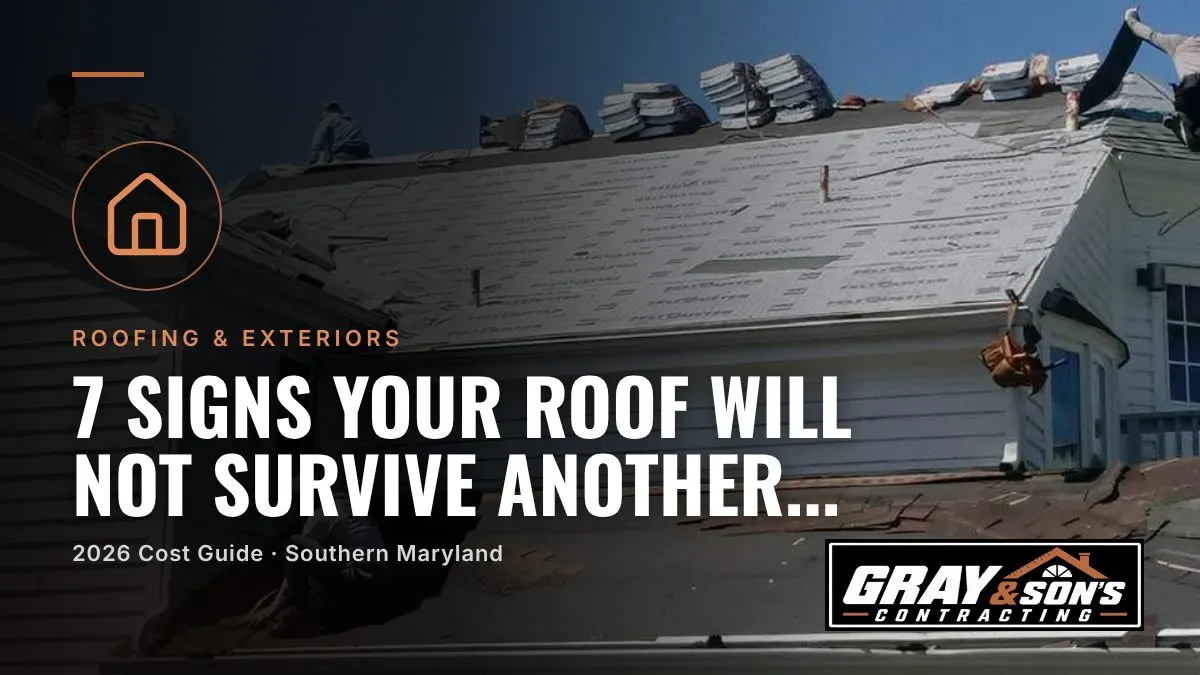
A roof replacement in Southern Maryland runs $8,000 to $25,000 depending on the size of the house, the pitch, and the material. An emergency leak repair in January, with a crew working in freezing rain and limited daylight, costs more per hour, takes longer to schedule, and usually only buys you time until a proper fix in spring.
September is when you catch these problems. The weather is still workable, roofers are not yet buried in storm-damage calls, and you have eight to ten weeks before the first hard freeze to get the work done right.
Here are the seven things to look for on a Southern Maryland roof before winter.
1. The Roof Is Over 20 Years Old and Has Never Been Replaced
Most three-tab asphalt shingle roofs installed in the 1990s and early 2000s were rated for 20 to 25 years. Architectural shingles last longer, typically 25 to 30 years. But those are manufacturer ratings under ideal conditions, and Southern Maryland's conditions are not ideal.
The combination of Chesapeake Bay humidity, summer heat that regularly hits the mid-90s, nor'easters, and occasional tropical storm remnants puts more stress on roofing materials than the same shingle would see in, say, central Pennsylvania. A roof in Chesapeake Beach or Solomons also gets salt air exposure that accelerates the deterioration of metal flashing and fasteners.
What to do: If your roof is 20 years old and you do not know when it was last replaced, get an inspection. A qualified roofer can tell you how much life is left and whether you are looking at a repair, a partial replacement, or a full tear-off.
What it costs: A professional roof inspection runs $150 to $400. Some contractors, including us, include the inspection cost in the project price if you proceed with the work.
2. Shingle Granules Are Piling Up in the Gutters
Every asphalt shingle is coated with ceramic granules that protect the underlying asphalt from UV damage. As the shingle ages, those granules loosen and wash into the gutters. A small amount is normal, especially on a newer roof that is shedding manufacturing excess.
A lot of granules, enough that you can see a gritty layer in the bottom of the gutter or a sandy residue in the downspout splash blocks, means the shingles are losing their protective coating. Once the granules are gone, the asphalt underneath dries out, cracks, and curls, and you are on a countdown to leaks.
What to check: Look in the gutters during your fall cleaning. Run your hand along the bottom. If it comes up coated in dark grit, that is granule loss.
What it means: Moderate granule loss on a 15-plus-year-old roof means you are likely two to four years from needing a replacement. Heavy granule loss with visible bare spots on the shingles means this winter is the risk.
3. Shingles Are Curling, Buckling, or Missing
Walk across the street and look at your roof from ground level. You do not need to climb a ladder for this.
Curling means the edges of the shingles are turning up. It happens when the shingle's underside absorbs moisture from the deck below while the top dries out in the sun. In Southern Maryland, where summer humidity regularly runs above 70 percent, this is one of the most common failure modes.
Buckling shows as a wavy, distorted line running vertically up the roof slope. It usually means the roof deck underneath has shifted or the underlayment was not laid flat. Either way, water can get under the raised edges.
Missing shingles are obvious. If a storm blew tabs off and you can see black underlayment or bare wood, that spot is leaking or about to.
What it costs: Replacing a few missing or damaged shingles is a $200 to $500 repair if the rest of the roof is sound. If shingles are curling across large sections, that is a replacement, not a repair.
4. The Flashing Is Cracked, Rusted, or Pulling Away
Flashing is the metal (usually aluminum or galvanized steel) that seals the joints where the roof meets a wall, a chimney, a vent pipe, or a skylight. These joints are where most leaks start, because they are the points where two different materials meet and expand at different rates in the heat and cold.
In Southern Maryland, flashing failures are especially common around chimneys on older homes. Many houses in Prince Frederick, Huntingtown, and the older parts of Waldorf and La Plata have masonry chimneys where the original step flashing was set into mortar that has since cracked and separated.
What to look for from the ground: Visible gaps between the flashing and the chimney, flashing that has bent or lifted, or rust stains running down from a flashing joint.
What to look for from inside: Check the attic around the chimney and any plumbing vent penetrations. Water stains, damp insulation, or daylight visible through the roof deck all mean the flashing has failed.
What it costs: Re-flashing a chimney runs $300 to $1,500 depending on size and complexity. Re-flashing vent pipes and other small penetrations is $100 to $300 each. These are straightforward repairs when the rest of the roof is in good shape.
5. You Can See Daylight or Water Stains in the Attic
Go into the attic on a sunny day and turn off the light. If you can see pinpoints of light through the roof deck, water can get in through those same spots.
While you are up there, look at the underside of the deck and the rafters. Brown or black staining means water has been coming in, even if you have not noticed a ceiling leak downstairs yet. Damp or compressed insulation along the eaves is another sign, and it also means your attic ventilation may be inadequate, a separate problem that accelerates ice dam formation in winter.
Why this matters more in Southern Maryland: The high humidity means that even small leaks promote mold growth quickly. A leak that might dry out harmlessly in an arid climate can produce a mold problem in a Calvert County attic within weeks.
What it costs: If the leak is isolated to one area and the damage has not reached the deck, a targeted repair ($300 to $800) may be enough. If the deck is rotted, that section needs to be replaced during the roofing job, adding $50 to $100 per sheet of plywood on top of the shingle cost.
6. The Roof Is Sagging
Stand at the curb and look at your roofline. It should be straight. If it dips, bows, or sags, even slightly, something structural is failing underneath.
The most common cause is a roof deck (the plywood sheathing) that has absorbed moisture and delaminated. On older homes, particularly those built with 3/8-inch plywood instead of the modern standard 1/2-inch or 5/8-inch, this happens sooner. The second most common cause is undersized or damaged rafters, which sometimes show up in homes that have had additions built without proper engineering.
This is not a repair. This is a replacement, and possibly a structural repair. A sagging roof can fail under the weight of a heavy snow or ice load, and Southern Maryland gets one to three significant snow or ice events most winters.
What to do: Do not wait. Call a contractor for an inspection. If the sag is visible from the ground, the problem is already significant.
7. Your Energy Bills Have Jumped Without Explanation
A failing roof system does not just leak water. It leaks air. When the underlayment deteriorates, or the deck develops gaps, or the ridge vent and soffit vents lose their integrity, the thermal envelope of the attic breaks down.
In winter, heat escapes through the compromised roof, and your furnace runs longer to compensate. In summer, hot air from the attic pours into the living space, and the air conditioner works overtime.
If your heating bill went up noticeably last winter and you have not changed anything else, no new appliances, no change in thermostat settings, no rate increase from your utility, the roof and attic insulation system is worth investigating.
What to do: Have the attic inspected for insulation depth, ventilation, and air sealing. Sometimes the fix is adding insulation and sealing gaps ($1,500 to $3,000), not replacing the roof. But if the roof deck is the source of the air leaks, those two jobs happen together.
When a Repair Is Enough
Not every problem means a full replacement. As a general rule:
Repair when the damage is isolated to one area, the rest of the roof is in good condition, and the roof has at least five to eight years of expected life remaining. A few missing shingles, a failed section of flashing, or a small leak around a vent pipe are all repairable.
Replace when the damage is widespread, the roof is past its expected lifespan, or you are facing a second or third repair in the same few years. At that point, the repairs are just buying time at a cost that would have been better spent toward a new roof.
The September Advantage
Roofers in Southern Maryland get busiest after the first big storm of fall and winter, when emergency calls flood in. If you schedule an inspection and any needed work in September or early October, you get better scheduling flexibility, crews that are not rushing between emergency calls, and enough warm dry days to do the job properly.
By December, you are competing with every homeowner who waited too long.
Want a free roof inspection before winter? Gray & Sons Contracting has been doing roofing in Calvert, St. Mary's, and Charles County since 1976. Schedule Your Free Inspection