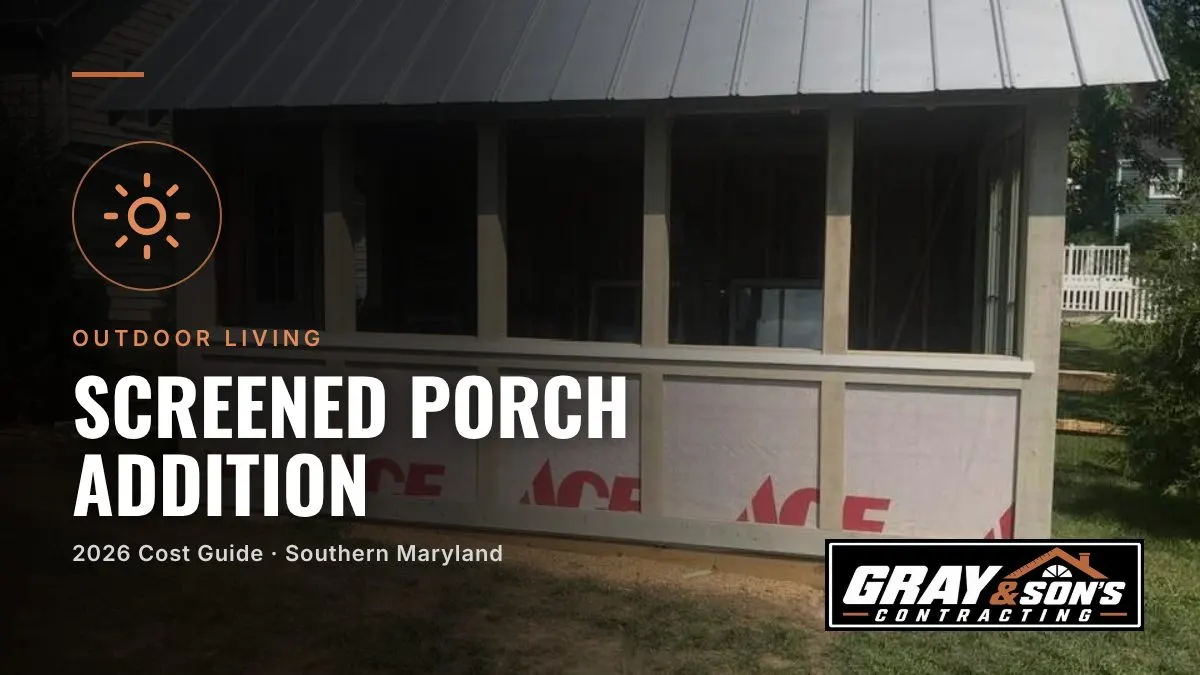
A screened porch addition in Southern Maryland costs $10,000 to $45,000 in 2026, with most homeowners in Calvert, St. Mary's, and Charles County paying $15,000 to $30,000 for a new 200 to 300-square-foot screened porch with a solid roof, composite or pressure-treated wood framing, fiberglass screening, a concrete or composite deck floor, and ceiling fan prewiring. Screening an existing open porch or deck, adding screen panels, a roof if one does not exist, and a screen door, costs significantly less: $2,000 to $8,000 depending on the size and condition of the existing structure.
The range is wide because screened porches vary enormously in scope. A simple screen enclosure on an existing covered deck with aluminum screen frames bolted to the posts is the low end. A fully custom screened porch with a new foundation, engineered framing, tongue-and-groove ceiling, stone or composite flooring, recessed lighting, an outdoor fan, and a screen door with a pneumatic closer is the high end. The footprint, materials, roofline complexity, foundation type, and level of finish all drive the price.
In Southern Maryland, a screened porch is not a luxury, it is one of the most practical additions you can make to a home. The region's humid subtropical climate delivers warm, pleasant evenings from April through October, but the mosquitoes, gnats, deer flies, and stink bugs that come with living along the Chesapeake Bay, the Patuxent River, and the Potomac River make an unscreened outdoor space unusable for much of that season without constant chemical intervention. A screened porch gives you the outdoor living experience without the insects. It is one of the highest-return outdoor projects in the Mid-Atlantic market.
Here is what a screened porch costs in this area, what drives the price, what options are available, and how to plan the project.
Screened Porch Cost by Project Type
The cost depends heavily on whether you are building new from the ground up, screening an existing covered porch, or converting an existing open deck.
| Project Type | Cost Range | Cost Per Sq Ft | What's Included |
|---|---|---|---|
| Screen an existing covered porch (screens, door, minor framing) | $2,000 to $5,000 | $10 to $25 | Screen panels, screen door, framing for screen attachment, hardware. Existing roof and floor structure remain. |
| Screen an existing open deck (add roof + screens) | $5,000 to $15,000 | $25 to $60 | New roof structure tied into existing house roof, screen panels, screen door, posts and beams as needed, and attachment to existing deck framing. |
| Build new screened porch (ground up) | $10,000 to $45,000 | $50 to $175 | Foundation or piers, floor framing, decking or slab, wall framing, roof structure, roofing, screen panels, screen door, electrical, and finish work. |
| Three-season room (screened porch with insulated panels or storm windows) | $20,000 to $60,000+ | $80 to $250 | Everything in a screened porch plus insulated lower knee walls, operable storm windows or removable glass panels, upgraded electrical, and potentially a heating source. |
The most common project in Southern Maryland is building a new screened porch on the back of a home where no covered outdoor space currently exists. This is a ground-up build that includes a foundation (concrete piers or a continuous footer), structural framing, a roof, screening, flooring, and electrical, the $15,000 to $30,000 range for a typical 200 to 300-square-foot porch.
The second most common project is screening an existing deck. Many homes in the tri-county area, particularly those built in the 1990s and 2000s in subdivisions across Waldorf, White Plains, Lexington Park, California, and Prince Frederick, have rear decks that are 10 to 15 years old and in need of either replacement or upgrade. Screening the deck (adding a roof and screen walls) transforms an aging deck into a much more usable space for less than the cost of building new.
Screened Porch Cost by Size
Size is the primary cost driver. Larger porches require more materials, more structural support, and more labor.
| Porch Size | Square Footage | New Build Cost | Screen Existing Covered Porch |
|---|---|---|---|
| Small (compact dining area) | 80 to 120 sq ft | $5,000 to $15,000 | $800 to $2,500 |
| Medium (dining + seating) | 150 to 200 sq ft | $10,000 to $25,000 | $1,500 to $4,000 |
| Large (full outdoor room) | 200 to 300 sq ft | $15,000 to $35,000 | $2,000 to $6,000 |
| Extra large (entertaining space) | 300 to 400 sq ft | $20,000 to $45,000 | $3,000 to $8,000 |
| Grand (multi-area, fireplace) | 400 to 600+ sq ft | $30,000 to $70,000+ | $4,000 to $12,000 |
Sizing recommendation for Southern Maryland: A 200 to 250-square-foot screened porch is the sweet spot for most homes in the area. This provides enough room for a dining table for four to six people and a separate seating area, the two activities that account for 90 percent of screened porch use. Going below 150 square feet makes the space feel cramped; going above 300 square feet adds cost without proportionally adding usability, unless you entertain regularly or want to include a specific feature like an outdoor fireplace or a grilling station.
Cost Breakdown by Component
Understanding what each piece of the project costs helps you see where the money goes and where you can adjust the budget.
Foundation and Floor
| Foundation/Floor Type | Cost | Notes |
|---|---|---|
| Concrete piers (sono tubes) | $500 to $2,000 | The most common foundation for screened porches in Southern Maryland. Piers are dug below the frost line (30 inches in this region per Maryland code), filled with concrete, and topped with a post bracket. Economical and effective on the area's clay soils. |
| Helical piers (screw piles) | $1,000 to $3,000 | Screwed into the ground with hydraulic equipment. Better for poor soils, slope conditions, or when minimal ground disturbance is desired. More expensive but faster installation than sono tubes. |
| Continuous concrete footer and slab | $2,500 to $6,000 | A poured concrete slab provides a solid, level floor that can be finished with tile, stamped concrete, or stone. Heavier, more expensive, but creates the most durable and low-maintenance floor. |
| Pressure-treated wood frame and composite decking | $2,000 to $5,000 | Standard wood-frame floor with composite deck boards. The most common flooring choice for screened porches built on piers. Composite does not rot, splinter, or require staining. |
| Pressure-treated wood frame and PT wood decking | $1,500 to $3,500 | The budget option. Pressure-treated decking is functional and costs less than composite, but it requires periodic staining or sealing and will eventually show wear. |
| Concrete paver floor | $1,500 to $4,000 | Pavers laid on a compacted gravel base at grade level. No elevated floor structure needed. Lower cost but requires the porch to be at ground level, which limits design options. |
Southern Maryland soil note: The heavy clay soils throughout the tri-county area, particularly the dense Monmouth and Nanjemoy formation clays, hold water and shift seasonally. This makes proper foundation design essential for any porch that sits above grade. Concrete piers must extend below the frost line (30 inches), and the soil must be compacted and drained properly to prevent settling. A porch built on shallow footings in Southern Maryland clay will shift, crack, and pull away from the house within a few years. This is a common problem with screened porches built by handymen or unlicensed contractors who do not understand the local soil conditions.
Roof Structure
The roof is typically the most expensive single component of a new screened porch.
| Roof Type | Cost | Notes |
|---|---|---|
| Shed roof (single slope) | $2,000 to $5,000 | The simplest and least expensive roof style. A single sloped plane that ties into the house wall. Functional but can look utilitarian if not well proportioned. |
| Gable roof (peaked) | $3,000 to $8,000 | A traditional peaked roof that can match the house's existing roofline. More attractive than a shed roof and provides better headroom. More complex framing and more expensive. |
| Hip roof | $4,000 to $10,000 | Slopes on all four sides. The most attractive and weather-resistant option but also the most expensive due to complex framing and more roofing material. |
| Existing roof extension | $2,500 to $7,000 | If the existing house roof overhangs the porch area or can be extended, this is the cleanest-looking and most integrated option. Cost depends on the roof's structure and how far the extension reaches. |
Roofing material adds to the cost and should match the house for a cohesive look. Architectural asphalt shingles (the standard in Southern Maryland) add $3 to $6 per square foot of roof area. Metal roofing on a screened porch adds $6 to $14 per square foot but lasts significantly longer and provides better performance in the area's heavy rain events and occasional tropical storm remnants.
Ceiling finish is an often-overlooked decision that significantly affects the porch's appearance and cost:
| Ceiling Type | Cost Per Sq Ft | Notes |
|---|---|---|
| Exposed rafters (no ceiling) | $0 (included in framing) | The most basic option. Functional but unfinished. |
| Beadboard (painted wood or PVC) | $4 to $8 | The classic screened porch ceiling. Tongue-and-groove boards installed over the rafters, usually painted white or a light color. PVC beadboard resists moisture better than wood in Southern Maryland's humidity. |
| Tongue-and-groove cedar | $6 to $12 | Natural wood ceiling with a warm, premium look. Weathers to a silvery gray if left unfinished, or can be sealed with a clear finish. |
| Vinyl soffit panels | $2 to $5 | A budget alternative to beadboard. Lower cost and lower maintenance but looks less refined. |
Screen Systems
The screens themselves are a relatively small portion of the total cost, but the type and quality affect durability, visibility, and maintenance.
| Screen Type | Material Cost Per Sq Ft | Notes |
|---|---|---|
| Fiberglass | $0.20 to $0.50 | The standard choice. Inexpensive, easy to replace, does not crease or dent. Provides good visibility. Lifespan: 5 to 10 years before UV degradation and tearing become issues. |
| Aluminum | $0.30 to $0.75 | More durable than fiberglass. Resists tearing better. Does not sag or stretch. Can dent. Available in charcoal (best visibility) or bright aluminum. Lifespan: 10 to 15 years. |
| Phifer Super Solar (or similar UV-blocking) | $0.50 to $1.50 | Blocks 65% to 90% of UV rays and reduces glare while maintaining outward visibility. Good for porches with western exposure that get direct afternoon sun. |
| Pet-resistant screen (Phifer Pet Screen) | $0.50 to $1.50 | Seven times stronger than standard fiberglass. Resists clawing and pushing by dogs and cats. Slightly reduced visibility due to heavier mesh. |
| Copper or bronze | $2.00 to $3.50 | The premium option. Develops a green patina over time. Extremely durable. Used on high-end homes and historic properties. |
| No-See-Um mesh (20x20 or finer) | $0.40 to $1.00 | Tighter mesh that blocks the tiny biting midges (no-see-ums) that are common along the waterways in St. Mary's and southern Calvert County, especially in Solomons, Ridge, Piney Point, and Scotland. Slightly reduces airflow compared to standard mesh. |
Southern Maryland screen recommendation: For most porches, start with standard charcoal fiberglass screening ($0.20 to $0.50 per square foot) with plans to replace the screens every seven to ten years as they degrade. If you have dogs or cats that will be on the porch, use pet-resistant screen in the lower panels. If you live near the water and deal with no-see-ums, use the finer 20x20 mesh, standard window screen mesh (18x16) does not stop these insects.
Screen Door
| Door Type | Cost (Installed) | Notes |
|---|---|---|
| Standard aluminum screen door | $150 to $400 | Lightweight, functional, and inexpensive. Available at every building supply store. The spring-loaded closer tends to slam if not adjusted properly. |
| Heavy-duty aluminum screen door with pneumatic closer | $300 to $700 | A better version of the standard door. The pneumatic closer prevents slamming and lasts longer than spring closers. |
| Wood screen door (custom or semi-custom) | $500 to $1,500 | A traditional look that matches the porch framing. Can be painted or stained. Requires maintenance but looks significantly better than aluminum. |
| Sliding screen door (for wider openings) | $400 to $1,200 | Good for porches where a swing door would obstruct traffic flow. Runs on a track. |
| Phantom or retractable screen door | $600 to $2,000 | Retracts into a housing when not in use. Clean look when open. Higher maintenance and shorter lifespan than fixed doors. |
Electrical
| Electrical Component | Cost | Notes |
|---|---|---|
| Ceiling fan prewire and installation (one fan) | $200 to $600 | A ceiling fan is nearly essential on a Southern Maryland screened porch. It circulates air, provides a breeze, and keeps mosquitoes at bay (they are weak flyers and avoid moving air). |
| Recessed lighting (4 to 6 can lights) | $400 to $1,200 | Provides even, unobtrusive lighting for evening use. LED recessed lights are the standard. |
| GFCI outlets (2 to 4 outlets) | $200 to $600 | For lamps, phone chargers, a TV, or a portable speaker. All outdoor and porch outlets must be GFCI-protected per code. |
| Overhead light fixture (one fixture) | $100 to $400 | A simpler alternative to recessed lighting. A single fixture works for small porches. |
| Electrical permit and rough-in | $100 to $300 | The electrical work on a screened porch addition requires a permit and inspection in all three counties. |
Budget tip: At minimum, wire for one ceiling fan and two GFCI outlets. The cost to add wiring during construction is minimal compared to the cost of adding it after the porch is finished. Even if you do not install recessed lighting now, having the wiring roughed in costs $100 to $200 and saves $500 or more if you add lights later.
What Drives the Cost in Southern Maryland
Attachment to the House
A screened porch must be structurally connected to the house, the ledger board (the horizontal framing member that bolts to the house wall) carries half the porch's roof and floor load. Proper ledger attachment is critical: a ledger that is not properly flashed and bolted can rot the house's rim joist, allow water intrusion into the wall cavity, or fail catastrophically.
In Southern Maryland, the predominant exterior cladding is vinyl siding, followed by fiber cement (HardiPlank), brick, and wood. Each cladding type requires a different approach to ledger attachment:
Vinyl siding: The siding must be cut and removed to expose the rim joist. The ledger bolts through the sheathing into the rim joist with lag bolts or through-bolts. Flashing goes over the ledger and behind the siding. This is straightforward but requires careful siding work. Cost impact: minimal.
Fiber cement (HardiPlank): Similar to vinyl but the cladding is harder to cut and work around. Requires carbide-tipped tools. Cost impact: $100 to $300 additional.
Brick veneer: The ledger cannot attach through brick, brick is a non-structural veneer. The contractor must either remove a course of brick to reach the rim joist behind, or use specialized fasteners that pass through the brick and the air gap behind it into the wood structure. This is more complex and more expensive. Cost impact: $300 to $800 additional.
Stone or stucco: Similar complexity to brick. Removing and repairing stone or stucco around the ledger is skilled work. Cost impact: $400 to $1,000 additional.
Roofline Integration
The porch roof must tie into the house roof in a way that sheds water without leaking. The intersection of the porch roof and the house wall (or existing roof) is the most common leak point on any addition.
A shed-style porch roof that tucks under the existing house eave is the simplest and least leak-prone connection. A gable or hip roof that intersects the existing roofline requires a valley, which must be flashed with step flashing and a valley pan. This more complex roof-to-roof connection costs $500 to $1,500 more than a simple shed-to-wall connection but looks better on homes with prominent rooflines.
In areas prone to heavy rain, and Southern Maryland gets 45 to 50 inches of rainfall annually, with intense summer thunderstorms that can dump two or more inches in an hour, the porch roof's capacity to handle water is important. Gutters on the porch roof ($4 to $8 per linear foot, installed) are strongly recommended to control roof runoff and prevent erosion around the porch foundation.
Permits and HOA Considerations
Permits: A screened porch addition requires a building permit in Calvert, St. Mary's, and Charles County. The permit process includes a plan review (the contractor submits drawings showing the foundation, framing, roof, and attachment details), a foundation inspection, a framing inspection, and a final inspection. Permit costs range from $200 to $600 depending on the project value and the county.
| County | Permit Office | Typical Permit Cost |
|---|---|---|
| Calvert County | Department of Planning & Zoning, Prince Frederick | $250 to $600 |
| St. Mary's County | Department of Land Use & Growth Management, Leonardtown | $200 to $500 |
| Charles County | Department of Planning & Growth Management, La Plata | $250 to $600 |
Setback requirements: The screened porch must comply with the zoning district's setback requirements, the minimum distance from the property line. In most residential zones in the tri-county area, the rear setback is 20 to 30 feet. A screened porch that extends 12 to 15 feet from the back of the house may bring the structure close to or past the setback line, particularly on lots with shallow rear yards. Check your property's setback requirements before design begins.
Chesapeake Bay Critical Area: Properties within 1,000 feet of the Bay, tidal tributaries, or tidal wetlands may face additional permitting requirements and limits on impervious surface coverage. A new screened porch adds impervious area (the roof footprint), which can trigger environmental review and stormwater mitigation requirements in the Critical Area. This can add $200 to $1,000 in permit and review fees and two to four weeks to the permit timeline.
HOA restrictions: Many of the larger subdivisions in Waldorf (St. Charles, Gleneagles, Beechtree), White Plains, California (Wildewood), and Lexington Park have HOA covenants that regulate exterior additions. Common requirements include architectural review approval, material and color restrictions, and setback requirements that may be more restrictive than county zoning. Submit your porch plans to the HOA architectural review committee early, ideally before finalizing the design, to avoid costly redesigns.
Best Time to Build a Screened Porch in Southern Maryland
Fall is the ideal construction season. September through November provides dry weather, comfortable working conditions, and contractor availability as the summer rush winds down. A porch started in early October can be completed and ready for use by Thanksgiving, and a screened porch in Southern Maryland is usable well into December on mild days (daytime temperatures in the 50s and 60s are common through November, and 40s and 50s in December).
Winter construction is feasible for the structural work, framing, roofing, and screening, but concrete foundation work is harder to schedule around freezing temperatures and wet conditions. If you plan to pour concrete piers or a slab, get the foundation done in fall before the ground freezes.
Spring is also a popular build season, but contractors book up quickly for spring and summer outdoor projects. If you want a porch ready for summer use, start the planning and permitting process in January or February and schedule construction for March or April.
Screened Porch vs. Other Outdoor Living Options
Southern Maryland homeowners often weigh the screened porch against other outdoor living improvements. Here is how they compare.
| Option | Cost Range | Pros | Cons |
|---|---|---|---|
| Screened porch (new build) | $10,000 to $45,000 | Insect-free, rain-protected, usable April through November, adds square footage to home | Higher cost than open deck, less open-air feel |
| Open deck (composite) | $8,000 to $25,000 | Open-air feel, lower cost per square foot, good for grilling | No insect protection, no rain cover, unusable in bad weather |
| Three-season room | $20,000 to $60,000+ | Usable most of the year, insulated, can heat with space heater | Higher cost, more complex construction, may require building permit as habitable space |
| Patio with pergola | $5,000 to $20,000 | Lower cost, some shade, open feel | No insect or rain protection |
| Sunroom (four-season) | $25,000 to $80,000+ | Year-round use, fully conditioned, adds appraised square footage | Highest cost, requires HVAC extension, full building code compliance as habitable space |
For most Southern Maryland homes, a screened porch offers the best value for outdoor living dollar spent. The insect protection alone, in a region where mosquitoes carrying West Nile and Eastern Equine Encephalitis are a genuine public health concern during the warm months, makes a screened porch significantly more usable than an open deck or patio from May through October.
How a Screened Porch Affects Home Value
A screened porch is one of the better-returning outdoor improvements in the Mid-Atlantic real estate market. National data from Remodeling Magazine's Cost vs. Value report consistently places screened porch additions at a 60 to 75 percent return on investment at resale, and in Southern Maryland's market, where outdoor living space is a major selling point for waterfront and water-oriented communities, the return can be higher.
A well-built screened porch adds functional square footage to the home. While it is not counted as heated living space in an appraisal, it is listed as an additional feature, and buyers recognize the value, particularly buyers moving to the area who discover the insect situation during their first Southern Maryland summer.
In waterfront or water-view properties, common along the Chesapeake Bay in Calvert County, along the Patuxent in St. Mary's County, and along the Potomac in Charles County, a screened porch facing the water can be the single most-used space in the home from April through October. For these properties, the porch is not just an addition, it is the primary living space during the best months of the year.
Screened Porch Maintenance
A screened porch requires modest but consistent maintenance to remain in good condition.
Inspect and repair screens annually. Fiberglass screening degrades under UV exposure and becomes brittle over time. Small tears and holes can be patched with screen repair kits ($5 to $10). When the screens become generally brittle and tear easily, usually after seven to ten years, plan for a full rescreen ($200 to $600 for a typical porch, or $2 to $4 per square foot of screen area).
Clean the screens. Pollen, mildew, and spider webs accumulate on screens, reducing visibility and airflow. Hose the screens down with a garden hose two to three times per year, more often if the porch faces a tree line or a wooded area, which is common in Northern Calvert County (Dunkirk, Owings, Huntingtown) and throughout St. Mary's County.
Check the roof. The porch roof is subject to the same weathering as the house roof. Inspect for missing shingles, damaged flashing, and clogged gutters twice a year. The roof-to-wall or roof-to-roof intersection is the most likely leak point, check the flashing and sealant carefully after heavy storms.
Maintain the floor. Composite decking needs only periodic washing. Pressure-treated wood decking should be cleaned and sealed or stained every two to three years. A concrete slab or paver floor may develop mildew in Southern Maryland's humidity, a power wash in spring keeps it clean.
Lubricate the screen door hardware. Screen door hinges, closers, and latches operate in a humid environment and corrode faster than interior hardware. Lubricate the closer mechanism and hinges with silicone spray annually. Replace the closer assembly when it no longer holds the door at a controlled speed ($15 to $40 for a pneumatic closer).
Frequently Asked Questions
How much does a screened porch cost in Southern Maryland? A new screened porch built from the ground up costs $10,000 to $45,000, with most homeowners paying $15,000 to $30,000 for a 200 to 300-square-foot porch with a solid roof, composite flooring, fiberglass screening, and basic electrical (fan and outlets). Screening an existing covered porch costs $2,000 to $5,000. Screening an existing open deck (adding a roof and screens) costs $5,000 to $15,000.
Do I need a permit for a screened porch in Southern Maryland? Yes. A screened porch addition requires a building permit in Calvert, St. Mary's, and Charles County. The permit covers the foundation, structural framing, roof attachment, and electrical work. Permit costs range from $200 to $600. Properties in the Chesapeake Bay Critical Area may require additional environmental review.
How long does it take to build a screened porch? A new screened porch typically takes two to four weeks from start to finish, depending on the complexity, weather, and permit inspection scheduling. The foundation and framing take three to five days, the roof takes two to three days, screening and trim take two to three days, and electrical and finish work take one to two days. Weather delays are the most common cause of schedule extensions in Southern Maryland, particularly during the spring and summer thunderstorm season.
Can I screen in my existing deck? In most cases, yes, if the deck is structurally sound. The deck must be able to support the additional weight of the roof, screen framing, and any wind loads. A deck built to standard residential code for a simple open deck may need structural reinforcement (larger posts, additional beams, or hurricane ties) to support a roof. Your contractor will evaluate the existing structure and recommend any necessary upgrades. If the deck is old, rotting, or undersized structurally, it may be more cost-effective to rebuild rather than retrofit.
What is the best screen material for Southern Maryland? Standard charcoal fiberglass screening is the best all-around choice for most homes. It provides good visibility, good airflow, and is inexpensive to replace when it wears out. For homes near the water where no-see-ums (biting midges) are a problem, use a finer 20x20 mesh. For homes with large or active dogs, use pet-resistant screen (Phifer Pet Screen or equivalent) at least in the lower panels where the dog contacts the screen.
Should I add a ceiling fan to my screened porch? Absolutely. A ceiling fan is the single most practical addition to a screened porch in Southern Maryland. It provides a constant breeze that makes the porch comfortable even on hot, humid evenings, and the air movement helps keep mosquitoes away from the seating area. Budget $200 to $600 for a fan prewired and installed during construction. Outdoor-rated fans with damp or wet ratings are required for screened porch applications.
Will a screened porch increase my home value? Yes. A screened porch typically returns 60 to 75 percent of its cost at resale in the Mid-Atlantic market. In Southern Maryland specifically, where outdoor living is a major lifestyle feature and insect pressure makes unscreened spaces impractical for much of the year, the functional value to buyers is high. Waterfront and water-view properties see an even higher return because the screened porch becomes the primary living and entertaining space during warm months.
Can I heat a screened porch? A standard screened porch is not designed for heating, the screens allow air to pass through freely, and any heat escapes immediately. If you want a porch that can be used in cooler weather, consider a three-season room with removable glass or insulated panels that replace the screens in winter. A portable electric space heater can take the chill off a screened porch on cool fall evenings, but it will not heat the space to a comfortable temperature when it is cold outside. For a fully heated and cooled outdoor room, you need a sunroom or four-season room, a much larger investment.
Ready to add a screened porch to your home? Gray & Sons Contracting has 50 years of experience building in Southern Maryland. We understand the local soil conditions, building codes, and the specific outdoor living needs of homeowners in Calvert, St. Mary's, and Charles County. Get a Free Estimate