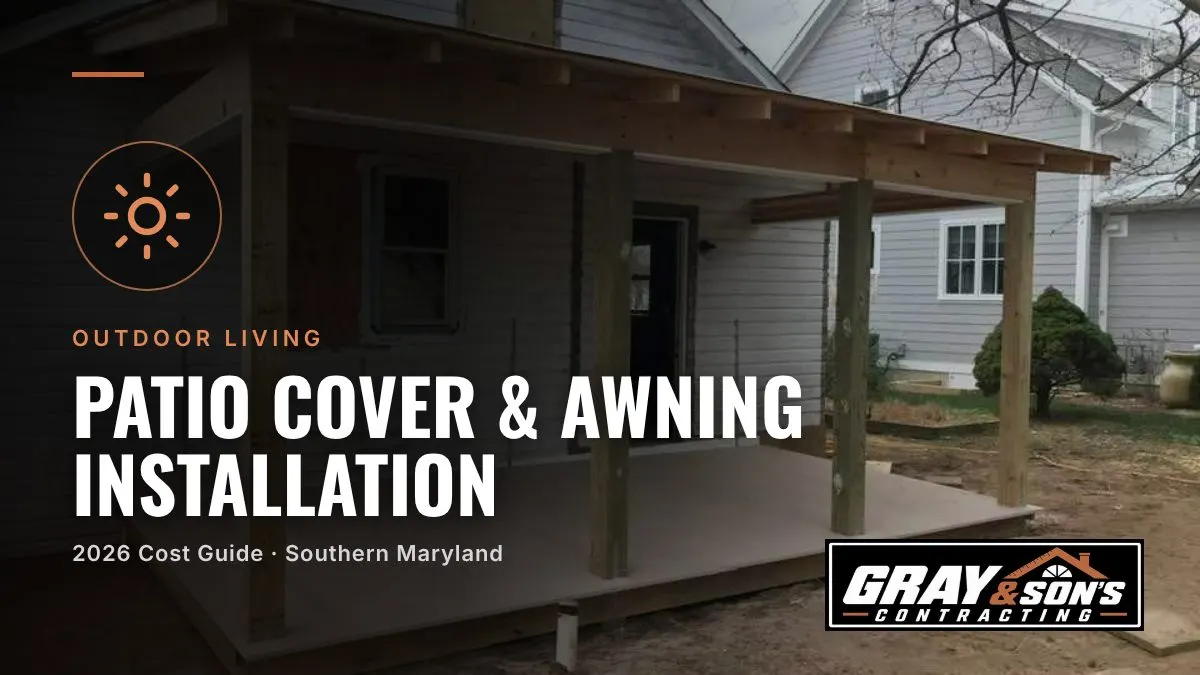
Patio cover and awning installation in Southern Maryland costs $1,500 to $5,000 for most homeowners in 2026, with the national average landing around $2,700 for a professionally installed awning or patio cover on an existing deck or patio. The full range runs from $150 for a small portable canopy or a window-mounted awning to $8,000 or more for a large motorized retractable awning or a built-in solid patio cover spanning 200 or more square feet. At the low end, a fixed fabric awning over a back door or window costs $300 to $700 installed. At the high end, a motorized retractable awning spanning a 20-foot deck or a permanent aluminum or wood patio cover with integrated lighting and ceiling fans runs $5,000 to $8,000 or more depending on materials, size, and features.
Fall is an ideal time to plan and install a patio cover or awning in the tri-county area. October and November offer mild, pleasant working conditions for outdoor installation projects, cool enough that contractors can work comfortably for full days without the heat stress that slows summer work, dry enough for most installation tasks, and warm enough that concrete footings and adhesives cure properly. Installing now means your covered patio is ready for the earliest warm days of spring, a covered outdoor space you can enjoy starting in March rather than scheduling installation in April or May and waiting through a two-to-four-week backlog while the prime outdoor season passes you by. A patio cover also protects your deck or patio surface from winter weather, reducing ice accumulation, minimizing UV damage from the low winter sun that hits at harsh angles, and keeping snow and rain from pooling on outdoor furniture left in place.
This guide covers the complete cost picture for patio cover and awning installation in Southern Maryland: pricing by cover type, material comparisons, size-based cost calculations, equipment versus installed cost breakdowns, regional factors specific to the tri-county area, DIY versus professional installation, real-world project scenarios with itemized costs, permit considerations, longevity expectations, and answers to the questions we hear most from homeowners across Waldorf, Prince Frederick, Leonardtown, and the surrounding communities.
Cost by Cover Type
The type of patio cover or awning you choose is the primary factor that determines your total project cost. Each type offers different benefits in terms of weather protection, aesthetics, flexibility, and durability. Here is what you can expect to pay for each type in 2026.
| Cover Type | Typical Installed Cost | Best For | Lifespan |
|---|---|---|---|
| Portable / Freestanding Canopy | $100 to $400 | Temporary shade; renters; flexible positioning | 2 to 5 years |
| Fixed Window / Door Awning | $300 to $700 | Individual windows; entry doors; rain deflection | 8 to 15 years |
| Fixed Patio Awning (fabric on frame) | $800 to $2,500 | Permanent shade over a patio or deck; moderate coverage | 8 to 12 years |
| Manual Retractable Awning | $500 to $1,700 | Flexible shade; preserving views when not in use; moderate budgets | 8 to 12 years |
| Motorized Retractable Awning | $2,000 to $5,500 | Large decks and patios; convenience; wind sensors; smart home integration | 12 to 20 years |
| Solid Patio Cover (aluminum) | $2,500 to $6,000 | All-weather protection; permanent structure; low maintenance | 20 to 30+ years |
| Solid Patio Cover (wood/timber) | $3,000 to $8,000 | Aesthetic appeal; custom design; natural material | 15 to 25 years (with maintenance) |
| Pergola with Canopy | $2,000 to $5,000 | Partial shade; visual appeal; outdoor living enhancement | 15 to 25 years (structure); 5 to 10 years (canopy) |
Portable / Freestanding Canopy: $100 to $400
Portable canopies, pop-up gazebos, freestanding shade sails, and tension-leg canopy frames, are the simplest and least expensive shade options. These units require no permanent installation, no structural attachment to the house, and no permits. They can be set up in an hour, repositioned freely, and stored during the winter months.
The $100 to $400 cost is for the unit itself, no professional installation is required. At the lower end ($100 to $200), you get a basic pop-up canopy with a steel or aluminum frame and a polyester fabric top that provides UV shade but limited rain protection. At the upper end ($300 to $400), you get a more substantial freestanding structure with a heavier frame, waterproof fabric, side curtains or mosquito netting, and better wind resistance.
The limitation of portable canopies is durability. The lightweight frames and fabric construction that make them portable also make them vulnerable to wind, a common afternoon thunderstorm with 30 to 40 mph gusts, which is a regular occurrence in Southern Maryland from May through September, can bend or destroy a portable canopy that is not secured with heavy-duty ground stakes or weighted bases. Most portable canopies last two to five years of seasonal use before the fabric fades, the frame joints loosen, or a storm causes damage that is not worth repairing.
For homeowners who want to test whether they will actually use a shaded outdoor area before investing in a permanent installation, or for renters who cannot make permanent modifications, a portable canopy is a reasonable starting point.
Fixed Window / Door Awning: $300 to $700
Fixed window and door awnings are small, permanently mounted shade structures that cover a single window or entry door. They project two to four feet from the house wall and are typically three to six feet wide, sized to match the window or door they protect. Fixed awnings deflect rain away from the window or door, reduce heat gain through the glass (lowering cooling costs during Southern Maryland's hot summers), and protect the entry area from rain so you can open the door without getting wet.
The installed cost of $300 to $700 covers the awning unit and professional mounting to the house exterior. Fabric awnings on aluminum frames fall at the lower end ($300 to $500). Metal awnings, aluminum or steel, fall at the upper end ($500 to $700) and offer greater durability and weather resistance. Installation typically takes one to two hours per awning, including drilling mounting brackets into the house framing, leveling the awning, and sealing the mounting points to prevent water intrusion into the wall.
Fixed window awnings are common on older homes throughout Southern Maryland, the ranchers, capes, and colonials of the 1950s through 1970s in Leonardtown, Mechanicsville, Charlotte Hall, and the older neighborhoods of Waldorf and La Plata often have original aluminum awnings that have served for decades. These vintage awnings are remarkably durable, many are still functional after 40 or 50 years, but their appearance may be dated. Replacing worn or outdated fixed awnings with modern units in contemporary colors and profiles is an affordable curb appeal improvement at $300 to $700 per awning.
Fixed Patio Awning (Fabric on Frame): $800 to $2,500
A fixed patio awning, a non-retractable fabric cover mounted to the house on a permanent frame, provides continuous shade over a deck or patio area. The awning is permanently extended, providing shade and rain protection at all times without the mechanical components of a retractable system. Fixed patio awnings use solution-dyed acrylic fabrics (such as Sunbrella) on powder-coated aluminum or steel frames, projecting 6 to 12 feet from the house wall with widths of 8 to 20 feet.
The installed cost of $800 to $2,500 depends primarily on the size of the awning. A small awning covering an 8-foot-wide by 6-foot-deep patio area (48 square feet of coverage) falls at the lower end. A large awning covering a 16-foot-wide by 10-foot-deep deck area (160 square feet of coverage) falls at the upper end. The per-square-foot cost runs approximately $6 to $9 including materials and professional installation.
Fixed patio awnings are a practical, mid-cost option for homeowners who want permanent shade without the mechanical complexity and higher cost of retractable systems. The trade-off is flexibility, a fixed awning cannot be retracted to let in sunlight or opened up for stargazing on a clear evening. For patios and decks that face south or west and receive direct afternoon sun throughout the warm months, which describes a large number of homes in the tri-county area, a fixed awning that blocks that sun all day may be exactly what is wanted.
Manual Retractable Awning: $500 to $1,700
Manual retractable awnings extend and retract with a hand crank, giving the homeowner control over when the awning provides shade and when it is stored against the house wall. When retracted, the awning folds into a compact housing mounted under the eave or soffit, preserving the view, allowing sunlight when desired, and protecting the awning fabric from weather exposure during periods of non-use.
The installed cost of $500 to $1,700 depends on the awning width, projection depth, and fabric quality. A basic 10-foot-wide by 8-foot-deep manual retractable awning with standard acrylic fabric runs $500 to $900 installed. A premium 16-foot-wide by 10-foot-deep unit with Sunbrella fabric, a powder-coated cassette housing, and heavy-duty lateral arms runs $1,200 to $1,700 installed.
Manual retractable awnings are an excellent value for homeowners who want the flexibility of retraction without the cost of motorization. The hand crank mechanism is reliable, requires minimal maintenance (occasional lubrication of the crank gear), and has no electrical components that can fail. The trade-off is convenience, extending and retracting a 12-to-16-foot awning with a hand crank takes 30 to 60 seconds of steady cranking, which is fine for once-a-day operation but can become tiresome if the homeowner retracts the awning multiple times per day in response to changing weather.
Motorized Retractable Awning: $2,000 to $5,500
Motorized retractable awnings operate with a tubular motor inside the roller bar, controlled by a wall switch, remote control, or smartphone app. The awning extends and retracts at the press of a button, and most motorized systems can be equipped with sensors that automatically retract the awning when wind speed exceeds a safe threshold (typically 20 to 25 mph) or extend the awning when a sun sensor detects direct sunlight on the patio.
The installed cost of $2,000 to $5,500 covers the awning unit, the tubular motor, the control system, electrical wiring from the nearest circuit to the motor, and professional installation. The cost breaks down approximately as follows:
| Component | Cost Range |
|---|---|
| Awning unit (fabric, arms, roller, cassette housing) | $800 to $2,500 |
| Tubular motor | $200 to $500 |
| Control system (wall switch, remote, or smart control) | $50 to $300 |
| Wind sensor (automatic retraction) | $100 to $250 |
| Sun sensor (automatic extension) | $75 to $150 |
| Electrical wiring and connection | $150 to $400 |
| Professional installation labor | $400 to $800 |
| Total installed | $2,000 to $5,500 |
Motorized awnings are the premium option for large decks and patios where manual cranking would be impractical, for homeowners who want automated sun and wind response, and for smart home integration where the awning can be controlled through Alexa, Google Home, or a home automation system. The motorized convenience also increases the likelihood that the homeowner will actually use the awning daily, the one-button operation removes the friction of manual cranking that sometimes leads homeowners to leave a manual awning either perpetually extended (exposing it to weather) or perpetually retracted (defeating its purpose).
Solid Patio Cover (Aluminum): $2,500 to $6,000
Solid aluminum patio covers provide the most complete weather protection of any patio cover type. Unlike fabric awnings that provide shade and light rain deflection, a solid aluminum patio cover creates a fully roofed outdoor space that is usable in any weather, heavy rain, snow, hail, and intense sun are all blocked completely. Aluminum patio covers are available in flat-roof, gabled, and sloped configurations and can be finished to match the house exterior.
The installed cost of $2,500 to $6,000 depends on the size, configuration, and finish. A basic flat-roof aluminum cover over a 10x12-foot patio (120 square feet) costs $2,500 to $3,500 installed. A larger gabled cover over a 12x20-foot patio (240 square feet) with a finished soffit, integrated gutters, and recessed LED lighting costs $4,500 to $6,000 installed. The per-square-foot cost runs approximately $15 to $25 including materials, footings, posts, and professional installation.
Aluminum patio covers require virtually no maintenance, no painting, no staining, no fabric replacement, no mechanical components. The powder-coated aluminum finish resists fading, corrosion, and chalking for 20 to 30 years or more in Southern Maryland's coastal-adjacent climate. This longevity and zero maintenance make the higher upfront cost competitive on a per-year basis with fabric awnings that need fabric replacement every 8 to 12 years.
Solid Patio Cover (Wood / Timber): $3,000 to $8,000
Wood patio covers, built with pressure-treated lumber, cedar, or redwood, offer the aesthetic warmth and custom design flexibility that aluminum covers cannot match. A wood patio cover can be designed in any configuration, flat roof, gabled roof, hip roof, shed roof, with custom details like decorative columns, rafter tails, tongue-and-groove ceiling, and integrated fan and lighting mounts. Wood covers are the preferred choice for homeowners who want their patio cover to look like a natural extension of the home's architecture rather than an add-on structure.
The installed cost of $3,000 to $8,000 reflects the higher material cost of dimensional lumber (especially cedar and redwood), the skilled carpentry required for custom framing, and the longer installation timeline (typically two to five days versus one to two days for aluminum). A pressure-treated pine patio cover over a 10x12-foot patio costs $3,000 to $4,500 installed. A cedar patio cover over a 12x20-foot patio with stained finish, vaulted ceiling, and fan mount costs $5,500 to $8,000 installed.
The maintenance requirement is the primary trade-off with wood patio covers. Pressure-treated pine must be stained or sealed every two to three years to prevent graying, splitting, and moisture damage. Cedar and redwood are naturally more resistant to decay but still benefit from periodic staining or sealing every three to five years. Homeowners who enjoy the warm aesthetic of natural wood and are willing to maintain it every few years will find a wood patio cover to be a beautiful, lasting addition to their outdoor living space. Homeowners who prefer zero maintenance should choose aluminum.
Pergola with Canopy: $2,000 to $5,000
A pergola with a removable or retractable fabric canopy combines the architectural appeal of an open-beam structure with adjustable shade. The pergola, an open framework of posts, beams, and rafters, provides the structure, and the fabric canopy weaves through or attaches to the rafters to provide shade when desired. The canopy can be removed entirely for winter storage, retracted for open-sky evenings, or extended for full shade during the day.
The installed cost of $2,000 to $5,000 covers the pergola structure and the initial canopy. A basic pressure-treated pine pergola over a 10x10-foot patio with a removable canvas canopy costs $2,000 to $3,000 installed. A larger cedar pergola over a 12x16-foot deck with a retractable wave-shade canopy system costs $3,500 to $5,000 installed.
Pergolas with canopies are popular throughout Southern Maryland's waterfront and semi-rural properties, homes in Solomons, Chesapeake Beach, North Beach, Scotland, Piney Point, and along the Patuxent and Potomac riverfronts where outdoor living is a central part of the lifestyle. The open-beam structure allows breezes to flow through while the canopy blocks direct sun, creating a comfortable shaded space that feels connected to the outdoors rather than enclosed.
Cost by Size
Patio cover cost scales roughly with the coverage area, though the per-square-foot cost decreases somewhat with larger installations due to the fixed costs (mobilization, permits, equipment) being spread across more square footage.
| Coverage Area | Fabric Awning (fixed) | Retractable (motorized) | Solid Cover (aluminum) | Solid Cover (wood) |
|---|---|---|---|---|
| 48 sq ft (8' × 6') | $500 to $800 | $1,500 to $2,200 | $1,500 to $2,200 | $2,000 to $3,000 |
| 80 sq ft (10' × 8') | $700 to $1,200 | $2,000 to $3,000 | $2,000 to $3,200 | $2,800 to $4,200 |
| 120 sq ft (12' × 10') | $900 to $1,600 | $2,500 to $3,800 | $2,800 to $4,200 | $3,500 to $5,500 |
| 160 sq ft (16' × 10') | $1,200 to $2,000 | $3,200 to $4,500 | $3,500 to $5,000 | $4,500 to $6,500 |
| 200 sq ft (20' × 10') | $1,500 to $2,500 | $4,000 to $5,500 | $4,200 to $6,000 | $5,500 to $8,000 |
| 240 sq ft (20' × 12') | $1,800 to $2,800 | $4,800 to $6,500 | $5,000 to $7,000 | $6,500 to $9,500 |
Per-Square-Foot Installed Cost
For quick budgeting, here are the approximate per-square-foot installed costs by cover type:
| Cover Type | Per Square Foot (installed) |
|---|---|
| Fixed fabric awning | $8 to $14 |
| Manual retractable awning | $10 to $18 |
| Motorized retractable awning | $15 to $28 |
| Solid aluminum cover | $18 to $28 |
| Solid wood cover | $25 to $40 |
| Pergola with canopy | $15 to $25 |
Material Comparison
Choosing the right material for your patio cover affects its durability, maintenance requirements, appearance, and long-term cost.
| Material | Upfront Cost | Maintenance | Lifespan | Weather Resistance | Aesthetic |
|---|---|---|---|---|---|
| Acrylic Fabric (Sunbrella) | Low-Medium | Clean annually; replace every 8 to 12 years | 8 to 12 years (fabric) | Excellent UV; moderate rain; not for snow loads | Soft, residential, wide color range |
| Polyester Fabric | Lowest | Replace every 3 to 5 years | 3 to 5 years | Moderate UV; light rain | Budget-friendly; limited colors |
| Aluminum (powder-coated) | Medium-High | Rinse occasionally; no painting | 20 to 30+ years | Excellent all-weather; resists corrosion | Clean, modern, limited colors |
| Pressure-Treated Pine | Medium | Stain/seal every 2 to 3 years | 15 to 20 years | Good with maintenance; rots without | Natural wood; takes stain well |
| Cedar | Medium-High | Stain/seal every 3 to 5 years | 20 to 25 years | Naturally rot-resistant; insects resist | Warm, aromatic, premium appearance |
| Vinyl / PVC | Medium | Rinse occasionally; no painting | 15 to 25 years | Excellent moisture; UV can cause yellowing | Clean lines; limited styles |
Acrylic Fabric (Sunbrella): Best Balance of Cost and Performance
Solution-dyed acrylic fabrics, with Sunbrella being the most recognized brand, are the standard for quality awnings and retractable covers. The "solution-dyed" process means the color is built into the fiber rather than applied to the surface, which is why Sunbrella and similar fabrics maintain their color for years despite constant UV exposure. The fabric blocks approximately 95 to 98 percent of UV radiation, is water-resistant (shedding rain when properly tensioned), breathable (allowing heat to escape rather than trapping it), and resistant to mold and mildew.
Sunbrella fabric for awnings costs $15 to $30 per square yard for the material alone, with a wide selection of solid colors, stripes, and patterns. The fabric is replaceable, when the fabric reaches the end of its life (typically 8 to 12 years in Southern Maryland's UV-intensive environment), the frame structure remains in place and a new fabric cover is ordered and installed for $200 to $600 depending on the awning size. This replaceable fabric model makes awnings a cost-effective long-term option, the frame lasts 20 years or more, and periodic fabric replacement keeps the awning looking fresh at a fraction of the cost of a new installation.
Aluminum: Best for All-Weather Permanent Protection
Powder-coated aluminum is the most durable patio cover material available. It does not rot, warp, split, rust, or attract insects. The powder coat finish, baked on at high temperature, resists fading, chalking, and peeling for decades in any climate. Aluminum covers can support accessories that fabric covers cannot, ceiling fans, recessed lighting, speakers, and even misting systems, because the rigid solid panels provide a stable, weather-tight mounting surface.
The primary aesthetic limitation of aluminum is its manufactured appearance, aluminum patio covers look like an engineered structure rather than a natural extension of the home. For modern, contemporary, or ranch-style homes, this clean-lined appearance works well. For traditional, craftsman, or colonial-style homes common throughout the tri-county area, the manufactured look may feel out of place, in which case a wood cover or a pergola with canopy may be a better aesthetic match.
Regional Factors for Southern Maryland
Several factors specific to the Calvert, St. Mary's, and Charles County area affect patio cover selection, installation requirements, and long-term performance.
Wind Exposure and Storm Vulnerability
Southern Maryland is exposed to significant wind events, afternoon thunderstorms with gusty winds from May through September, nor'easters from the Chesapeake Bay, and the occasional tropical system remnant. Wind gusts of 40 to 60 mph occur multiple times each year, and gusts exceeding 70 mph occur during severe storms. This wind exposure has significant implications for patio cover selection and installation.
Retractable awnings, both manual and motorized, must be retracted during high wind events. A retractable awning extended during a 50 mph gust can be torn from its mounting brackets, destroying the awning and potentially damaging the house fascia and siding where it was attached. Motorized awnings with wind sensors address this automatically by retracting when wind speed exceeds the sensor's threshold (typically 20 to 25 mph). Manual retractable awnings depend on the homeowner being home and aware of approaching weather, a vulnerability during the sudden afternoon thunderstorms that are common in the region.
Solid patio covers, aluminum and wood, are engineered to withstand wind loads and do not need to be retracted. However, they must be properly engineered for the wind zone. Southern Maryland falls in ASCE 7 wind speed zones that require structural calculations for permanent outdoor structures. Footings must be set to the depth specified by the structural design (typically 36 to 42 inches in the tri-county area), posts must be properly sized and anchored, and the roof structure must be engineered for both wind uplift and any potential snow loads.
UV Intensity and Fabric Degradation
Southern Maryland receives significant UV radiation, the region's latitude combined with its proximity to the reflective surface of the Chesapeake Bay and its tributaries means that outdoor fabrics face intense UV exposure from April through October. Fabric awnings and canopies fade and degrade faster here than in inland areas farther north.
Solution-dyed acrylic fabrics (Sunbrella and equivalents) are the minimum quality level for any fabric patio cover in the region. Polyester fabrics, which are less expensive but more UV-sensitive, may fade and weaken within two to three years under Southern Maryland's sun, less than half the lifespan they would achieve in a lower-UV environment. The cost savings of polyester over acrylic fabric is false economy in this climate.
Chesapeake Bay Climate and Salt Air
Homes in the eastern portions of Calvert and St. Mary's County, Solomons, Chesapeake Beach, North Beach, Scotland, Piney Point, Ridge, Lexington Park's waterfront areas, and the communities along the Patuxent and Potomac rivers, are exposed to salt-laden air from the Chesapeake Bay and its tributaries. Salt air accelerates corrosion of metal components and fasteners, degrades wood finishes faster, and deposits a film on fabric surfaces that traps moisture and promotes mildew.
For waterfront and near-waterfront properties, material selection should prioritize corrosion resistance. Aluminum patio covers with marine-grade powder coating, stainless steel fasteners throughout, and fabric canopies treated with marine-grade water repellent are the best choices. Wood covers on waterfront properties need more frequent maintenance, staining every one to two years rather than every two to three years, to counteract the accelerated weathering from salt air exposure.
Permit Requirements
Charles County, Calvert County, and St. Mary's County each have their own permit requirements for outdoor structures. In general:
- Portable canopies and small window awnings (under 120 square feet of coverage, no permanent foundation) typically do not require a building permit.
- Fixed awnings and retractable awnings mounted to the house require a building permit in most jurisdictions, since they attach to the house structure and affect the building's wind load profile. Permit cost: $50 to $150.
- Solid patio covers (aluminum or wood) with posts set in the ground or on footings always require a building permit and may require engineered drawings. These are permanent structures that must comply with setback requirements, building code provisions for wind and snow loads, and HOA architectural guidelines if applicable. Permit cost: $100 to $300, plus $200 to $500 for engineered drawings if required by the county.
Your contractor should handle the permit application as part of the project scope. Homeowners should verify that the contractor is pulling permits before work begins, an unpermitted patio cover can create problems during a home sale when the buyer's inspector identifies the structure and the title company requires either a retroactive permit or removal.
DIY vs. Professional Installation
The feasibility of DIY patio cover installation varies dramatically by cover type.
When DIY Is a Reasonable Option
| Cover Type | DIY Feasibility | Savings vs. Professional |
|---|---|---|
| Portable / freestanding canopy | Very high, assembly only | N/A (no professional installation needed) |
| Small fixed window awning (under 4 ft) | Moderate, requires drilling into house framing | $100 to $200 |
| Fixed patio awning (fabric on frame, small) | Moderate, two-person job; ladder work | $200 to $400 |
| Manual retractable awning (small, under 12 ft) | Moderate, precise mounting required | $200 to $400 |
DIY installation is most practical for small, lightweight units where the primary work is drilling mounting brackets into the house wall and attaching the awning frame. The critical skill is locating and drilling into the house framing (studs, headers, or ledger board) rather than just the siding, an awning mounted only to siding will pull out under the first significant wind event. A stud finder, a level, a drill with masonry and wood bits, and a helper to hold the unit during mounting are the essential requirements.
When Professional Installation Is the Clear Choice
| Cover Type | Why Professional Is Better |
|---|---|
| Motorized retractable awning | Electrical wiring; motor calibration; sensor programming |
| Large retractable awning (over 12 ft wide) | Weight requires multiple workers; precise alignment critical |
| Solid aluminum patio cover | Structural footings; post installation; engineered connections to house |
| Solid wood patio cover | Carpentry skills; structural engineering; footing excavation |
| Pergola | Post setting; beam and rafter installation; structural connections |
| Any installation requiring a permit | The contractor pulls the permit, schedules inspections, and ensures code compliance |
Professional installation at $400 to $800 in labor (on top of the unit cost) ensures proper structural attachment, correct load calculations, plumb and level installation, watertight connections to the house, and code compliance. For any permanent structure that will support wind loads, rain loads, and potential snow loads, and that you and your family will sit beneath during thunderstorms, professional installation is not optional.
Sample Project Scenarios
These scenarios represent common patio cover and awning installation projects in the tri-county area. All costs reflect 2026 pricing for materials and professional installation.
Scenario 1: Motorized Retractable Awning over a Waldorf Deck, $3,400
A homeowner in a 2005-built colonial in Waldorf wants shade over their 14-foot-wide, 10-foot-deep composite deck that faces west and receives brutal afternoon sun from May through September. The homeowner selects a motorized retractable awning with a Sunbrella fabric in a coordinating color, a wall-mounted cassette housing, and a wind sensor for automatic retraction during storms. The nearest electrical circuit is in the garage, 20 feet from the mounting location.
| Item | Cost |
|---|---|
| Motorized retractable awning unit, 14' × 10' projection, Sunbrella fabric, cassette housing | $2,100 |
| Tubular motor with remote control | $350 |
| Wind sensor, automatic retraction at 22 mph | $175 |
| Electrical wiring, 20 LF from garage circuit to motor location, outdoor-rated conduit | $275 |
| Mounting hardware, heavy-duty lag bolts into house rim joist | $50 |
| Professional installation labor, 6 hours (2 installers × 3 hours, plus electrician 2 hours) | $375 |
| Building permit, Charles County | $75 |
| Estimated total | $3,400 |
The installation team mounts the awning brackets into the house rim joist, the structural member behind the siding at the deck-to-house connection, using heavy-duty stainless steel lag bolts. The awning cassette is lifted into place and secured. An electrician runs outdoor-rated conduit from the garage subpanel to the motor location and connects the motor power supply. The wind sensor is mounted on the fascia above the awning and calibrated to retract the awning at 22 mph, well below the wind speeds that could damage the extended awning. The homeowner programs the remote and tests the system: the 14-foot awning extends and retracts smoothly in about 30 seconds. The west-facing deck that was unusable from 2:00 to 7:00 PM during summer is now a comfortable shaded outdoor room at the press of a button.
Scenario 2: Solid Aluminum Patio Cover in Prince Frederick, $4,800
A couple in Prince Frederick has a 12-foot by 16-foot concrete patio behind their home where they entertain frequently. They want all-weather coverage, shade from the summer sun, protection from rain during cookouts, and a solid roof that can support a ceiling fan. They select a flat-roof aluminum patio cover in a bronze finish to complement their home's dark trim.
| Item | Cost |
|---|---|
| Aluminum patio cover panels, 12' × 16' (192 sq ft), flat-roof, bronze powder coat | $2,200 |
| Aluminum posts (4), 8' height, 4" square, bronze finish | $400 |
| Post footings, 4 concrete piers, 12" diameter × 42" deep | $350 |
| Fascia and trim, matching aluminum, integrated rain gutter on front edge | $300 |
| Ledger board attachment to house, lag bolts into house rim joist, flashing | $200 |
| Ceiling fan pre-wire, junction box and wiring from interior circuit | $250 |
| Professional installation labor, 2 days (2 workers, footing excavation, assembly, trim) | $975 |
| Building permit, Calvert County | $125 |
| Estimated total | $4,800 |
The installation begins with footing excavation, four 12-inch-diameter holes drilled 42 inches deep at the corners of the patio perimeter (the two house-side connections use the ledger board rather than posts). Concrete piers are poured with post anchors set in the wet concrete. After the footings cure for 48 hours, the posts are set, plumbed, and bolted to the anchors. The ledger board is lag-bolted to the house rim joist with proper flashing to prevent water intrusion. The aluminum roof panels are installed on the post-and-ledger framework, the fascia and integrated gutter are attached, and the ceiling fan junction box is wired from an interior circuit. The couple now has a permanent, maintenance-free outdoor room that they use for dining, entertaining, and morning coffee regardless of weather.
Scenario 3: Cedar Pergola with Retractable Canopy in Solomons, $4,200
A waterfront homeowner in Solomons wants an outdoor shade structure over the 10-foot by 14-foot flagstone patio between the house and the water. They want the option to enjoy open sky on clear evenings while having shade during the day. They select a cedar pergola with a retractable wave-shade canopy in a Sunbrella marine-grade fabric, designed to withstand the salt air environment.
| Item | Cost |
|---|---|
| Cedar pergola, 10' × 14', 6×6 posts, 2×8 beams, 2×6 rafters, stainless steel hardware | $2,200 |
| Retractable wave-shade canopy, Sunbrella marine fabric, stainless steel glide rings | $650 |
| Post footings, 4 concrete piers, 12" diameter × 42" deep | $350 |
| Marine-grade stain, initial application, UV and salt protection | $150 |
| Professional installation labor, 3 days (pergola construction, canopy installation) | $750 |
| Building permit, Calvert County | $100 |
| Estimated total | $4,200 |
The cedar pergola is built with all stainless steel hardware, no galvanized or zinc-coated fasteners that would corrode in the salt air within a few years. The retractable wave-shade canopy runs on stainless steel cables tensioned between the end beams, with fabric panels that slide along the cables to provide full shade, partial shade, or full open sky. The marine-grade Sunbrella fabric resists salt, UV, and mildew. The cedar structure is stained with a UV-resistant marine-grade stain that protects the wood and enhances its natural warm tone. The result is a beautiful outdoor structure that frames the water view when open and provides comfortable shade during daytime entertaining.
Scenario 4: Fixed Fabric Awning over a Mechanicsville Patio, $1,350
A homeowner in a 1982-built rancher in Mechanicsville wants shade over the 10-foot by 8-foot concrete patio outside the sliding glass door. The south-facing patio gets direct sun all day during summer, making the patio uncomfortable and heating the family room through the sliding door. The homeowner selects a fixed fabric awning on an aluminum frame with a Sunbrella fabric in a tan stripe that complements the home's siding.
| Item | Cost |
|---|---|
| Fixed awning frame, powder-coated aluminum, 10' wide × 8' projection, roof-mount brackets | $550 |
| Sunbrella fabric cover, tan stripe, solution-dyed acrylic, with valance | $300 |
| Mounting hardware, lag bolts into roof rafters through fascia | $35 |
| Professional installation labor, 4 hours (1 installer) | $375 |
| Sealant, roofing-grade sealant at all fascia penetrations | $15 |
| Building permit, St. Mary's County | $75 |
| Estimated total | $1,350 |
The awning is mounted to the fascia board with heavy-duty brackets that are lag-bolted through the fascia into the roof rafters, structural members that can support the awning's weight and wind load. All mounting penetrations are sealed with roofing-grade sealant to prevent water intrusion. The angled awning sheds rain to the front edge (away from the sliding door) and reduces solar heat gain through the glass door by an estimated 50 to 65 percent, a noticeable reduction in the family room's cooling load during Southern Maryland's hot months. The homeowner reports that the patio, which was previously unused from May through September due to the heat, is now their favorite outdoor space.
Longevity and Maintenance
The lifespan of your patio cover depends on the materials selected, the quality of installation, and the maintenance provided.
| Cover Type / Material | Expected Lifespan | Annual Maintenance |
|---|---|---|
| Polyester fabric awning | 3 to 5 years | Clean twice yearly; store for winter if possible |
| Acrylic fabric awning (Sunbrella) | 8 to 12 years | Clean annually; brush off debris; inspect for wear |
| Manual retractable mechanism | 10 to 15 years | Lubricate crank and pivot points annually |
| Motorized retractable mechanism | 15 to 20 years | Lubricate pivot points; test sensors seasonally; inspect wiring |
| Aluminum solid cover | 20 to 30+ years | Rinse with hose annually; inspect fasteners every 3 to 5 years |
| Pressure-treated pine structure | 15 to 20 years | Stain/seal every 2 to 3 years; inspect for rot and insect damage annually |
| Cedar structure | 20 to 25 years | Stain/seal every 3 to 5 years; inspect annually |
Frequently Asked Questions
Do I need a permit for a patio cover or awning? In most cases, yes, any permanent structure attached to the house or set on footings in the ground requires a building permit in Charles, Calvert, and St. Mary's County. Small portable canopies and window-sized awnings may be exempt. Your contractor should handle the permit process as part of the project. Expect permit costs of $50 to $300 depending on the county and the scope of the project.
How long does installation take? Installation timelines vary by cover type: small fixed awnings take two to four hours, retractable awnings take four to eight hours (including electrical for motorized units), solid aluminum covers take one to two days, and wood covers and pergolas take two to five days. Add one to two days for footing excavation and concrete curing if the project requires post footings.
Can a patio cover be attached to vinyl siding? The patio cover is never attached to the siding itself, it is attached through the siding into the structural framing behind it (rim joist, studs, or headers). Vinyl siding is decorative, not structural, and would pull away under the weight and wind load of a patio cover. The contractor removes a section of siding, installs a ledger board or mounting brackets directly to the structural framing with proper flashing, and reinstalls the siding around the attachment point.
Will a patio cover increase my home's value? A quality patio cover or awning is an outdoor living improvement that appeals to buyers in Southern Maryland, where outdoor spaces are highly valued. A permanent, well-built patio cover, particularly a solid aluminum or wood cover that creates a true outdoor room, can increase the home's perceived value by $3,000 to $8,000 depending on the quality and size of the installation. The return on investment is highest when the cover creates genuinely usable outdoor space that expands the home's livable area.
What happens to my retractable awning during a hurricane or tropical storm? Retractable awnings should always be retracted and secured before any significant storm. Motorized awnings with wind sensors will retract automatically when wind exceeds the sensor threshold, but for storms with expected winds above 50 mph, the awning should be manually secured in the retracted position with any available tie-down straps. The retracted awning, protected within its cassette housing, can withstand significantly higher winds than an extended awning. No fabric awning, retractable or fixed, should remain extended during a hurricane.
Can I add a patio cover to an existing deck? Yes, patio covers can be retrofit to most existing decks. The ledger board attaches to the house framing above the deck, and posts are set on footings alongside the deck or bolted to the deck frame (depending on the deck's structural capacity and the cover's weight). If the deck is older, the contractor will assess whether the deck structure can support the additional load of a solid cover and the wind loads transmitted through the posts. Some older decks may need structural reinforcement before a cover can be safely installed.
What is the difference between an awning and a patio cover? An awning is a fabric-based shade structure, either fixed or retractable, that provides shade and light rain protection. A patio cover is a solid-roofed structure, typically aluminum, wood, or vinyl, that provides complete weather protection including heavy rain, snow, and intense sun. Awnings are lighter, less expensive, and less permanent. Patio covers are heavier, more expensive, and more permanent, functioning essentially as an extension of the home's roof over an outdoor area.
Ready to add a patio cover or awning? Gray & Sons Contracting provides professional patio cover and awning installation throughout Calvert, St. Mary's, and Charles County, from motorized retractable awnings in Waldorf, La Plata, and Lexington Park to solid aluminum and wood patio covers in Prince Frederick, Leonardtown, and Solomons, to pergolas with canopies in Dunkirk, Huntingtown, and California (MD), to fixed awnings and shade structures in Mechanicsville, Charlotte Hall, Hollywood, Chaptico, Avenue, Lusby, Chesapeake Beach, and North Beach. We handle the complete project, design consultation, material selection, permit applications, footing excavation, structural installation, electrical wiring, and final inspection, with honest pricing and the craftsmanship to build an outdoor space you will enjoy for years. Get a Free Estimate