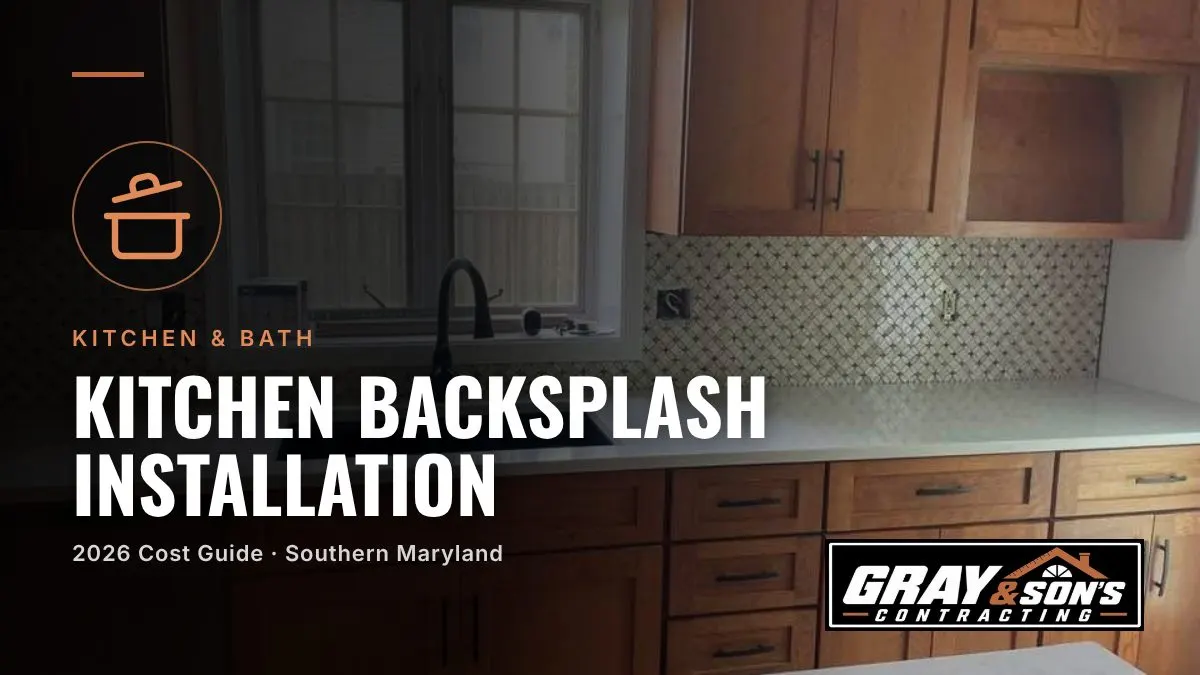
Kitchen backsplash installation in Southern Maryland typically costs $600 to $2,500 in 2026, depending on the tile material, kitchen layout, and square footage covered. Most homeowners pay $1,000 to $1,500 for a standard ceramic or porcelain subway tile backsplash covering 25 to 35 square feet of wall space between the countertop and upper cabinets. Budget-friendly ceramic tile projects start as low as $400 for materials and labor, while premium natural stone slab or intricate glass mosaic installations can push past $3,500 for larger kitchens with complex layouts. With fall settling in across Southern Maryland and the holiday entertaining season approaching, a backsplash upgrade is one of the most cost-effective kitchen improvements you can make, it protects your walls, dramatically changes the look of the room, and typically takes just one to two days to install.
A backsplash serves two practical purposes that matter in every Southern Maryland kitchen. First, it protects the wall behind your sink, stove, and countertops from water splashes, grease splatters, and food stains that would otherwise soak into drywall or paint and create conditions for mold growth, a persistent concern in the humid Chesapeake Bay climate where indoor moisture levels already run high for much of the year. Second, a well-chosen backsplash ties together the visual elements of your kitchen, the cabinets, countertops, flooring, and fixtures, in a way that few other single upgrades can match. Whether you are updating a dated kitchen in a 1990s Colonial in Waldorf or finishing a gut renovation in a waterfront home near Solomons, the backsplash is where function meets design in a very visible way.
This guide breaks down every cost you need to budget for a kitchen backsplash project in Calvert, St. Mary's, and Charles County, including materials by type and quality tier, labor rates, surface preparation, demolition of existing backsplash, grout and sealant, and the timeline from start to finish.
Backsplash Material Costs by Type
The material you choose drives the largest portion of your total project cost. Here is what each major backsplash material costs per square foot in 2026, including the range from builder-grade to premium options.
| Material | Material Cost Per Sq Ft | Installed Cost Per Sq Ft | Best For |
|---|---|---|---|
| Ceramic Tile | $1 to $20 | $12 to $35 | Budget-friendly projects, classic subway tile look |
| Porcelain Tile | $3 to $30 | $15 to $45 | Durability, low water absorption, modern designs |
| Glass Tile | $8 to $50 | $25 to $65 | Light reflection, modern kitchens, accent strips |
| Natural Stone (Marble, Travertine) | $5 to $50 | $20 to $65 | Upscale kitchens, unique veining and character |
| Natural Stone Slab | $50 to $200 | $75 to $250 | Seamless luxury look, easy cleaning |
| Stainless Steel / Metal Mosaic | $15 to $30 | $30 to $55 | Contemporary and industrial styles |
| Peel-and-Stick Tile | $2 to $10 | $2 to $10 (DIY) | Renters, temporary updates, quick refreshes |
Ceramic Tile: $12 to $35 Per Square Foot Installed
Ceramic tile remains the most popular backsplash material and the best value for most Southern Maryland homeowners. The classic 3x6-inch subway tile in white or off-white can be purchased for as little as $1 per square foot for basic machine-made options, meaning a 30-square-foot backsplash might cost just $30 in tile. Even with labor, a straightforward ceramic subway tile backsplash in a standard kitchen layout runs $360 to $1,050 total, making it accessible for nearly any remodeling budget.
The price range widens significantly as you move into handmade, textured, or designer ceramic tiles. Handcrafted ceramic tiles with irregular edges and reactive glazes, popular for farmhouse and transitional kitchen styles common in Southern Maryland, run $15 to $30 per square foot for the tile alone. Large-format ceramic tiles (12x24 or larger) offer a modern, clean-lined look with fewer grout lines, though they require more precise installation and stiffer substrate preparation, which adds to labor costs.
Porcelain Tile: $15 to $45 Per Square Foot Installed
Porcelain is fired at higher temperatures than ceramic, making it denser, harder, and less porous, all qualities that translate to better performance behind a kitchen sink or stove. Porcelain's water absorption rate is below 0.5 percent compared to ceramic's 3 to 7 percent, which matters in Southern Maryland's humid environment where moisture management in kitchens is an ongoing consideration.
Porcelain tile designed to mimic natural marble, wood grain, or concrete has become enormously popular. These look-alike tiles give you the aesthetic of premium materials with the durability and lower maintenance of porcelain. A marble-look porcelain subway tile runs $5 to $15 per square foot, a fraction of the cost of actual Carrara marble while being essentially maintenance-free.
Glass Tile: $25 to $65 Per Square Foot Installed
Glass tile backsplashes catch and reflect light in ways that no other material can match, making them especially effective in kitchens that could use a brightness boost, a common situation in older Southern Maryland homes where kitchen windows may be limited. Glass tiles come in everything from translucent subway tiles to iridescent mosaics to recycled glass blends with an organic, beachy feel that suits the Chesapeake Bay aesthetic.
The catch with glass tile is that installation requires more skill and specialized materials. Glass tile adhesive (typically a white latex-modified thinset) costs more than standard thinset, and the installer needs to work more slowly to avoid cracking tiles and to ensure the adhesive does not show through translucent pieces. Expect labor rates 15 to 25 percent higher than standard ceramic tile installation when working with glass.
Natural Stone: $20 to $250 Per Square Foot Installed
Natural stone backsplashes include a wide range of materials and price points. Marble tile, particularly Carrara, Calacatta, and honed marble subway tiles, is the most requested stone backsplash in Southern Maryland kitchen renovations. Marble tile runs $5 to $50 per square foot depending on the variety and format, with classic Carrara hexagon mosaics around $15 per square foot being a popular mid-range choice.
Full stone slab backsplashes, where a single piece of marble, granite, or quartzite extends from the countertop to the upper cabinets, create a dramatic, seamless look with no grout lines. Slab backsplashes are often fabricated from the same stone as the countertop, creating visual continuity. The cost is substantial: $50 to $200 per square foot installed, with most projects running $1,500 to $4,000 or more depending on the stone variety and the linear footage of wall covered. This option is most commonly seen in higher-end kitchen renovations in communities like Chesapeake Beach, North Beach, and newer developments in Waldorf and La Plata.
Stone backsplashes require sealing upon installation and periodic resealing (typically every 6 to 12 months for marble, annually for granite) to prevent staining from cooking oils, wine, and acidic foods. Your installer should apply an initial penetrating sealer as part of the job, and you should budget $15 to $40 for a quality stone sealer for annual maintenance.
Labor Costs for Backsplash Installation
Labor typically accounts for 40 to 60 percent of your total backsplash project cost. Here is what professional tile installers charge in the Southern Maryland market.
| Labor Component | Cost Range |
|---|---|
| Tile installation labor (per sq ft) | $8 to $25 |
| Demolition of existing backsplash | $100 to $300 |
| Surface preparation and repair | $50 to $200 |
| Thinset mortar (per 50-lb bag, covers ~60 to 80 sq ft) | $15 to $30 |
| Grout (per 25-lb bag, covers ~75 to 100 sq ft) | $12 to $35 |
| Grout sealer | $10 to $25 |
| Tile trim and edging (per linear foot) | $2 to $12 |
| Caulk (silicone, for countertop-to-tile joint) | $8 to $15 per tube |
Standard Installation: $8 to $15 Per Square Foot
A standard backsplash installation using ceramic or porcelain tile in a straightforward running bond (brick) pattern takes a skilled installer one full day for a typical kitchen. The work involves measuring and marking the layout, mixing and applying thinset mortar, cutting tiles to fit around outlets, switches, and corners, setting the tiles with consistent spacing, and returning the next day to grout and seal. Labor at the standard rate runs $8 to $15 per square foot, which translates to $240 to $525 for a 30-square-foot backsplash, the size of a typical galley or L-shaped kitchen's primary backsplash area.
Tile installers in the Calvert, St. Mary's, and Charles County area typically charge either by the square foot or by the day. Day rates for experienced tile professionals run $300 to $500 per day, which includes a helper on larger jobs. For a standard backsplash that takes one day of setting and a half day of grouting, you are looking at $450 to $750 in total labor.
When Labor Costs Run Higher
Several factors push backsplash labor above the standard range:
Complex tile patterns: Herringbone, chevron, basketweave, and diagonal patterns require more cuts, more layout time, and more material waste (typically 15 to 20 percent more tile than a standard running bond). The additional labor for a herringbone backsplash adds $3 to $8 per square foot above a standard installation.
Mosaic tile sheets: Small mosaic tiles (1-inch or 2-inch squares, penny rounds, or hexagons mounted on mesh backing) look stunning but require precise alignment of each sheet to maintain consistent grout lines across the entire backsplash. The installation is slower and more painstaking. Add $3 to $6 per square foot for mosaic tile labor compared to standard subway tile.
Glass tile: As noted above, glass requires specialized adhesive, careful handling to avoid chipping or cracking, and slower setting to ensure proper adhesion and appearance through translucent pieces. Add $4 to $10 per square foot for glass tile installation labor.
Existing backsplash removal: Removing an old tile backsplash without damaging the underlying drywall takes time and care. Demolition adds $100 to $300 depending on the size and how firmly the original tile was set. If the drywall is damaged during removal, which is common, especially in older homes where tile was set directly on unpainted drywall, the installer will need to patch or replace sections before the new tile can go up. Drywall patching and skim-coating adds $50 to $200.
Electrical outlet adjustments: Your backsplash area almost certainly includes electrical outlets for countertop appliances and possibly under-cabinet lighting switches. The tile installer will cut tiles to fit around the outlet boxes, but if the new tile thickness causes the outlet boxes to sit too far recessed, the boxes will need extenders or repositioning. This is a minor item ($5 to $15 per outlet for extenders) but should be accounted for.
Typical Backsplash Project Sizes
Kitchen size and layout determine how many square feet of backsplash you need. Here are common configurations for Southern Maryland homes.
| Kitchen Type | Typical Backsplash Area | Budget Estimate (Ceramic) | Mid-Range Estimate (Porcelain/Glass Accent) | Premium Estimate (Natural Stone) |
|---|---|---|---|---|
| Galley Kitchen | 15 to 25 sq ft | $300 to $600 | $500 to $1,000 | $800 to $1,800 |
| L-Shaped Kitchen | 25 to 40 sq ft | $500 to $900 | $800 to $1,600 | $1,200 to $3,000 |
| U-Shaped Kitchen | 35 to 55 sq ft | $650 to $1,200 | $1,100 to $2,200 | $1,800 to $4,200 |
| Open-Concept with Island | 20 to 45 sq ft | $400 to $1,000 | $700 to $1,800 | $1,100 to $3,500 |
Most Southern Maryland kitchens, the ranch homes in Lexington Park, split-levels in California, Colonials and Cape Cods throughout Waldorf, La Plata, and Prince Frederick, have L-shaped or U-shaped kitchen layouts with 25 to 45 square feet of backsplash area. The most common request is a full backsplash from countertop to the bottom of the upper cabinets (typically 18 inches of height) on all walls with countertops, plus a full-height backsplash behind the stove.
Sample Project Scenarios
Scenario 1: Budget Subway Tile in a Waldorf Townhome
The situation: A 2005-built townhome in a Waldorf subdivision. The homeowner wants to replace a painted wall behind the kitchen countertops with a classic white 3x6 subway tile backsplash. The kitchen is L-shaped with approximately 30 square feet of backsplash area. No existing tile to remove.
| Item | Cost |
|---|---|
| White ceramic subway tile (30 sq ft + 10% waste) | $35 |
| Thinset mortar (1 bag) | $18 |
| Grout (1 bag, light gray) | $15 |
| Grout sealer | $12 |
| Tile trim (bullnose edge, 15 linear feet) | $45 |
| Outlet box extenders (4 outlets) | $20 |
| Silicone caulk (countertop joint) | $12 |
| Tile installer labor (1.5 days) | $475 |
| Total | $632 |
Timeline: Day one, surface prep, layout, and tile setting. Day two morning, grouting and caulking. Ready to use within 24 hours after grouting.
Scenario 2: Marble-Look Porcelain in a Prince Frederick Home
The situation: A 1998-built Colonial in Prince Frederick undergoing a kitchen update. The homeowner wants a marble-look porcelain tile in a large-format (4x12) stacked pattern. The U-shaped kitchen has 42 square feet of backsplash area, including a full-height (36-inch) section behind the stove. An existing laminate backsplash needs to be removed.
| Item | Cost |
|---|---|
| Marble-look porcelain tile (46 sq ft including waste) at $9/sq ft | $414 |
| Demolition of existing laminate backsplash | $150 |
| Drywall repair and skim coat (behind old backsplash) | $120 |
| Thinset mortar (2 bags, white for light-colored tile) | $40 |
| Grout (unsanded, matching) | $25 |
| Grout sealer | $12 |
| Tile edge trim (Schluter or similar, 20 linear feet) | $80 |
| Outlet box extenders (5 outlets) | $25 |
| Silicone caulk | $12 |
| Tile installer labor (2 days) | $650 |
| Total | $1,528 |
Timeline: Day one, demolition, wall prep, and begin setting tile. Day two, finish tile setting, grouting, and sealing. Ready to use within 48 hours.
Scenario 3: Glass Mosaic Accent with Ceramic Field Tile in a Chesapeake Beach Kitchen
The situation: A 2012-built waterfront home near Chesapeake Beach. The homeowner wants a combination backsplash: white ceramic subway tile as the field tile with a decorative band of iridescent glass mosaic tile running horizontally at eye level behind the cooktop and along the main countertop run. The open-concept kitchen has 38 square feet of total backsplash area, with the glass accent band covering approximately 10 square feet of that total.
| Item | Cost |
|---|---|
| White ceramic subway tile (31 sq ft including waste) at $3/sq ft | $93 |
| Iridescent glass mosaic tile (11 sq ft including waste) at $22/sq ft | $242 |
| White latex-modified thinset (for glass, 1 bag) | $28 |
| Standard thinset (for ceramic, 1 bag) | $18 |
| Grout (2 colors: white for field, coordinating for accent) | $35 |
| Grout sealer | $12 |
| Tile edge trim and transition strips | $65 |
| Outlet box extenders (4 outlets) | $20 |
| Silicone caulk | $12 |
| Tile installer labor (2.5 days, higher rate for glass work) | $875 |
| Total | $1,400 |
Timeline: Three days including a half day for grouting and final sealing. The glass portion requires careful handling and slower installation to ensure proper adhesion and alignment.
DIY vs. Professional Installation
Can You Install a Kitchen Backsplash Yourself?
A kitchen backsplash is one of the more approachable tile projects for a confident DIYer. The area is relatively small, the tiles are typically lightweight, and the consequences of a mistake are less severe than with floor tile or a shower surround. A homeowner with basic tools, patience, and a free weekend can save $300 to $750 or more in labor on a standard backsplash project.
| Factor | DIY | Professional |
|---|---|---|
| Material savings | None, same tile cost | Same |
| Labor savings | $300 to $750+ | Full labor cost applies |
| Tools needed | Tile saw or scorer, notched trowel, float, spacers, level | Provided by installer |
| Time investment | 2 to 3 days for a first-timer | 1 to 2 days |
| Cut quality | Adequate with a manual scorer for straight cuts; wet saw rental ($40 to $70/day) needed for complex cuts | Clean, precise cuts standard |
| Risk | Uneven lines, lippage, poor cuts around outlets | Professional finish |
| Grout quality | Uneven or inconsistent grout lines common for beginners | Consistent, clean lines |
The areas where DIY backsplash installations most commonly fall short are around outlets and switches (where precise notch cuts are needed), at inside corners (where tiles meet at a 90-degree angle), and in the grout work (where consistency and cleanliness separate amateur from professional results). If your backsplash includes a decorative accent band, glass tile, or a pattern like herringbone, the difficulty increases substantially, and professional installation is worth the investment.
Tool Rental for DIY
If you decide to tackle the project yourself, you will need either a manual tile scorer (adequate for straight cuts on ceramic and porcelain subway tiles, about $20 to buy) or a wet tile saw (available for rent at home improvement stores in Waldorf and La Plata for $40 to $70 per day). Other supplies you likely need to purchase: a 1/4-inch V-notched trowel ($8 to $15), a grout float ($10 to $18), tile spacers ($4 to $8), a level ($15 to $30 if you do not own one), and mixing supplies for thinset and grout. Budget $60 to $120 for tools and consumables beyond the tile and adhesive materials.
Backsplash Materials for Southern Maryland's Climate
Southern Maryland's warm, humid summers and the proximity to the Chesapeake Bay and its tributaries create specific considerations for backsplash material selection. While a backsplash does not face the same moisture exposure as a shower surround or exterior cladding, kitchens in this region can see sustained high humidity levels during the summer months, particularly in homes without central air conditioning or in kitchens with poor ventilation.
Porcelain over ceramic in high-moisture kitchens: If your kitchen runs humid or if the backsplash is adjacent to a sink without a window exhaust fan, porcelain's lower water absorption rate (under 0.5 percent versus ceramic's 3 to 7 percent) provides an extra margin of protection against moisture infiltration behind the tile. The cost difference between comparable ceramic and porcelain tiles is typically $2 to $5 per square foot, a modest premium for better long-term performance.
Grout selection matters: In the humid Southern Maryland climate, using an epoxy-based or urethane grout rather than standard cement grout provides much better resistance to mold and mildew growth in the grout lines. Epoxy grout costs $7 to $15 per pound compared to $0.50 to $1 per pound for standard sanded grout, but it does not require sealing and resists staining and biological growth far better. For a typical 30-square-foot backsplash, the upgrade to epoxy grout adds $40 to $80 to the project, well worth the long-term maintenance savings.
Ventilation check: Before installing a backsplash, especially a full-height backsplash behind the stove, verify that your kitchen ventilation is adequate. The backsplash replaces a surface (painted drywall) that was at least somewhat permeable with one (glazed tile) that is essentially impermeable. In a kitchen where steam and cooking moisture were previously absorbed partially by the wall surface, a new tile backsplash redirects all of that moisture into the room air. If your range hood vents to the exterior, this is not a concern. If your range hood recirculates (common in many Southern Maryland homes where the range is on an interior wall), consider upgrading to a vented hood as part of the backsplash project.
Frequently Asked Questions
How long does a kitchen backsplash installation take?
Most backsplash installations take one to two days. Day one covers surface preparation, layout, and tile setting. Day two covers grouting and sealing. You should plan to keep the backsplash area dry for at least 24 hours after grouting to allow proper curing. Simple ceramic subway tile installations in a small kitchen can sometimes be completed in a single long day by an experienced installer, while complex patterns, glass tile, or large kitchens may take three days.
Do I need to remove the old backsplash before installing a new one?
In most cases, yes. Installing new tile over an existing tile backsplash is technically possible but not recommended. The added thickness can cause problems with outlet box depth, create an uneven transition at the countertop edge, and adds weight that the original adhesive may not have been designed to support. Removing the old backsplash typically costs $100 to $300 and ensures the new tile has a clean, flat substrate for proper adhesion.
Should the backsplash go all the way to the ceiling?
A standard backsplash extends from the countertop to the bottom of the upper cabinets, typically 18 inches. Extending the tile to the ceiling is a design trend that works well in kitchens with high ceilings or where there are no upper cabinets on a particular wall (common above ranges with a decorative hood). A ceiling-height backsplash adds square footage and cost, a 36-inch height doubles the tile area compared to an 18-inch standard, but can make a dramatic visual statement. Make sure your installer accounts for any unevenness in the ceiling line, which is common in older Southern Maryland homes.
Can I install a backsplash over a laminate countertop?
Yes. The backsplash installs on the wall above the countertop, not on the countertop surface itself. The critical detail is the joint where the bottom row of tile meets the top edge of the countertop, this joint should be filled with a flexible silicone caulk (not grout) to accommodate the slight movement between the wall and countertop surfaces. This applies whether your countertops are laminate, granite, quartz, or butcher block.
What is the most popular backsplash in Southern Maryland right now?
As of fall 2026, the most requested backsplash styles in the Calvert, St. Mary's, and Charles County area are white or off-white subway tile in a 3x6 or 4x12 format (still the dominant choice for its clean look and broad appeal), marble-look porcelain tile (delivering the high-end aesthetic of Carrara marble without the sealing and maintenance), and matte or textured finishes in neutral tones (a shift away from the high-gloss look that dominated a few years ago). Herringbone and stacked-bond patterns have overtaken the traditional running bond as the most popular layout for subway tile, though running bond remains the most cost-effective option.
Ready to transform your Southern Maryland kitchen with a new backsplash? Gray & Sons Contracting installs kitchen backsplashes throughout Calvert, St. Mary's, and Charles County, from budget-friendly ceramic subway tile in Waldorf and La Plata to premium natural stone installations in Chesapeake Beach, Prince Frederick, and Leonardtown. We help you select the right material for your kitchen, your budget, and the Southern Maryland climate, and every installation includes proper surface preparation, precision cuts, and professional grouting. Get a Free Estimate