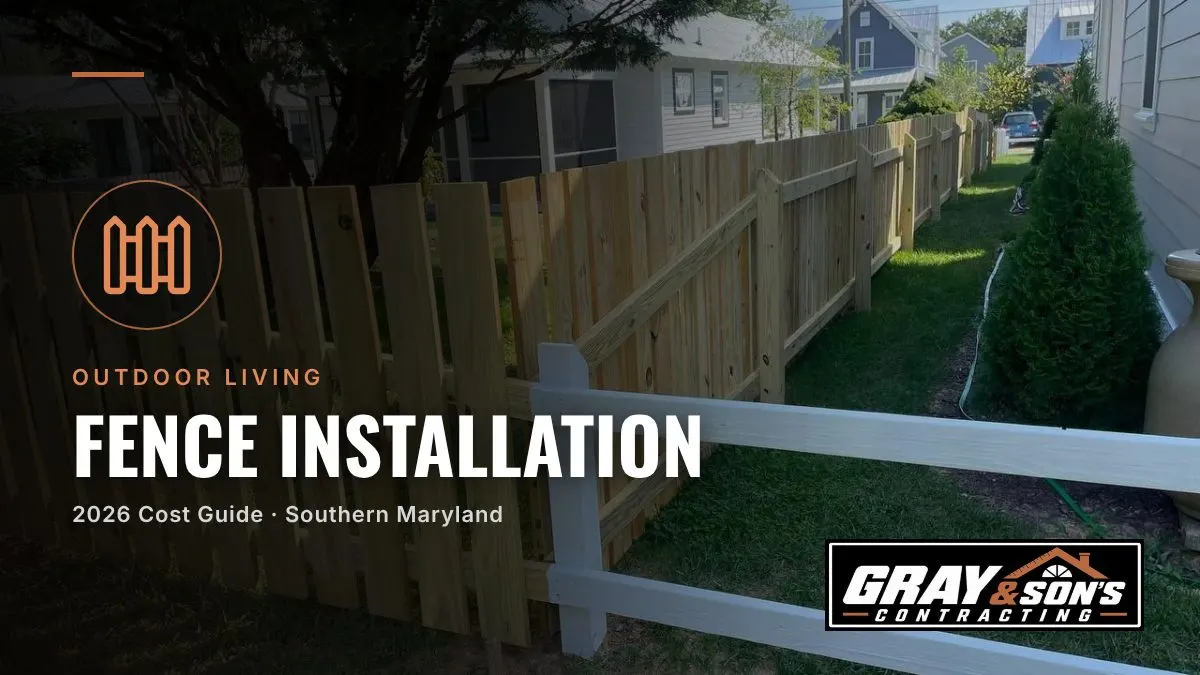
Fence installation in Southern Maryland costs $15 to $75 per linear foot in 2026, with most homeowners in Calvert, St. Mary's, and Charles County paying $3,500 to $10,000 for a full yard fence. The national average for a 150-linear-foot privacy fence sits around $4,500 to $7,500, but the total depends on the material, the height, the terrain, and whether you are fencing a flat suburban lot in Waldorf or a sloped waterfront property in Chesapeake Beach.
That is not a vague range. It reflects the real difference between a 4-foot chain link fence at $15 to $22 per foot and a 6-foot composite privacy fence at $40 to $80 per foot. Those are fundamentally different products at fundamentally different price points, and the right choice depends on what you need the fence to do, contain a dog, screen a neighbor, define a property line, meet a pool code requirement, or survive 20 years of Chesapeake Bay weather without rotting.
Here is what each type of fence costs installed in Southern Maryland, how each material performs in this climate, and what to know about permits, property lines, and the hidden costs that turn a straightforward fence project into an expensive one.
Fence Cost by Material: Full Comparison
| Material | Cost Per Linear Foot (Installed) | 150 LF Fence Cost | Lifespan | Maintenance |
|---|---|---|---|---|
| Chain link (4 ft) | $15 to $25 | $2,250 to $3,750 | 15 to 25 years | Minimal |
| Chain link (6 ft) | $20 to $35 | $3,000 to $5,250 | 15 to 25 years | Minimal |
| Pressure-treated pine (6 ft privacy) | $18 to $38 | $2,700 to $5,700 | 10 to 20 years | Stain/seal every 2 to 3 years |
| Cedar (6 ft privacy) | $25 to $55 | $3,750 to $8,250 | 15 to 25 years | Stain/seal every 2 to 3 years |
| Vinyl (6 ft privacy) | $28 to $55 | $4,200 to $8,250 | 20 to 30 years | Minimal (occasional wash) |
| Aluminum ornamental | $30 to $55 | $4,500 to $8,250 | 25 to 40+ years | Minimal |
| Wrought iron | $35 to $75 | $5,250 to $11,250 | 40 to 100+ years | Rust treatment every few years |
| Composite | $40 to $80 | $6,000 to $12,000 | 25 to 50 years | Minimal |
These installed costs include materials, posts, concrete for post holes, hardware, standard installation labor, and one gate. They do not include old fence removal, grading, permit fees, or survey costs, each of which adds to the total when applicable.
Wood Fencing: Pressure-Treated Pine and Cedar
Wood is the most popular fencing material in Southern Maryland, it looks natural, offers complete privacy, costs less than vinyl or composite for the same height, and can be stained or painted any color. The trade-off is maintenance. Wood fences in this climate require attention, and the gap between a well-maintained wood fence and a neglected one is the difference between a 20-year fence and a 7-year fence.
Pressure-Treated Pine
Cost: $18 to $38 per linear foot installed for a 6-foot privacy fence.
Pressure-treated pine is the budget wood option. The lumber is southern yellow pine that has been infused with chemical preservatives (most commonly micronized copper azole, or MCA) to resist rot and insect damage. It is the green or tan-tinted lumber you see at every home center and lumberyard.
| Style | Cost Per Linear Foot |
|---|---|
| Dog-ear privacy (6 ft) | $18 to $28 |
| Board-on-board privacy (6 ft) | $25 to $35 |
| Stockade (6 ft) | $18 to $25 |
| Picket (3 to 4 ft) | $12 to $20 |
| Post and rail (3-rail) | $10 to $18 |
| Shadow box / semi-privacy (6 ft) | $22 to $32 |
Pressure-treated pine is structurally adequate for fencing and resistant to rot and termites for 10 to 15 years in ground contact, which is what matters, because the posts are the failure point. The pickets and rails above ground last longer, but once a post rots at the ground line, the section falls regardless of how good the pickets look.
In Southern Maryland's climate, the combination of clay soils that retain moisture, high humidity, and frequent rain means pressure-treated fence posts are constantly exposed to damp conditions at the ground line. Posts set directly in concrete fare better than posts set in dirt, but even concrete-set treated posts begin showing soft spots at the base within 10 to 15 years. Using metal post brackets (Simpson Strong-Tie, Oz-Post) that keep the wood above the concrete extends post life to 15 to 20 years because the wood is never in direct ground contact.
Maintenance: Pressure-treated pine should be stained and sealed within 6 to 12 months of installation (after the wood has dried enough to absorb the stain) and re-stained every 2 to 3 years. Without stain, the wood weathers to a silver-gray within one to two years and begins checking (cracking along the grain), splitting, and warping. The silver-gray look is fine aesthetically if that is what you want, but the lack of a water-repellent finish means the wood absorbs and releases moisture with every rain cycle, which accelerates decay.
Cedar
Cost: $25 to $55 per linear foot installed for a 6-foot privacy fence.
Cedar, typically western red cedar in fencing applications, is naturally resistant to rot and insects without chemical treatment. The natural oils in cedar heartwood repel moisture and deter termites and carpenter bees, which makes it last longer than pressure-treated pine in ground-contact applications.
| Style | Cost Per Linear Foot |
|---|---|
| Dog-ear privacy (6 ft) | $25 to $35 |
| Board-on-board privacy (6 ft) | $30 to $45 |
| Board-on-board with metal posts (6 ft) | $35 to $50 |
| Horizontal slat (modern) | $35 to $55 |
| Picket (3 to 4 ft) | $18 to $28 |
| Pre-stained privacy (6 ft) | $40 to $55 |
Cedar costs 30 to 50 percent more than pressure-treated pine for the same style, and the premium is worth it for most homeowners in Southern Maryland. Cedar's natural rot resistance performs better in this climate's wet conditions, it does not have the chemical preservatives that some homeowners want to avoid (particularly around vegetable gardens and play areas), and it weathers more gracefully, cedar turns a warm silver tone rather than the dingy gray of weathered pine.
The post question applies here too. Even cedar posts rot at the ground line over time. For maximum fence life, use cedar pickets and rails (for appearance and natural resistance above ground) on galvanized steel or aluminum posts (for structural permanence below ground). This combination costs $35 to $50 per foot installed but creates a fence that lasts 25 to 30 years with only periodic picket and rail replacement, the posts are permanent.
Maintenance: Cedar benefits from a UV-blocking stain or clear sealer applied every 2 to 3 years. The stain preserves the color (cedar's warm reddish-brown tone fades to gray within one to two years without stain) and adds a water-repellent barrier that reduces moisture cycling. A penetrating oil-based stain (Cabot, TWP, Ready Seal) outperforms film-forming stains on cedar because it soaks into the wood rather than sitting on top, which means it wears gradually rather than peeling.
Vinyl Fencing
Cost: $28 to $55 per linear foot installed for a 6-foot privacy fence.
Vinyl (PVC) fencing is the lowest-maintenance option available. It does not rot, does not attract insects, does not need staining, does not warp, and does not fade significantly over its lifespan. It cleans with a garden hose or a mild detergent and lasts 20 to 30 years with essentially no maintenance.
| Style | Cost Per Linear Foot |
|---|---|
| Picket (3 to 4 ft) | $18 to $32 |
| Post and rail (3-rail) | $15 to $28 |
| Semi-privacy (6 ft) | $25 to $45 |
| Privacy (6 ft, standard) | $28 to $45 |
| Privacy (6 ft, premium texture or color) | $35 to $55 |
Where vinyl excels in Southern Maryland: moisture resistance. In a region where wood fences battle constant humidity, rain, and clay soils that hold water against the posts, vinyl's imperviousness to moisture is a significant practical advantage. A vinyl fence in Lusby performs identically in year 15 to how it performed in year 1, which cannot be said of any wood fence in this climate without diligent maintenance.
Where vinyl has limits: impact resistance. Vinyl becomes brittle in cold weather and can crack on impact, a fallen branch, a kicked ball, a mower strike, in ways that wood simply dents or scratches. A cracked vinyl panel must be replaced entirely; you cannot patch or repair it the way you can nail a split wood picket back together. In areas prone to falling limbs, and Southern Maryland's heavily wooded lots, particularly in Huntingtown, Dunkirk, Owings, St. Leonard, and the forested areas of St. Mary's County, have plenty of those, this is a real consideration.
Wind resistance is the other factor. A solid vinyl privacy fence acts as a sail in high winds. The standard vinyl fence is designed for sustained winds up to 75 miles per hour when properly installed with posts at 6- to 8-foot intervals set in concrete below the frost line. For exposed properties, open fields in Mechanicsville and Charlotte Hall, waterfront lots, and hilltop properties with no wind break, specify reinforced posts with aluminum inserts and reduce the post spacing to 6 feet.
Cost comparison over 20 years: A pressure-treated pine privacy fence costs $18 to $28 per foot installed plus $1.50 to $3 per foot every 2 to 3 years for staining, and it likely needs post replacement or a full rebuild around year 12 to 15. Over 20 years, that is roughly $35 to $60 per foot in total cost. A vinyl fence costs $28 to $45 per foot installed, needs zero maintenance, and lasts the full 20 years. On a lifetime basis, vinyl is often cheaper than wood despite the higher upfront cost.
Chain Link Fencing
Cost: $15 to $35 per linear foot installed, depending on height and gauge.
Chain link is the least expensive fencing option per linear foot and the most functional if the goal is simply to enclose an area, a backyard for dogs, a pool per code requirements, a property boundary. It is not a privacy fence (unless you add slats or screening), it is not the most attractive option, and it does not increase property value the way wood, vinyl, or ornamental metal does. But it works, it lasts, and it costs half or less of what a wood privacy fence costs.
| Height | Cost Per Linear Foot |
|---|---|
| 3 ft (decorative, garden, short boundary) | $12 to $18 |
| 4 ft (standard residential, pool code) | $15 to $25 |
| 5 ft (dog containment, moderate security) | $18 to $30 |
| 6 ft (privacy with slats, security) | $20 to $35 |
Add-ons that change the equation:
- Privacy slats (woven through the mesh): add $4 to $7 per linear foot. Available in a range of colors. They provide 70 to 85 percent privacy, not as complete as a solid fence, but a significant improvement over open mesh.
- Privacy screening or windscreen fabric: add $2 to $5 per linear foot. Attaches to the mesh with zip ties. Provides 80 to 95 percent privacy. Less durable than slats (2 to 5 year life) but cheaper and easier to install.
- Vinyl-coated mesh (black or green): add $2 to $4 per linear foot over galvanized. Looks better and resists rust longer. Black vinyl-coated chain link disappears visually against dark backgrounds and is the standard for pool enclosures.
Chain link with a vinyl coating and privacy slats runs $22 to $45 per linear foot installed, approaching wood privacy fence pricing, which is why many homeowners who start shopping for "the cheapest fence option" end up reconsidering once they add the privacy they actually need.
Aluminum Ornamental Fencing
Cost: $30 to $55 per linear foot installed.
Aluminum fencing replicates the look of wrought iron at roughly half the cost and a fraction of the maintenance. It does not rust (aluminum oxidizes with a protective layer rather than corroding), it does not need painting, and it maintains its appearance for decades with nothing more than an occasional rinse.
Aluminum is not a privacy fence, it is an open-rail design that defines boundaries, meets pool codes, and adds curb appeal without blocking sight lines. For homeowners in Southern Maryland who want to fence a front yard, enclose a pool, or define a property line without the visual weight of a solid fence, aluminum is the standard choice.
| Style | Cost Per Linear Foot |
|---|---|
| Standard 2-rail (3 to 4 ft, residential) | $25 to $40 |
| Standard 3-rail (4 to 5 ft, residential) | $30 to $50 |
| Pool code compliant (4 ft minimum, self-closing gate) | $35 to $55 |
| Estate style (5 to 6 ft, heavier gauge) | $40 to $60 |
Pool fencing note for Southern Maryland. Maryland requires a barrier around residential swimming pools with a minimum height of 48 inches and a self-closing, self-latching gate. Aluminum pool fencing meets this requirement and is the most common material for pool enclosures in the region because it does not obstruct the view of the pool (important for supervision), does not rot from pool splash, and does not rust from chemical exposure. Budget $35 to $55 per linear foot for a code-compliant aluminum pool fence, including the self-closing gate hardware.
Composite Fencing
Cost: $40 to $80 per linear foot installed.
Composite fencing, a blend of wood fiber and recycled plastic, is the premium option for homeowners who want the appearance of wood with the maintenance profile of vinyl. It does not rot, does not warp, does not need staining, and resists insects. It is heavier and more rigid than vinyl, which gives it a more substantial feel and better wind resistance.
Brands like Trex (the deck manufacturer), SimTek, and Fiberon offer composite fence panels that mimic the grain and color of natural wood. The appearance is convincing from a few feet away, though up close the difference from real wood is discernible.
The cost premium over wood and vinyl is significant, composite runs 1.5 to 3 times the cost of pressure-treated pine for the same height and style. The justification is zero maintenance over a 25- to 50-year lifespan. For homeowners who plan to stay in the house long-term, the lifetime cost calculation favors composite over wood, though not by as much as it favors vinyl over wood, since vinyl achieves similar maintenance savings at a lower installed cost.
What Drives Fence Installation Cost
Linear Footage
Fence projects are priced per linear foot, so the perimeter you need to fence determines the base cost. A typical fencing project in Southern Maryland:
| Lot Size | Approximate Perimeter | Fence Cost (Wood Privacy) |
|---|---|---|
| 0.25 acre (suburban, typical Waldorf/La Plata subdivision) | 120 to 180 LF | $2,800 to $6,800 |
| 0.50 acre | 200 to 280 LF | $4,600 to $10,600 |
| 1 acre (common in Calvert and St. Mary's) | 300 to 400 LF | $6,900 to $15,200 |
| 2+ acres | 500+ LF | $11,500+ |
Most homeowners do not fence the entire property, they fence the backyard or a portion of it. A three-sided backyard fence (the house serves as the fourth side) on a quarter-acre suburban lot is typically 100 to 150 linear feet, which puts a wood privacy fence at $2,300 to $5,700 and a vinyl privacy fence at $3,500 to $8,250.
Gates
Gates cost more per foot than the fence line because they require additional hardware (hinges, latches, self-closers for pool gates), stronger posts to support the swinging weight, and more precise installation to ensure they open and close properly over time without sagging.
| Gate Type | Cost |
|---|---|
| Walk gate (3 to 4 ft, standard) | $200 to $500 |
| Walk gate (pool code, self-closing) | $350 to $700 |
| Double drive gate (8 to 12 ft, vehicle access) | $500 to $1,500 |
| Sliding gate (manual) | $800 to $2,000 |
| Automated gate (electric opener) | $1,500 to $5,000+ |
Most residential fence projects include one walk gate and, if there is a side yard or driveway access, one double drive gate. Budget $500 to $1,500 for gates on a standard residential project.
Terrain and Soil Conditions
Flat, clear lots with normal soil are the baseline for fence pricing. Southern Maryland is not always flat, clear, or normal.
Slopes and hills require the fence to either step down in sections (each section drops one post height at each step, creating a staircase effect) or rack (the panels tilt to follow the slope). Stepped fencing is standard for wood and vinyl; racked fencing is available in aluminum and some vinyl systems. Either approach adds 10 to 25 percent to the installation cost because each section requires individual measurement, custom cutting, and additional hardware.
Rocky soil and tree roots increase post hole excavation time. The standard post hole is 8 to 10 inches in diameter and 30 to 36 inches deep (below the frost line, which is 30 inches in Southern Maryland). In normal soil, an auger digs a post hole in 2 to 5 minutes. In rocky ground or through heavy root systems, each hole can take 15 to 30 minutes with a combination of auger, digging bar, and sometimes a jackhammer. This adds $3 to $8 per post hole, meaningful when a 150-foot fence has 20 to 25 posts.
Clay soils, which are dominant across Calvert, St. Mary's, and Charles County, present a specific drainage challenge. Clay holds water against the post base rather than draining away, which accelerates rot on wood posts and can heave concrete footings during freeze-thaw cycles. Proper installation in clay soils means setting posts in concrete with gravel at the bottom of the hole for drainage, and in some cases using a wider hole (12 inches instead of 8) to provide a more stable concrete collar.
Wooded lots require clearing the fence line of trees, brush, and root systems before installation. Minor clearing (brush and small trees under 4 inches in diameter) typically adds $2 to $5 per linear foot. Removing larger trees along the fence line is a separate cost that varies widely, $200 to $1,500 per tree depending on size and access.
Old Fence Removal
If you are replacing an existing fence, the old fence must come out first. Removal costs $3 to $8 per linear foot depending on the material, condition, and disposal requirements. A 150-foot old fence removal runs $450 to $1,200.
Wood fence removal is straightforward, pull the pickets, extract the posts (or cut them off at ground level and drive them below grade with a sledge), and haul the debris. Concrete post footings can be left in place if they are deep enough not to interfere with the new fence posts, though this limits where the new posts can go.
Chain link removal is more labor-intensive because the mesh is connected to the posts with tension bands, rail ends, and tie wires that must all be disconnected before the mesh can be rolled up. Disposal of chain link mesh and metal posts may require a separate trip to a metal recycler.
Permits and Property Lines
Permits
Calvert, St. Mary's, and Charles County each have their own fence regulations, and they differ on height limits, setback requirements, and whether a permit is required.
General rules across all three counties: - Fences in the front yard are typically limited to 4 feet in height - Fences in the side and rear yard can be up to 6 feet (8 feet in some agricultural zones) - Fences must be set back from the property line, typically on your side, not on the line itself - Pool enclosures must meet Maryland's pool barrier code (48 inches minimum, self-closing gate) - Fences in the Chesapeake Bay Critical Area may require additional review
Always check with your county's planning and zoning department before installing a fence. A fence installed without a required permit, or in violation of height or setback rules, can result in a removal order, which means paying to take it down and reinstall it in compliance, doubling your cost.
Property Lines
The most common fence dispute in residential neighborhoods is a fence built on or over the property line. This is avoidable: get a survey before you build.
A property line survey in Southern Maryland costs $300 to $800, depending on the lot size, complexity, and whether the surveyor needs to set new pins. This is money well spent. A fence installed 12 inches onto your neighbor's property is a legal liability that can result in a forced removal regardless of how long the fence has been there. Maryland does not recognize adverse possession of fence encroachments the way some states do, your neighbor can demand removal at any time.
Set the fence 2 to 6 inches inside your surveyed property line. This provides a buffer for post hole diameter and ensures the fence, including the post faces, is entirely on your property. The finished side (the "good" side) traditionally faces outward toward the neighbor, though this is a courtesy, not a legal requirement in Maryland.
Best Fence Materials for Southern Maryland's Climate
Southern Maryland's combination of high humidity, heavy rainfall, clay soils, freeze-thaw cycles, and salt air near the Chesapeake Bay creates a demanding environment for fence materials. Here is how each performs:
Pressure-treated pine: Adequate for 10 to 15 years with regular staining. Posts are the weak point, expect to replace individual posts starting around year 8 to 12 in wet locations. Not recommended for waterfront properties where salt air accelerates corrosion of the fasteners and chemical preservatives.
Cedar: Good natural performance for 15 to 20 years with staining. Better than pine in wet conditions because the natural oils provide moisture resistance independent of the chemical treatment. Cedar holds up well near the water, though the fasteners (nails, screws, brackets) should be stainless steel or hot-dipped galvanized, standard zinc-plated fasteners corrode rapidly in salt air.
Vinyl: Excellent for this climate. Immune to moisture, rot, and insects. Performs identically at the waterfront and inland. The only climate-related concern is brittleness in extreme cold (below 20 degrees), which Southern Maryland rarely experiences, and impact damage from falling branches.
Aluminum: Excellent. Does not rust, does not corrode in salt air, and maintains its finish indefinitely. The best choice for waterfront properties where a non-privacy fence is acceptable.
Composite: Excellent moisture and rot resistance. The wood fiber component is encapsulated in plastic, so it does not absorb water the way natural wood does. Performs well in all Southern Maryland conditions including waterfront.
Chain link (galvanized): Good for 15 to 20 years inland. Near the water, galvanized chain link eventually rusts, vinyl-coated chain link lasts longer in salt air environments.
Frequently Asked Questions
How long does fence installation take? A standard 150-linear-foot residential fence takes 1 to 3 days for most materials. Wood privacy fence: 1 to 2 days. Vinyl: 1 to 2 days. Chain link: 1 day. Aluminum: 1 to 2 days. Composite: 2 to 3 days. Add a day for old fence removal if applicable, and a day for significant terrain work on sloped or wooded lots.
What is the cheapest fence for a full yard? Chain link at $15 to $25 per linear foot is the least expensive installed fence. For privacy fencing, pressure-treated pine at $18 to $28 per linear foot is the budget option. If you are fencing a large area, an acre or more, common on rural properties in St. Mary's and Calvert County, post and rail ($10 to $18 per foot) or agricultural wire fencing ($5 to $12 per foot) provides a boundary at the lowest per-foot cost.
Can I install a fence myself? Yes, though it is more labor-intensive than most homeowners expect. The hardest part is the post holes, digging 25 to 30 holes by hand in Southern Maryland's clay soil is a full day of brutal work. Renting a two-person power auger ($50 to $100 per day) makes it manageable. The rest, setting posts in concrete, attaching rails, hanging pickets or panels, is straightforward with basic tools and a helper. DIY saves $5 to $15 per linear foot in labor, or $750 to $2,250 on a 150-foot fence. The risk is misaligned posts, which cannot be corrected after the concrete sets without starting over.
How deep should fence posts be in Southern Maryland? At least 30 inches, below the frost line, which is 30 inches in this region. Posts that are not below the frost line will heave (lift out of the ground) during freeze-thaw cycles, causing the fence to lean and eventually fail. For 6-foot fences, most installers set posts 36 inches deep to provide additional stability against wind loads. Each post hole should have 4 to 6 inches of gravel at the bottom for drainage before the concrete.
Do I need to tell my neighbor before installing a fence? Maryland does not require you to notify a neighbor before building a fence on your own property, but doing so is strongly recommended, and not just as a courtesy. If the neighbor plans to build on the same boundary, you may be able to share the cost. If the neighbor has concerns about the style, height, or placement, it is far easier to address them before the fence goes in than after. And a survey confirming the property line, shared with the neighbor before construction begins, prevents boundary disputes that can otherwise linger for years.
Will a fence increase my property value? A well-built fence adds $1,500 to $5,000 in perceived value to a residential property, though the exact return depends on the material, style, and how it fits the neighborhood. In subdivisions where most homes have fenced backyards, common throughout Waldorf, La Plata, and the newer developments in Calvert County, a fenced yard is expected, and the absence of one can actually hurt resale. In rural areas where fencing is less common, the value add is smaller. Privacy fencing and pool enclosures have the strongest return because they solve specific buyer objections (privacy and safety). The highest return is typically from a well-maintained wood or vinyl privacy fence that matches the quality of the house and the neighborhood.
Ready to fence your yard? Gray & Sons Contracting has been building fences across Calvert, St. Mary's, and Charles County for 50 years. We will walk the property, help you pick the right material for your lot and your budget, and build it to last. Get a Free Estimate