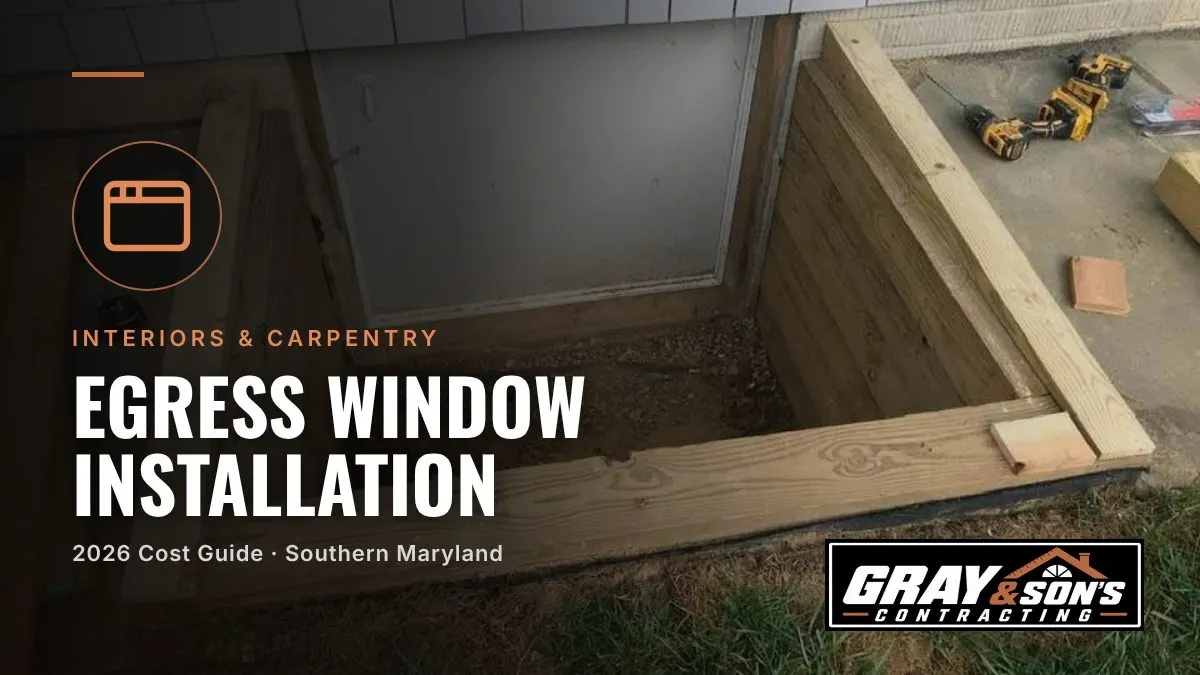
Egress window installation in Southern Maryland costs $2,500 to $7,500 per window in 2026, with most homeowners in Calvert, St. Mary's, and Charles County paying $3,500 to $5,500 for a single egress window with a well, installed in a concrete or block foundation. That price includes cutting the foundation wall, setting the window, excavating and installing the window well, waterproofing, drainage, and all the interior and exterior finish work.
The range is wide because the cost depends on several variables: the type and size of window, the window well material, the soil conditions at the excavation site, the foundation type (poured concrete vs. block), and whether the installation is new (cutting into a solid wall) or a retrofit of an existing smaller window opening. A straightforward installation in stable, well-drained soil on a poured concrete foundation is the low end. A large casement window with a tiered, decorative well in Southern Maryland's notorious clay soil with a high water table is the high end.
This is not a cosmetic upgrade. Egress windows are a life safety requirement. If you are finishing a basement bedroom, converting a below-grade space into habitable living area, or adding a rental unit, Maryland building code requires egress windows, and for good reason. In a fire, an egress window is the way out when the stairs are blocked. In Southern Maryland, where a large percentage of the housing stock has full or partial basements, egress window installation is one of the most common projects that comes with a basement finish.
Here is what egress windows cost in this area, what drives the price, what the code requires, and how to plan the project.
What an Egress Window Is and Why You Need One
An egress window is a window large enough for an adult to climb through and a firefighter in full gear to enter through. It is not just any window, it must meet specific minimum dimensions set by the International Residential Code (IRC), which Maryland adopts.
IRC egress window requirements (Section R310):
| Requirement | Minimum Dimension |
|---|---|
| Minimum net clear opening area | 5.7 square feet |
| Minimum net clear opening height | 24 inches |
| Minimum net clear opening width | 20 inches |
| Maximum sill height above finished floor | 44 inches |
| Window well minimum area (if below grade) | 9 square feet |
| Window well minimum projection from wall | 36 inches |
These are minimums, and they are non-negotiable. The "net clear opening" is the actual usable opening when the window is fully open, not the frame size, not the rough opening, and not the glass area. A window that measures 36 by 24 inches in the frame may or may not meet the 5.7 square foot net clear opening requirement depending on the window type and how much of the frame obstructs the opening when the sash is open.
Every sleeping room (bedroom) in a basement must have an egress window or an egress door. This is not a suggestion, it is code, and it is enforced during inspections. If you finish a basement with a bedroom and no egress window, the space cannot legally be called a bedroom, the inspector will not pass it, and if you sell the house, the listing cannot count it as a bedroom. More importantly, the people sleeping in that room do not have a way out in a fire.
Egress Window Installation Cost by Window Type
Not all egress windows are the same. The window type affects both the purchase price and the installation complexity.
| Window Type | Window Unit Cost | Installed Cost (Complete) | Notes |
|---|---|---|---|
| Sliding (horizontal slider) | $300 to $700 | $2,500 to $4,500 | The most common and economical egress window. Opens by sliding one sash horizontally. Meets egress requirements in larger sizes. Simple operation. |
| Casement (crank-out) | $400 to $1,000 | $3,000 to $5,500 | Hinged on one side, cranks open outward. Provides excellent clear opening relative to frame size, often the best choice for meeting egress minimums. |
| In-swing hopper | $350 to $800 | $2,800 to $5,000 | Hinged at the bottom, swings inward. Good clear opening. Must swing clear of furniture and the well. |
| Awning (top-hinged, pushes out) | $350 to $900 | $2,800 to $5,000 | Hinged at top, pushes out into the well. Can remain open during light rain. Must have sufficient well depth for the sash to swing fully open. |
| Double-hung | $400 to $900 | $3,000 to $5,500 | Traditional look but harder to meet egress minimums, only the bottom sash opens, so the window must be significantly larger to achieve 5.7 sq ft of clear opening. Less common for basement egress. |
The recommendation for most Southern Maryland basements: a casement window is the best choice for egress compliance. Because the entire sash swings open on a hinge, a casement window provides the maximum clear opening relative to its frame size. A 32-by-24-inch casement meets egress requirements, while a slider or double-hung of the same size does not. This means you can cut a smaller opening in the foundation, less concrete to remove, less structural concern, and lower cost.
Sliding windows are the budget option and work well when there is room for a larger opening. They are simpler mechanically and less expensive, but they require a bigger rough opening to meet egress minimums because only half the window opens at a time.
Egress Window Well Types and Costs
If the egress window is below grade, and in a full basement, it almost always is, you need a window well. The well is the excavated area outside the foundation wall that provides the clear space in front of the window, allows light in, and provides the means of escape. The well must meet the same IRC requirements: minimum 9 square feet of area and minimum 36 inches of projection from the wall.
| Well Type | Cost (Installed) | Description |
|---|---|---|
| Corrugated galvanized steel | $200 to $500 | The standard, no-frills option. Semi-circular corrugated metal well bolted or anchored to the foundation wall. Functional, durable, and the most common well type in the Mid-Atlantic. |
| Composite/polycarbonate (tiered) | $500 to $1,500 | Molded wells with a step-out design, tiered "steps" inside the well that serve as a built-in escape ladder. More attractive than metal. Available in stone or earth-tone finishes. |
| Poured concrete or block | $800 to $2,500 | A custom-built masonry well. Expensive, but the most durable and can be sized and shaped to any configuration. Common on high-end homes or where the well must accommodate irregular grading. |
| Prefabricated polyethylene (Bilco, Rockwell, etc.) | $400 to $1,200 | Heavy-duty molded plastic wells. Come in standard sizes with built-in steps. Lighter than masonry, resist rust, and install quickly. A good middle ground between steel and custom concrete. |
Step-out wells vs. ladder wells: If the window sill is more than 44 inches below grade, the IRC requires a permanently attached ladder or steps inside the well. Tiered composite wells with built-in steps eliminate the need for a separate ladder and meet this requirement by design. A corrugated steel well at the same depth needs a bolted-on ladder ($50 to $150) or step rungs. For wells deeper than five feet, common in Southern Maryland homes where the basement floor sits seven to eight feet below grade, a tiered well with steps is the safer and more practical choice.
Window well covers ($50 to $300) are not required by code but are strongly recommended. A polycarbonate or metal grate cover keeps debris, animals, rainwater, and children out of the well. The cover must be operable from the inside without tools or special knowledge, a cover that is screwed or bolted down defeats the purpose of the egress window. Spring-loaded or hinged covers that push open from inside are the standard.
What Drives the Cost in Southern Maryland
Several factors specific to this region push egress window installation costs above or below the averages.
Soil Conditions
This is the biggest regional cost factor. Southern Maryland sits on the Atlantic Coastal Plain, and the dominant soil types, Monmouth, Matawan, and Nanjemoy formation clays, are dense, heavy, and slow to drain. Excavating a window well in this clay is significantly more labor-intensive than digging in sandy or loamy soil. The clay is sticky when wet, rock-hard when dry, and does not come out of the hole easily in either condition.
A window well excavation in clay soil takes roughly 30 to 50 percent longer than the same excavation in well-drained soil, and the backfill must include more drainage gravel to prevent the clay from holding water against the well and the foundation wall. This adds $300 to $800 to the installation cost compared to a home on better-draining soil.
In certain areas, particularly lower-lying neighborhoods in Lusby, Solomons, Chesapeake Beach, and along the Patuxent and Potomac river corridors in St. Mary's County, the excavation may hit the water table. If the hole fills with water during digging, dewatering adds time and cost, and the drainage system around the well must be more robust. A well installation that encounters groundwater typically adds $500 to $1,500 for additional drainage pipe, gravel, and potentially a connection to the home's sump pump system.
Foundation Type
Poured concrete foundations are easier and cheaper to cut. A concrete-cutting contractor uses a diamond-blade wall saw to cut the opening cleanly and precisely. The cut is fast, the edges are clean, and the structural header (if needed) sits on solid concrete. Cutting a poured concrete wall costs $500 to $1,200 for the opening.
Concrete block (CMU) foundations are more common in older Southern Maryland homes, particularly those built before 1985 in places like Mechanicsville, Chesapeake Ranch Estates, Charlotte Hall, and the older subdivisions in Waldorf and La Plata. Block is harder to cut cleanly because it is composed of individual units with mortar joints. The opening must align with the block coursing as closely as possible, and the cut edges must be reinforced to prevent the remaining block from cracking or shifting. Block also requires a lintel (steel angle or reinforced concrete beam) above the opening to carry the load. Cutting a block foundation for an egress window costs $800 to $1,800, roughly 40 to 60 percent more than poured concrete.
Stone or rubble foundations are rare in the tri-county area but exist in some of the oldest homes in Charles County and along the Patuxent. Cutting an egress opening in a stone foundation is a specialty job that requires shoring the wall, carefully removing stone, and building a reinforced frame within the opening. This can cost $2,000 to $4,000 for the opening alone and is not a job for a general contractor without masonry and structural experience.
Waterproofing Requirements
Every egress window well is a potential water entry point. The well collects rainwater, and if that water is not drained away from the foundation, it pools against the window and the foundation wall and eventually enters the basement. Proper waterproofing and drainage are not optional in Southern Maryland.
A standard egress window installation includes a drainage layer of 12 to 18 inches of washed gravel at the bottom of the well, a perforated drain pipe connected to the home's footing drain or sump system, and waterproof flashing and sealant around the window frame where it meets the foundation wall. This drainage work is included in the $2,500 to $7,500 installed cost.
For homes with known water problems, homes in the Chesapeake Bay Critical Area where drainage is more heavily regulated, or homes in low-lying areas with a high water table, the drainage system around the well may need to be more extensive. A dedicated drain line from the window well to the sump pit or to daylight adds $300 to $1,000. A waterproof membrane applied to the exterior of the foundation around the window opening adds another $200 to $500.
Chesapeake Bay Critical Area Regulations
Homes within 1,000 feet of the Chesapeake Bay, its tidal tributaries, or tidal wetlands fall within the Chesapeake Bay Critical Area, and any ground disturbance, including excavating an egress window well, may be subject to additional permitting requirements and environmental review. The Critical Area regulations are administered at the county level by the local planning and zoning departments.
In Calvert County, the Critical Area encompasses much of the Bay-facing shoreline from Chesapeake Beach south through North Beach, Long Beach, Scientists Cliffs, Flag Harbor, and Solomons. In St. Mary's County, the Critical Area runs along the Potomac shoreline through Piney Point, Ridge, and St. George Island and along the Patuxent through Lexington Park and California. In Charles County, the Critical Area includes the Potomac waterfront from Indian Head south through Nanjemoy and Cobb Island.
If your property is in the Critical Area, the permit process for an egress window may take longer and may require a site plan showing the limits of disturbance and stormwater management for the excavation. This does not necessarily increase the installation cost significantly, but it can add two to four weeks to the permit timeline and $200 to $500 in additional permit and review fees.
Permits and Inspections
Egress window installation requires a building permit in all three Southern Maryland counties. The work involves structural modification to the foundation wall (cutting a new opening or enlarging an existing one), which triggers a structural review.
| County | Permit Office | Typical Permit Cost | Inspection Requirements |
|---|---|---|---|
| Calvert County | Department of Planning & Zoning, Prince Frederick | $150 to $400 | Rough framing, final |
| St. Mary's County | Department of Land Use & Growth Management, Leonardtown | $125 to $350 | Rough framing, final |
| Charles County | Department of Planning & Growth Management, La Plata | $150 to $400 | Rough framing, final |
MHIC licensing: Maryland law requires any contractor performing home improvement work exceeding $500 to hold a Maryland Home Improvement Commission (MHIC) license. This is not a suggestion, it is state law, and it is your primary protection as a homeowner. An MHIC-licensed contractor carries the required insurance, contributes to the Home Improvement Guaranty Fund (which reimburses homeowners if a licensed contractor fails to perform), and is subject to oversight by the state. Never hire an unlicensed contractor for egress window work. The foundation cut is structural, the waterproofing is critical, and a botched installation creates both a safety hazard and a water intrusion problem.
New Installation vs. Retrofit: What Is the Difference?
New installation means cutting a new opening in a foundation wall that currently has no window. This is the more expensive option because it involves concrete or masonry cutting, structural reinforcement (a header or lintel above the opening), and full excavation of the window well from scratch.
Retrofit means enlarging an existing basement window opening to meet egress requirements. Many Southern Maryland homes built in the 1970s through 1990s have small, non-egress basement windows, typically 32-by-14-inch or 32-by-18-inch slider windows set in a shallow well. These windows provide some light and ventilation but do not meet egress minimums. Retrofitting involves cutting the foundation below the existing opening to increase the height, widening the opening if needed, and enlarging or replacing the window well.
| Scenario | Typical Cost | Why |
|---|---|---|
| New egress window in a solid foundation wall (no existing window) | $3,500 to $7,500 | Full foundation cut, new header, full well excavation, all new materials |
| Retrofit, enlarging an existing small window to egress size | $2,500 to $5,000 | Less cutting (only extending the opening downward), existing well may be partially usable |
| Retrofit, replacing an existing egress-sized window (window swap only, no structural work) | $800 to $2,000 | No foundation cutting, no excavation. Just the window unit and installation. |
Retrofitting an existing window is typically 20 to 30 percent cheaper than a new installation because part of the opening already exists and the well excavation may only need to be deepened or widened rather than dug from scratch.
However, retrofitting is not always possible. If the existing window is in a corner where the intersecting foundation wall limits how far the opening can be extended, or if the existing window is too high in the wall to achieve the 44-inch maximum sill height without lowering it into the footer zone, a new opening in a different location may be the better option.
The Full Cost Breakdown for a Typical Installation
Here is what a typical new egress window installation costs, line by line, for a Southern Maryland home with a poured concrete foundation and clay soil.
| Component | Cost Range |
|---|---|
| Casement egress window (vinyl, insulated, Low-E glass) | $400 to $1,000 |
| Foundation wall cutting (diamond saw, poured concrete) | $500 to $1,200 |
| Structural header/lintel | $150 to $400 |
| Window well (prefabricated composite with steps) | $500 to $1,200 |
| Well excavation (clay soil, 6 to 8 ft deep) | $400 to $1,000 |
| Drainage gravel (12 to 18 inches at well bottom) | $100 to $250 |
| Drain pipe and connection to footing drain or sump | $150 to $500 |
| Waterproof flashing and sealant | $75 to $200 |
| Interior framing and drywall around window | $200 to $500 |
| Exterior backfill, grading, and landscaping repair | $100 to $400 |
| Window well cover (polycarbonate, operable) | $50 to $300 |
| Permit and inspection | $125 to $400 |
| Total | $2,750 to $7,350 |
For a second window on the same project, the cost per window typically drops by $300 to $800 because the contractor already has equipment on site, the permit covers both windows, and there are efficiencies in doing two cuts and two excavations in sequence. If you need two egress windows for a basement with two bedrooms, expect a total of $5,000 to $12,000 rather than double the single-window price.
When to Install Egress Windows
The Best Season
Fall is an excellent time for egress window installation in Southern Maryland. The ground is still workable (not frozen), the summer thunderstorm season is winding down, and contractors are transitioning from peak summer exterior work (decks, siding, roofing) into a slightly less hectic schedule. September through November gives you dry enough weather for clean excavation and backfill, and the work is complete before winter.
Winter installation is possible, the ground in Southern Maryland rarely freezes deeper than a few inches, and the tri-county area does not see the sustained hard freezes that make excavation impossible in northern states. However, wet winter conditions make clay soil even harder to work with, and the excavation site takes longer to dry out and grade properly.
Spring is also workable but comes with more rain, and contractors are often booked with the rush of spring home improvement projects. If you are planning a basement finish for next year, get the egress windows in this fall so the opening is sealed, waterproofed, and proven before you start framing and finishing the interior.
The Trigger Events
Most egress window installations happen in connection with one of these projects: finishing a basement with a bedroom, converting a basement into a rental or in-law suite, selling a home where a basement "bedroom" was never permitted or does not have proper egress, or an insurance or code compliance issue. If you are finishing a basement, the egress window should be the first thing you install, before framing, insulation, drywall, and flooring, because the foundation cut generates dust and debris, and the excavation outside needs to happen before the interior is enclosed.
Egress Window Maintenance
Egress windows and their wells require minimal but important maintenance to function properly over time.
Keep the well clear of debris. Leaves, mulch, soil, and other debris accumulate in the well and clog the drainage gravel. A well filled with organic debris holds moisture against the foundation, invites insects, and can block the window from opening fully. Clean the well at least twice a year, once after leaf fall and once in spring. In wooded areas common throughout Huntingtown, Dunkirk, Owings, and the northern Calvert County corridor, quarterly cleaning is more realistic.
Check the drain. Pour a bucket of water into the bottom of the well and watch it drain. In well-functioning drainage, the water should disappear into the gravel within a few minutes. If it pools and sits, the drain pipe may be clogged or the gravel may be saturated with fine sediment from the surrounding clay soil. A clogged well drain is a water intrusion problem waiting to happen, and in Southern Maryland, it will happen during the first heavy rain after the drain fails.
Inspect the sealant. The caulk and flashing around the window frame where it meets the foundation wall deteriorates over time, five to ten years for standard polyurethane sealant, longer for high-quality products. Cracked or separated sealant allows water to bypass the window frame and enter the wall. Resealing is a $20 tube of caulk and 30 minutes of work.
Test the window. Open and close the egress window at least twice a year to make sure the hardware operates smoothly. Casement window cranks can corrode in a damp well environment. Lubricate the hinges, crank mechanism, and weatherstripping annually with a silicone-based lubricant.
Check the well cover. Make sure the cover is intact, seated properly, and opens from the inside without tools. A cover that has shifted, cracked, or had something heavy placed on it is a safety hazard, it is the one thing between a person and their escape route in an emergency.
How Egress Windows Affect Home Value
Egress windows add value in two ways: they increase the legal bedroom count of the home, and they transform a dark, uninviting basement into a brighter, more usable space.
A basement bedroom without egress cannot be counted as a bedroom in a real estate listing. In Southern Maryland's market, where median home prices in Calvert and St. Mary's Counties sit in the $350,000 to $450,000 range, adding a legal bedroom to the home can increase its value by $15,000 to $30,000 or more, far exceeding the $3,500 to $5,500 cost of the window installation. The return on investment for egress windows is among the highest of any home improvement project, particularly when the window is part of a basement finish that adds livable square footage.
Beyond the bedroom count, egress windows bring natural light into the basement. A finished basement with natural light feels like living space. A finished basement without it feels like a bunker. The difference in how buyers perceive and value the space is significant.
Frequently Asked Questions
How much does it cost to install an egress window in Southern Maryland? Most homeowners pay $3,500 to $5,500 for a single egress window installation, including the window, foundation cutting, window well, drainage, and finish work. The total ranges from $2,500 for a simple retrofit of an existing window opening to $7,500 for a new installation in a block foundation with difficult soil conditions. A second window on the same project typically costs $300 to $800 less per window due to on-site efficiencies.
Do I need an egress window in my basement? You need an egress window if the basement contains a sleeping room (bedroom). Maryland building code, based on the International Residential Code Section R310, requires every sleeping room below the fourth story to have at least one egress window or egress door. If you are finishing your basement and including a bedroom, the egress window is required. If the basement is used only as a family room, workshop, or storage area with no sleeping room, an egress window is not code-required, but it is still a smart safety investment and a good source of natural light.
What size window qualifies as egress? The window must provide a minimum net clear opening of 5.7 square feet, with a minimum opening height of 24 inches and a minimum opening width of 20 inches. "Net clear opening" is the actual usable opening when the window is fully open, not the frame size. Casement windows are the most efficient at meeting egress requirements because the entire sash opens, giving you maximum clear opening in a smaller frame. A slider or double-hung of the same frame size provides less clear opening because only part of the window opens.
Can I install an egress window myself? This is not a recommended DIY project. The work involves cutting a structural opening in a load-bearing foundation wall, which requires a structural header, proper reinforcement, and an understanding of load paths. The excavation in Southern Maryland clay soil typically requires equipment (a mini-excavator or backhoe), and the drainage and waterproofing must be done correctly to prevent water intrusion for the life of the home. Improper foundation cuts can crack the wall, compromise the structural integrity of the foundation, or void your homeowner's insurance. This is a job for a licensed contractor with experience in foundation work. Beyond the practical reasons, the permit process requires a licensed contractor's involvement for the structural modification, and the installation must pass inspection.
Do I need a permit for an egress window in Calvert, St. Mary's, or Charles County? Yes. Egress window installation involves cutting or modifying the foundation wall, which is a structural change that requires a building permit in all three counties. The permit process typically includes a plan review, a rough framing inspection (after the opening is cut and the header is installed but before the interior is finished), and a final inspection. Permit costs range from $125 to $400 depending on the county and the scope of the project. Properties in the Chesapeake Bay Critical Area may require additional environmental review and a site disturbance plan.
How long does egress window installation take? A single egress window installation typically takes one to two days. Day one covers the foundation cutting, window well excavation, drainage installation, and window setting. Day two covers interior finish work (framing, insulation, drywall around the opening), exterior backfill and grading, and the window well cover. A second window on the same project adds roughly one day. Weather can extend the timeline if the excavation site becomes saturated, a real possibility in Southern Maryland's clay soil during wet periods.
Will an egress window make my basement leak? Not if it is installed correctly. A properly installed egress window with adequate drainage gravel, a functioning drain pipe connected to the footing drain or sump system, waterproof flashing around the frame, and a well cover is not a water entry point. In fact, the drainage system installed with the window well often improves drainage in that section of the foundation compared to the original solid wall with no drainage at all. The risk of leaking comes from poor installation, insufficient drainage gravel, no drain pipe, inadequate sealant, or a well that is not graded to drain away from the house. This is why hiring an experienced contractor and insisting on proper drainage is critical, especially in Southern Maryland's wet, clay-heavy environment.
What is the difference between an egress window and a regular basement window? Size and operability. A regular basement window (the small, narrow slider or hopper commonly found in older Southern Maryland homes) provides light and ventilation but does not meet the IRC's minimum opening requirements for emergency escape. An egress window is specifically sized and configured to allow an adult to climb out and a firefighter to enter. The egress window is larger, opens wider, and is installed with a window well deep and wide enough to stand in. The difference is the difference between a window and an exit.
Ready to add egress windows to your home? Gray & Sons Contracting has 50 years of experience building in Southern Maryland. We understand the soil conditions, drainage requirements, and permit process in Calvert, St. Mary's, and Charles County. Get a Free Estimate