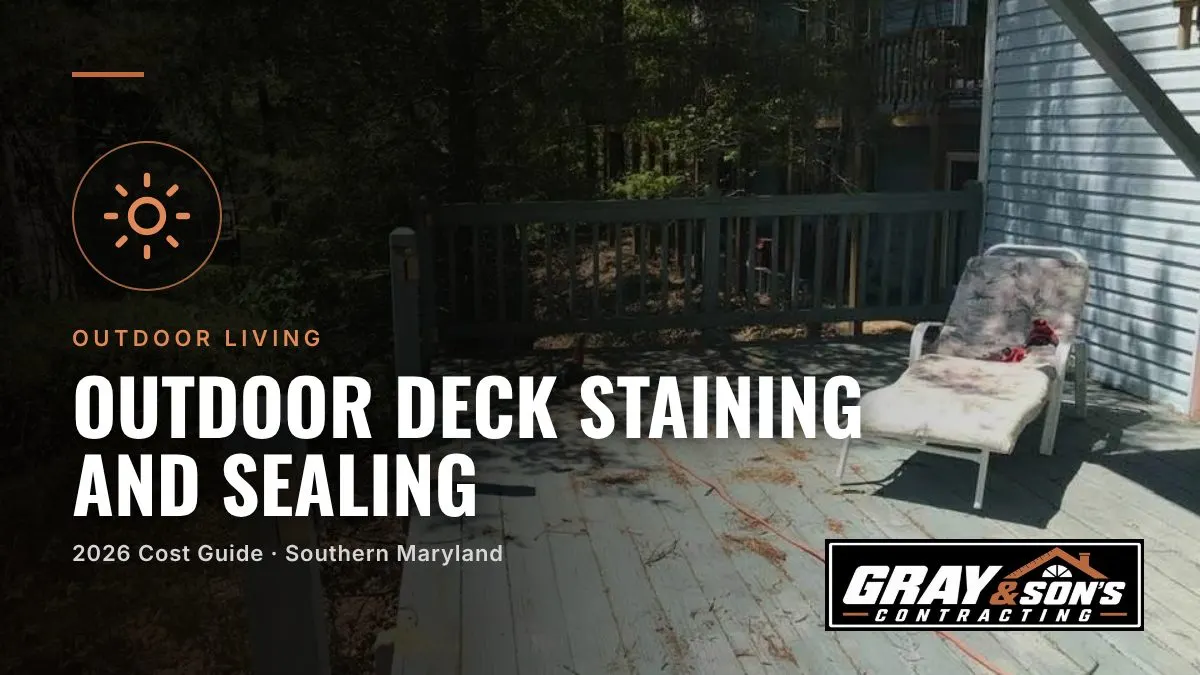
Professional deck staining and sealing in Southern Maryland costs $1 to $3.25 per square foot in 2026, with the national average project coming in around $730. Most homeowners in Calvert, St. Mary's, and Charles County pay between $520 and $980 for a complete staining and sealing job on a standard-sized residential deck. Smaller, straightforward projects, a compact 120-square-foot deck with no repairs needed, can come in as low as $310. Larger decks that require board repairs, extensive prep work, sanding, and a premium stain-and-seal treatment run up to $1,970 or more. If you are looking at sealing alone without stain, expect to pay $550 to $1,285 depending on the deck size and sealer type.
These numbers apply across the tri-county area, whether you are maintaining a pressure-treated pine deck on a townhouse in Waldorf, restoring a cedar deck overlooking the Patuxent in Solomons, or protecting a large composite-and-wood combination deck in Leonardtown. The specific cost depends on the deck's square footage, the condition of the wood, the type of stain you choose, and whether the project includes pressure washing, sanding, or board replacement. Homeowners in Prince Frederick, La Plata, California, Mechanicsville, Lexington Park, Dunkirk, Huntingtown, Chesapeake Beach, and Lusby should all expect pricing within these ranges, with minor variation based on the contractor's travel distance and the particular challenges of the deck.
October is the last practical window for deck staining in Southern Maryland before winter sets in. Daytime temperatures in the tri-county area are holding between 55 and 75 degrees, squarely in the 50-to-80-degree range that stain manufacturers require for proper application and curing. Humidity levels are dropping from summer's peaks, which means the stain absorbs and dries more evenly than it would in July or August. The trees are beginning to shed, and the pollen season that deposits a fine layer of yellow-green dust on every exterior surface in spring is months away. If your deck did not get stained this year, the next two to three weeks are your best remaining opportunity before cold temperatures, rain, and frost make exterior wood finishing impractical until April or May of next year.
This guide covers every aspect of deck staining and sealing costs in the tri-county area: pricing by deck size, stain type comparisons, the difference between staining and sealing, the step-by-step process, additional costs to plan for, DIY versus professional considerations, maintenance schedules, and the regional factors that make Southern Maryland's climate uniquely demanding on exterior wood.
Why Deck Staining and Sealing Matters
An unprotected wood deck in Southern Maryland is under constant assault from three directions: ultraviolet radiation, moisture, and biological growth. Understanding what happens to unfinished wood in this climate explains why regular staining and sealing is not cosmetic vanity, it is structural preservation.
UV radiation from direct sunlight breaks down the lignin in wood fibers, the natural polymer that holds the cell walls together and gives wood its structural rigidity. On a south-facing or west-facing deck in Waldorf or Prince Frederick that receives full afternoon sun, unprotected wood begins to gray and develop surface fibers within 60 to 90 days. Within a year, the surface is weathered to a uniform silver-gray with raised grain, splinters, and surface checking (small cracks that run along the grain). The graying itself is cosmetic, but the underlying fiber degradation weakens the wood surface and makes it more vulnerable to moisture absorption.
Moisture is the more serious threat. Southern Maryland averages 45 to 48 inches of rainfall annually, with an additional 15 to 20 inches of equivalent precipitation from high humidity, fog, dew, and the proximity to the Chesapeake Bay and its tidal rivers. Wood absorbs and releases moisture constantly with changes in humidity and rain exposure. This cycle, swell, shrink, swell, shrink, stresses the wood at a cellular level, opening micro-cracks that allow water to penetrate deeper with each cycle. On an unsealed deck, this moisture cycling leads to cupping (boards that curl at the edges), warping, splitting, and eventually rot. Pressure-treated lumber resists insect damage and ground-contact decay, but it is not immune to surface deterioration, moisture cycling, or mildew growth, it needs protection from the elements just as much as untreated wood.
Mildew and algae thrive in Southern Maryland's warm, humid conditions. The combination of moisture, moderate temperatures, and organic material (pollen, leaf debris, dust) creates an ideal environment for biological growth on wood surfaces. Black mildew stains, green algae films, and moss growth are not just unsightly, they trap moisture against the wood surface, accelerating the decay process. On a deck shaded by trees in Mechanicsville, Lusby, or the wooded neighborhoods of Huntingtown, mildew can establish itself within weeks of the stain wearing off. A quality stain with mildewcide provides a chemical barrier against this growth, keeping the wood surface cleaner and drier between maintenance cycles.
Wood rot is the end-stage consequence of neglect. Once moisture penetrates deep into the wood fibers, through cracks, checks, end grain, and the underside of boards that do not dry properly, fungal decay organisms colonize the wood and begin breaking it down. Soft spots, spongy boards, and structural failure follow. Replacing rotted deck boards costs $10 to $35 per square foot depending on the wood species, compared to $1 to $3.25 per square foot for staining and sealing. Regular staining and sealing is the cheapest form of deck maintenance by a wide margin.
Deck Staining and Sealing Cost by Deck Size
The total cost of a staining and sealing project scales directly with square footage. The per-square-foot rate of $1 to $3.25 accounts for the stain product, labor, surface preparation (cleaning and light sanding), and standard application. The range reflects differences in stain type, wood condition, and project complexity.
| Deck Size (sq ft) | Low Estimate | High Estimate |
|---|---|---|
| 120 sq ft | $120 | $390 |
| 144 sq ft | $144 | $468 |
| 200 sq ft | $200 | $650 |
| 240 sq ft | $240 | $780 |
| 280 sq ft | $280 | $910 |
| 320 sq ft | $320 | $1,040 |
| 400 sq ft | $400 | $1,300 |
A 200-square-foot deck is a common size for a rear-entry deck on a townhouse or starter home in Waldorf, La Plata, or Lexington Park, a 10-by-20-foot rectangle off the sliding door. At the midpoint of the price range, staining and sealing that deck costs approximately $400 to $450. A 320-square-foot deck, roughly 16 by 20 feet, the typical size on a single-family home in Prince Frederick, Dunkirk, or California, runs $500 to $700 with a semi-transparent stain and standard preparation. A large 400-square-foot deck with multiple levels, as you might find on a waterfront property in Chesapeake Beach, Solomons, or Piney Point, falls in the $600 to $1,300 range depending on stain choice and the amount of prep work the wood requires.
These estimates cover the deck floor surface. Railings, balusters, stairs, and built-in benches add additional surface area that increases the total cost. A deck with railings on three sides and a set of stairs typically has 30 to 50 percent more stainable surface area than the floor alone, that 320-square-foot deck may have an effective staining area of 420 to 480 square feet when railings and stairs are included.
Stain Cost by Type: Transparent, Semi-Transparent, and Solid
The type of stain you choose determines the appearance, the level of UV and moisture protection, and how often you will need to restain. Each type has a different pigment concentration, which directly affects how much the wood grain shows through, how much protection the finish provides, and how long the finish lasts before it needs to be reapplied.
| Stain Type | Cost Per Gallon | Pigment Level | Wood Grain Visibility | UV Protection | Typical Lifespan |
|---|---|---|---|---|---|
| Transparent | $21 to $60 | Minimal | Full grain visible | Low | 1 to 2 years |
| Semi-transparent | $25 to $65 | Moderate | Most grain visible | Moderate | 2 to 3 years |
| Solid | $21 to $66 | High (paint-like) | No grain visible | High | 3 to 5 years |
Transparent stains contain very little pigment and allow the full natural grain and color of the wood to show through. They highlight the beauty of high-quality wood species, the rich red tones of cedar, the warm amber of redwood, the dramatic dark grain of ipe. For homeowners who invested in premium decking materials and want to showcase the natural wood character, transparent stain is the aesthetic choice. The trade-off is durability: because transparent stains contain minimal pigment, they provide the least UV protection. In Southern Maryland's sun exposure, particularly on south-facing and west-facing decks, a transparent stain may need to be reapplied every one to two years to maintain its protective quality. On a shaded deck under a tree canopy in Mechanicsville or the wooded lots of Owings and northern Calvert County, a transparent stain lasts somewhat longer because the UV exposure is reduced.
Semi-transparent stains are the most popular choice for residential decks in the tri-county area, and for good reason. They contain enough pigment to provide meaningful UV protection and color enhancement while still allowing the wood grain pattern to show through. The wood looks like wood, you can see the grain, the knots, the character, but the color is enriched and evened out, and the surface has a uniform tonal quality that raw or transparently stained wood does not achieve. Semi-transparent stains typically last two to three years on a horizontal deck surface in Southern Maryland's climate, making them the best balance of appearance, protection, and maintenance frequency for most homeowners. They are available in a wide range of wood-tone colors, natural cedar, honey gold, dark walnut, redwood, weathered gray, that complement the wood species and the home's exterior color palette.
Solid stains are essentially thin exterior paints. They contain a high concentration of pigment that completely covers the wood grain, producing a uniform, opaque color surface. Solid stains provide the highest level of UV protection because the heavy pigment blocks virtually all ultraviolet penetration, and they last the longest, three to five years on a horizontal surface before recoating is needed. They are the best choice for older decks with discoloration, staining, or cosmetic damage that the homeowner wants to conceal, and for pressure-treated lumber that does not have an attractive natural grain worth showcasing. The downside of solid stain is that it builds up on the surface with each application. After two or three coats over the years, the buildup can peel and flake, particularly in areas of heavy foot traffic and moisture exposure, requiring scraping and sanding before the next coat. This makes long-term maintenance of solid-stained decks more labor-intensive and expensive than maintaining a semi-transparent finish.
Oil-Based vs. Water-Based Stains
Within each pigment category (transparent, semi-transparent, solid), stains are formulated as either oil-based or water-based products. The choice between them affects application behavior, drying time, appearance, durability, and environmental compliance.
| Characteristic | Oil-Based Stain ($29 to $84/gal) | Water-Based Stain ($25 to $76/gal) |
|---|---|---|
| Penetration | Deep, absorbs into wood fibers | Surface-level, sits more on top |
| Appearance | Rich, warm, natural look | Slightly flatter, more muted tones |
| Drying time | 12 to 24 hours | 2 to 4 hours |
| Cleanup | Mineral spirits required | Soap and water |
| Odor during application | Strong solvent odor | Minimal odor |
| VOC content | Higher (regulatory limits apply) | Lower, more environmentally friendly |
| Durability on horizontal surfaces | Excellent, wears gradually | Good, may peel if not properly prepped |
| Recoat preparation | Minimal, new coat bonds to old | Previous coat must be fully removed or abraded |
| UV resistance | Good to excellent | Good |
| Mildew resistance | Moderate (improves with additives) | Good (most formulas include mildewcide) |
Oil-based stains have traditionally been the professional's choice for exterior wood finishing because of their superior penetration. An oil-based stain soaks deep into the wood fibers rather than forming a surface film, which means it protects from the inside out. It enhances the natural color and grain of the wood with a warm, rich tone that most homeowners find more attractive than water-based finishes. Oil-based stains also wear more gracefully, they fade gradually and evenly over time rather than peeling or flaking, which makes recoating simpler (in many cases, you can clean the deck and apply a fresh coat directly over the faded previous coat without extensive sanding or stripping). The disadvantages are the long drying time (a concern in Southern Maryland's fall weather when overnight temperatures can drop into the 40s and dew forms early), the strong solvent odor during application, and the cleanup process that requires mineral spirits rather than water.
Water-based stains (also called latex or acrylic stains) have improved dramatically in the past decade and now offer performance that approaches oil-based products in many applications. They dry much faster, two to four hours compared to twelve to twenty-four, which reduces the risk of a ruined finish from unexpected rain or heavy dew, a real concern during October in the tri-county area when afternoon weather can shift quickly. Water-based stains clean up with soap and water, have lower odor, and contain fewer volatile organic compounds, making them the more environmentally friendly option. Many water-based formulations include built-in mildewcide, which is a significant advantage in Southern Maryland's humidity. The primary drawback is that water-based stains do not penetrate as deeply as oil-based products and can form a surface film that is prone to peeling if the wood surface was not properly cleaned and prepared before application.
For most residential decks in Southern Maryland, both formulations perform well when properly applied. Oil-based stains are the better choice for homeowners who prioritize depth of color, natural appearance, and ease of future recoating. Water-based stains are the better choice for homeowners who want faster drying time, easier cleanup, built-in mildew protection, and lower environmental impact. A professional contractor will recommend the appropriate formulation based on the wood species, the deck's sun and weather exposure, and the homeowner's maintenance preferences.
Staining vs. Sealing vs. Both: What Is the Difference
The terms "staining" and "sealing" are often used interchangeably by homeowners, but they are different products that serve different purposes. Understanding the distinction helps you choose the right treatment for your deck and budget.
Sealing is a protective clear coat that repels water without adding color. A clear deck sealer penetrates the wood surface and creates a hydrophobic barrier that causes water to bead on the surface rather than absorb into the wood fibers. Sealers protect against moisture damage, swelling, shrinking, cracking, and rot, but they provide little to no UV protection because they contain no pigment. A sealed deck retains its natural wood color initially, but without UV protection, the wood will still gray over time from sun exposure. Clear sealers are the right choice for new decks made from premium wood species (cedar, redwood, ipe) where the homeowner wants to preserve the natural color for the first season or two before transitioning to a tinted stain. Sealing alone costs $550 to $1,285 depending on deck size and sealer product.
Staining adds color and UV protection through pigment while also providing some degree of moisture resistance. Most quality deck stains include water-repellent ingredients in addition to their pigment, so a good stain provides both color and moisture protection in a single product. However, the moisture protection in a stain is generally not as robust as a dedicated sealer, the stain's primary job is color and UV protection, and its water repellency is a secondary function.
Staining and sealing, applying both products, provides the most comprehensive protection. The stain delivers color, UV blocking, and moderate moisture resistance. The sealer adds an additional layer of water repellency on top of the stain, extending the life of both the stain and the wood. This combination treatment costs more upfront, typically 20 to 40 percent more than staining alone, but it extends the maintenance interval and provides the most complete defense against Southern Maryland's triple threat of sun, rain, and humidity. For decks in high-exposure locations, south-facing decks in open yards in Waldorf and La Plata, waterfront decks in Chesapeake Beach and Solomons, decks in low-lying areas near Breton Bay or St. George Island, the combination treatment is the better long-term investment.
Some modern products combine stain and sealer into a single application, marketed as "stain and sealer" or "stain with waterproofer." These all-in-one products simplify the process and reduce labor costs, but standalone products applied separately generally provide superior individual performance. Your contractor can recommend the best approach based on your deck's specific exposure and condition.
The Deck Staining Process Step by Step
A professional deck staining job is not simply opening a can and brushing on color. Proper preparation is the difference between a finish that lasts three years and one that peels within six months. Here is what the process looks like from start to finish.
Step 1: Inspection and assessment. The contractor walks the deck and evaluates every board, railing post, stair tread, and connection point. They are looking for structural issues (loose boards, popped fasteners, wobbly railings, soft spots that indicate rot), surface conditions (previous stain or sealer residue, mildew staining, graying, raised grain, splinters), and the overall readiness of the wood to accept a new finish. On older decks in the tri-county area, particularly those built in the early 2000s construction boom in Waldorf, White Plains, and the St. Charles communities, this inspection often reveals boards that need replacement and fasteners that need to be reset or replaced before finishing work can begin.
Step 2: Cleaning and pressure washing. The deck is thoroughly cleaned to remove dirt, debris, mildew, algae, old stain residue, and the gray oxidized wood fibers on the surface. Professional deck cleaning typically involves applying a deck cleaning solution (either an oxygen bleach cleaner for general cleaning or a stronger sodium percarbonate solution for heavy mildew and stain removal), allowing it to dwell on the surface for 10 to 15 minutes, and then pressure washing the deck at a controlled pressure setting, typically 1,200 to 1,500 PSI for softwoods (pine, cedar) and up to 2,000 PSI for hardwoods (ipe, mahogany). Pressure washing too aggressively damages the wood fibers, creating a fuzzy, raised surface that does not accept stain evenly. An experienced operator knows the right pressure, nozzle, and distance for each wood species. After pressure washing, the deck must dry completely, typically 48 to 72 hours in Southern Maryland's October weather, before stain application.
Step 3: Sanding (if needed). If the wood surface is rough, splintered, or has raised grain from pressure washing, the deck is sanded with 60- to 80-grit sandpaper to create a smooth, even surface. Sanding also opens the wood pores, allowing the stain to penetrate more deeply and evenly. On decks with heavy existing stain buildup, particularly solid stains that are peeling, mechanical sanding or chemical stripping may be necessary to remove the old finish down to bare wood. Sanding adds $0.50 to $1.50 per square foot to the project cost but is essential for a quality result on decks that need it.
Step 4: Repairs. Damaged boards are replaced, popped nails and screws are reset or replaced with new fasteners, and loose railing connections are tightened. Any structural repairs identified during the inspection are completed at this stage, before the finishing work begins. Repair costs vary widely depending on the extent of the damage and the wood species involved (see the board replacement costs in the additional costs section below).
Step 5: Masking and protection. The contractor masks off areas adjacent to the deck that should not receive stain, the house siding, windows, doors, concrete walkways, plants, and landscaping below the deck. Drop cloths are placed under the deck to catch drips. This step takes 30 to 60 minutes on a typical residential deck and is essential for a clean, professional result.
Step 6: Stain application. The stain is applied using a combination of brushes, rollers, and spray equipment depending on the product, the deck configuration, and the contractor's preferred method. Most professionals use a pump sprayer for the broad deck floor surface (faster coverage, more even application) and follow immediately with a brush or roller to back-brush the stain into the wood grain. Railings, balusters, and detailed areas are typically brush-applied. The stain is applied in thin, even coats, one coat for most semi-transparent stains, two coats for transparent and some solid stains, working in manageable sections to maintain a wet edge and avoid lap marks. The timing of the application is critical: the stain must be applied when the wood is dry, the air temperature is between 50 and 80 degrees, no rain is expected for 24 to 48 hours, and the deck surface is not in direct sunlight (which causes the stain to dry too quickly and prevents proper penetration).
Step 7: Sealer application (if included). If a separate sealer is being applied over the stain, it goes on after the stain has fully cured, typically 24 to 72 hours depending on the product and weather conditions. The sealer is applied in a single thin coat using the same spray-and-back-brush technique as the stain. Over-application of sealer creates a glossy, slippery surface film that is both a safety hazard and an aesthetic problem.
Step 8: Cleanup and final inspection. Drop cloths and masking are removed, overspray is cleaned from adjacent surfaces, and the contractor does a final walk-through to check for missed spots, drips, lap marks, and uneven coverage. The homeowner receives instructions on curing time, typically 24 to 48 hours before foot traffic and 72 hours before placing furniture back on the deck.
Additional Costs to Plan For
The per-square-foot staining cost covers the stain application and standard surface preparation. Several common additions increase the total project cost.
Pressure washing is virtually always required before staining and is sometimes priced separately from the staining work itself. Professional pressure washing labor runs $60 to $120 per hour, or approximately $0.30 to $0.50 per square foot of deck surface. For a 300-square-foot deck, pressure washing adds $90 to $150 to the project if it is not already included in the staining estimate. Some contractors bundle pressure washing into their per-square-foot staining price; others list it as a separate line item. Clarify this when comparing estimates.
Sanding adds $0.50 to $1.50 per square foot when the wood requires it. A 300-square-foot deck that needs full sanding adds $150 to $450 to the project. Not every staining job requires sanding, a deck in good condition with no peeling stain or severe grain damage may only need cleaning before staining. Decks with peeling solid stain, heavy splintering, or rough surfaces from aggressive pressure washing will need sanding for the new stain to adhere properly and look uniform.
Railing and baluster staining adds surface area and labor time that may not be included in the deck floor estimate. Railings are more labor-intensive to stain than flat deck boards because each baluster must be individually coated (by brush, since spray application on balusters wastes product and creates overspray). Railing staining typically adds 25 to 40 percent to the total staining labor cost. If your deck has railings on three sides with balusters and a top rail, the railing staining alone may cost $150 to $400 depending on the linear footage and complexity.
Board replacement is the most variable additional cost. If the inspection reveals rotted, cracked, or structurally compromised boards, they need to be replaced before the deck is stained. Board replacement costs depend entirely on the wood species.
| Wood Species | Replacement Cost Per Sq Ft |
|---|---|
| Pressure-treated pine | $10 to $25 |
| Cedar | $10 to $25 |
| Redwood | $5 to $30 |
| Ipe (Brazilian hardwood) | $10 to $30 |
| Composite decking | $15 to $35 |
Replacing two or three boards on a pressure-treated deck adds $100 to $300 to the project. Replacing a full section of rotted decking, say, 30 square feet of boards at the base of a staircase where water pools, can add $300 to $750 or more. This is why regular staining and sealing is so cost-effective as a maintenance strategy: the $500 to $800 you spend on staining every two to three years prevents the $1,000 to $3,000 board replacement that neglected wood eventually requires.
Stripping old stain is necessary when the existing stain is peeling, flaking, or was applied over an incompatible previous finish. Chemical stripping adds $1 to $3 per square foot to the project, a significant cost that can double the total price. Stripping is most commonly needed on decks that have been coated with solid stain multiple times, where the buildup has begun to peel, or on decks where an oil-based stain was previously applied and the homeowner wants to switch to a water-based product (the two formulations are not directly compatible without removing or thoroughly abrading the old finish).
DIY vs. Professional Deck Staining
Deck staining is one of the exterior home maintenance tasks that a capable homeowner can do, and one of the tasks most frequently done poorly, resulting in wasted time, wasted money on stain that peels within a year, and a deck that looks worse than it did before the project started.
| Factor | DIY | Professional |
|---|---|---|
| Stain cost (stain and supplies only) | $100 to $250 | Included in project price |
| Pressure washer | $50 to $100 rental, or $200 to $400 to buy | Included |
| Total supply cost (stain, cleaner, brushes, rollers, masking, sandpaper) | $321 to $497 | Included |
| Labor cost | $0 (your time) | $300 to $700+ |
| Total project cost (300 sq ft deck) | $321 to $497 | $520 to $980 |
| Time required | 8 to 16 hours over 2 to 3 days | 4 to 8 hours (plus drying) |
| Equipment quality | Consumer-grade | Commercial-grade |
| Warranty on work | None | Typically 1 to 2 year workmanship warranty |
| Risk of damage from improper pressure washing | Moderate to high | Low |
| Risk of stain failure from improper application | Moderate | Low |
The cost savings of DIY are real but more modest than most homeowners expect. The stain, cleaner, sandpaper, brushes, rollers, masking materials, and pressure washer rental (or purchase) total $321 to $497 for a typical project, the supplies alone represent 40 to 60 percent of what a professional charges for the complete job. The savings, in absolute dollars, amount to $200 to $500 on a standard deck, meaningful but not dramatic, especially when weighed against the risks.
The primary risks of DIY deck staining are pressure washing damage (using too much pressure or the wrong nozzle, which gouges the wood fibers and creates a rough surface that accepts stain unevenly), inadequate surface preparation (not cleaning thoroughly enough, not allowing adequate drying time, not sanding when sanding is needed), and application errors (applying too much stain, not maintaining a wet edge, creating lap marks, staining in direct sunlight or when rain is imminent). These mistakes are common, and their consequences, peeling stain, blotchy coverage, damaged wood surface, are expensive to correct. Stripping and restaining a deck that was improperly finished costs more than having it done professionally the first time.
For homeowners in the tri-county area who are comfortable with exterior work, own or are willing to rent a pressure washer, and are willing to invest two to three days in the project, DIY staining is feasible on a deck in good condition that needs straightforward cleaning and a fresh coat of semi-transparent stain. For decks with significant prep needs, peeling old stain, mildew damage, board replacement, heavy sanding, and for homeowners who want a guaranteed, professional-quality result, hiring a contractor is the better value.
How Often to Restain Your Deck
The restaining frequency depends on the type of stain, the wood species, and the deck's exposure to sun, rain, and foot traffic. Southern Maryland's climate, with its high humidity, heavy rainfall, strong summer UV, and freeze-thaw cycling, is more demanding on exterior finishes than drier, milder climates, so restaining intervals here tend to fall at the shorter end of manufacturer estimates.
By stain type: Transparent stains require reapplication every one to two years in this climate. Semi-transparent stains last two to three years on horizontal surfaces and three to four years on vertical surfaces (railings) that receive less direct sun and foot traffic. Solid stains last three to five years before recoating is needed, though the buildup from multiple coats eventually requires stripping, typically after three to four coats over eight to fifteen years.
By wood species: Pressure-treated pine, the most common decking material in the tri-county area, absorbs stain readily and holds it reasonably well, but it is a softer wood that wears faster in high-traffic areas. Expect to restain a pressure-treated deck every two to three years with a semi-transparent stain. Cedar is naturally rot-resistant and has a tighter grain than pressure-treated pine, so it holds stain somewhat longer, two to four years with a semi-transparent product. Ipe and other tropical hardwoods are extremely dense and do not absorb penetrating stains as readily as softer species; they require specialized hardwood stain formulations and typically need recoating every one to two years (the stain sits more on the surface than inside the wood, so it wears off faster from foot traffic).
The water bead test: The simplest way to determine whether your deck needs restaining is to sprinkle water on the surface. If the water beads up and sits on the surface, the existing finish is still repelling moisture effectively. If the water soaks into the wood within 10 to 15 seconds, the finish has degraded and the deck is due for restaining. Perform this test in several locations, the center of the deck where foot traffic is heaviest, the perimeter where exposure is lower, and on the stairs.
Best Time of Year to Stain a Deck in Southern Maryland
The ideal conditions for deck staining are air temperatures between 50 and 80 degrees Fahrenheit, low to moderate humidity, no rain in the forecast for 24 to 48 hours after application, and a dry deck surface. In Southern Maryland's climate, three seasons offer windows that meet these requirements, and one does not.
Spring (April through May) is the most popular time for deck staining in the tri-county area. Temperatures are moderate, the days are getting longer, and homeowners are eager to get outdoor spaces ready for summer. The challenge is spring rain, April and May are among the wettest months in Southern Maryland, and scheduling staining work around rain events can be frustrating. Pollen is another spring concern: the yellow pine pollen that blankets everything in April and early May can settle on wet stain and become permanently embedded in the finish. Wait until after the heavy pollen season (typically mid-May) for the best results.
Early fall (September through mid-October) is the professional's preferred window and the time that produces the most consistent results. Temperatures are ideal, humidity is dropping from summer peaks, pollen is absent, and the weather patterns are generally more stable and predictable than spring. The deck has had all summer for the wood to dry out from spring and summer rains, and the stain has the best conditions for deep penetration and even curing. October is the tail end of this window, by late October, overnight temperatures in the tri-county area regularly drop into the 40s and low 50s, dew forms heavily on morning surfaces, and the shortening days reduce the drying time available before nightfall moisture.
Summer (June through August) is workable but not ideal. Temperatures frequently exceed 85 degrees, which causes stain to dry too quickly on the surface (preventing proper penetration into the wood). Afternoon thunderstorms are a constant scheduling threat. High humidity slows drying and can cause moisture to become trapped beneath the stain film, leading to adhesion problems and milky discoloration in clear finishes. If staining must be done in summer, early morning application (before 10 AM, when the deck surface is cool and shaded) produces the best results.
Winter (November through March) is essentially off-limits for deck staining. Temperatures are too cold for most stain products to cure properly (most require a minimum application temperature of 50 degrees, and many require the temperature to remain above 50 for 24 to 48 hours after application). Rain, snow, frost, and heavy dew prevent the deck surface from being dry enough for stain application. The limited daylight hours also restrict the available working time.
Regional Considerations for Southern Maryland
Deck maintenance in Calvert, St. Mary's, and Charles County involves several factors that are specific to this region and that contractors and homeowners from other areas may not account for.
Chesapeake Bay climate influence. Properties near the bay and its tidal rivers, the Patuxent, the Potomac, the St. Mary's River, Breton Bay, St. George Creek, experience higher humidity, more frequent fog and dew, and salt air exposure that accelerates wood degradation. Salt air is mildly corrosive and draws moisture into wood fibers, increasing the rate of swelling and shrinking cycles. Decks on waterfront properties in Solomons, Chesapeake Beach, North Beach, Scotland, and Piney Point typically need restaining six to twelve months sooner than identical decks in inland locations like Waldorf, La Plata, or Hughesville. Using a marine-grade or salt-resistant stain formulation adds $10 to $20 per gallon over standard products but significantly extends the finish life in these coastal environments.
Tree cover and shade. Many residential properties in the tri-county area, particularly in the established neighborhoods of Huntingtown, Dunkirk, Owings, Mechanicsville, and the rural communities of northern St. Mary's County, have heavy tree cover that shades the deck for most of the day. Shaded decks face less UV damage (transparent and semi-transparent stains last longer) but significantly more mildew and algae growth (the moisture from shade, leaf debris, and reduced air circulation creates ideal conditions for biological growth). On heavily shaded decks, selecting a stain with strong mildewcide protection and ensuring that leaf debris is regularly cleared from the deck surface are more important than maximizing UV protection.
Common wood species in the area. The overwhelming majority of residential decks in Southern Maryland are built with pressure-treated southern yellow pine, it is the most affordable structural lumber available in the region and the default choice for deck construction by most builders. Cedar decks are the second most common, favored for their natural beauty and rot resistance. Composite decking (Trex, TimberTech, Azek) has gained significant market share in new construction over the past decade, particularly in the newer developments in Waldorf, White Plains, and Lexington Park. Composite decking does not require staining (the color is integrated into the material), though it does benefit from periodic cleaning and, in some cases, a UV-protectant sealer. Ipe and other exotic hardwood decks are uncommon in the tri-county area but occasionally appear on high-end waterfront properties.
Humidity and drying times. Southern Maryland's average relative humidity, 60 to 75 percent in fall, higher in summer, affects stain drying times. What a stain manufacturer's label says about drying time ("dry to touch in 2 hours, recoat in 4 hours") assumes moderate humidity conditions. In this region, add 30 to 50 percent to the stated drying times for water-based stains and up to 100 percent for oil-based stains during humid conditions. A professional contractor accounts for this by scheduling application early in the day when humidity is lower and temperatures are rising, allowing maximum drying time before the evening humidity increase and overnight dew formation.
Frequently Asked Questions
How much does it cost to stain and seal a deck in Southern Maryland? Professional deck staining and sealing in the tri-county area costs $1 to $3.25 per square foot in 2026, with most projects falling between $520 and $980 total. A small, simple deck can be done for as little as $310, while a large deck requiring repairs and premium products can reach $1,970 or more. The cost depends on the deck size, the type of stain (transparent, semi-transparent, or solid), whether additional prep work like sanding or board replacement is needed, and whether sealing is done separately or as part of a combination stain-and-seal product.
Can I stain my deck in October in Southern Maryland? Yes, early to mid-October is one of the best times to stain a deck in this region. Daytime temperatures are typically 55 to 75 degrees, well within the 50-to-80-degree window that stain products require for proper application and curing. Humidity is lower than summer, pollen is absent, and rain frequency is generally lower than in spring. The key is timing: monitor the weather forecast and ensure that no rain is expected for at least 24 to 48 hours after application, and that overnight temperatures remain above 50 degrees during the curing period. By late October, as overnight temperatures regularly drop into the 40s, the staining window closes.
Should I stain my deck or seal it? The answer depends on what your deck needs. If you want to add or change the color of the wood and protect against UV damage, use a stain. If your deck has good color and you just want to protect it from moisture, a clear sealer is sufficient. For the most comprehensive protection in Southern Maryland's demanding climate, a combination treatment, staining for color and UV protection, followed by sealing for maximum water repellency, provides the best results and the longest maintenance interval. For most homeowners, a quality semi-transparent stain with built-in waterproofing is the best single-product choice that balances color, protection, and value.
How long does deck stain last in Southern Maryland's climate? In this region's combination of high humidity, heavy rainfall, strong UV, and freeze-thaw cycling, expect transparent stains to last one to two years, semi-transparent stains to last two to three years, and solid stains to last three to five years on horizontal deck surfaces. Vertical surfaces (railings, posts) receive less direct weathering and typically last one to two years longer than the deck floor. Waterfront properties with salt air exposure may need restaining six to twelve months sooner than inland properties.
Is it worth paying a professional to stain my deck? For a typical 300-square-foot deck, the cost difference between DIY ($321 to $497 in supplies) and professional ($520 to $980 including all labor and materials) is $200 to $500. The professional advantage is equipment quality, surface preparation expertise, product knowledge, and a workmanship warranty. The most common DIY mistakes, pressure washer damage, inadequate surface prep, application errors, and poor timing around weather, result in premature stain failure that requires stripping and redoing the work, which costs more than hiring a professional from the start. For homeowners who are experienced with exterior finishing and have the time to invest, DIY can save money. For everyone else, professional application is the better value over the life of the finish.
Do I need to strip my deck before restaining? Not always. If the existing stain has faded but is not peeling or flaking, and you are recoating with the same type of stain (oil-based over oil-based, or water-based over water-based), a thorough cleaning and light sanding is usually sufficient preparation for the new coat. If the existing stain is peeling, flaking, or you are changing stain types (oil to water or vice versa), the old finish must be stripped down to bare wood before the new stain is applied. Stripping adds $1 to $3 per square foot to the project cost. Your contractor will assess the existing finish condition during the initial inspection and advise whether stripping is necessary.
What is the best stain for pressure-treated wood in Southern Maryland? A semi-transparent, oil-based or high-quality water-based stain is the best all-around choice for pressure-treated decks in this region. Semi-transparent stains provide meaningful UV and moisture protection while allowing the wood grain to show, and their two-to-three-year maintenance cycle strikes the right balance between protection and convenience. Pressure-treated lumber should be allowed to dry and weather for three to six months after installation before the first stain application, new pressure-treated wood contains moisture from the treatment process that prevents stain from penetrating properly. If your deck was built this past spring or summer and has not been stained yet, the wood should be ready for its first coat by now.
Ready to protect your deck before winter? Gray & Sons Contracting stains and seals decks throughout Calvert, St. Mary's, and Charles County, from compact townhouse decks in Waldorf and La Plata to large multi-level decks in Prince Frederick, Dunkirk, and Leonardtown to waterfront decks in Chesapeake Beach, Solomons, and along the Potomac. We handle the complete process, inspection, pressure washing, surface preparation, repairs, staining, and sealing, using professional-grade products matched to your wood species, your deck's exposure, and Southern Maryland's demanding climate. October is the last window before winter, schedule now while conditions are ideal. Get a Free Estimate