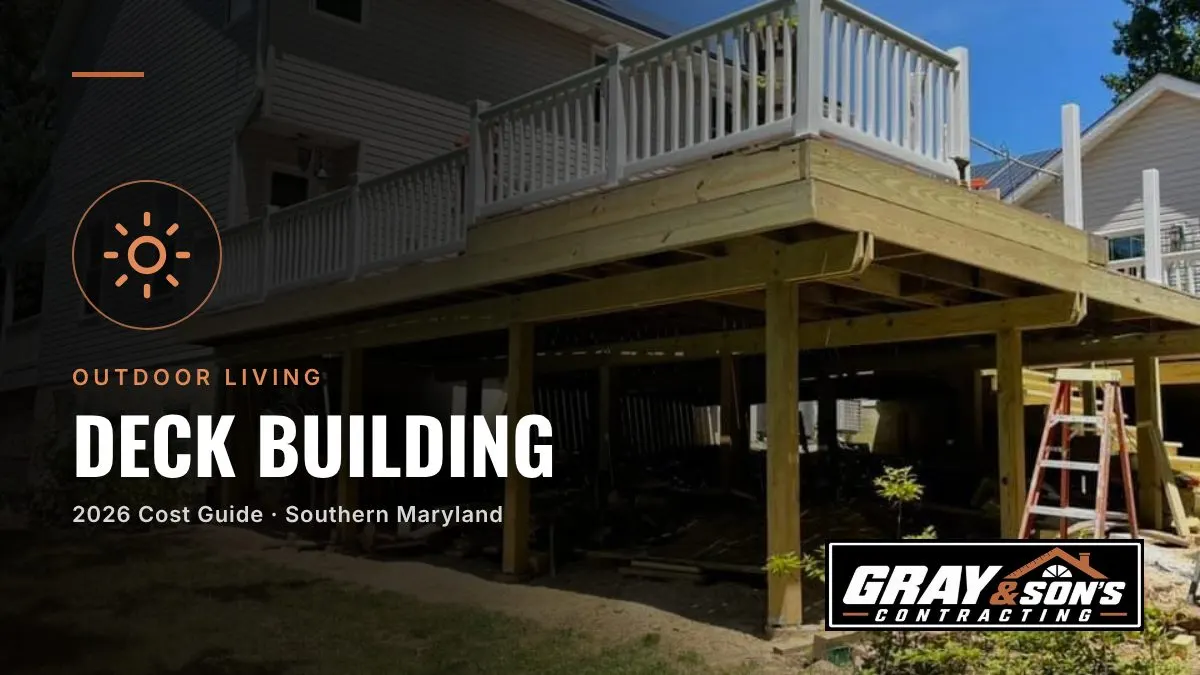
Building a deck in Southern Maryland costs $4,500 to $22,000 in 2026, with most homeowners paying between $8,000 and $16,000 for a standard 200 to 320 square foot deck. The final number depends on three things: the material you choose, the size of the deck, and how complicated the build is. A basic 12x16 pressure-treated wood deck on a flat lot in Waldorf is a fundamentally different project than a second-story composite deck overlooking the Patuxent River in Solomons, and the price reflects that.
Southern Maryland is outdoor living territory. The Chesapeake Bay, the Patuxent and Potomac rivers, and the region's wooded rural character mean that homeowners in Calvert, St. Mary's, and Charles County use their decks more months of the year than most people realize. From March through November, a deck is a second living room, where the crabs get picked, where the grill runs on weekends, where the morning coffee happens from spring through fall. The mild winters, with only 15 to 25 nights below freezing, mean that even December and January see deck use on warm afternoons. That extended season makes a well-built deck one of the highest-value improvements a homeowner in this region can make. It also means the deck needs to be built for humidity, rain, clay soil, and, for waterfront properties, salt air.
Fall is the smartest time to plan and book a deck project. Most homeowners start thinking about decks in March and April, which means contractors are booked solid by May. If you contact a builder in September or October, you get two advantages: you lock in a spot on the spring schedule before the rush, and you use the winter months as design time, choosing materials, finalizing the layout, pulling permits, and ordering materials so that construction starts as soon as the ground thaws. Some builders, including us, offer off-season pricing for projects booked in fall and winter for spring construction. The homeowners who plan in September build in April. The ones who call in April build in August.
Deck Cost by Material
The decking material is the single biggest factor in your total project cost. It determines the upfront price, the long-term maintenance cost, and how the deck holds up in Southern Maryland's climate.
Pressure-Treated Lumber
Pressure-treated pine is the most common decking material in Southern Maryland and across the Mid-Atlantic. It costs $2 to $5 per square foot for materials alone and $15 to $35 per square foot for labor, with a total installed cost of approximately $30 to $45 per square foot. For a 300 square foot deck, that means $9,000 to $13,500 all in.
Pressure-treated lumber is affordable, strong, and readily available at local lumberyards and suppliers in Prince Frederick, Waldorf, and Leonardtown. The wood is treated with preservatives that resist rot and insect damage, important in Southern Maryland, where termites and carpenter ants are active from April through October and the humidity keeps wood damp longer than in drier climates.
The tradeoff is maintenance. Pressure-treated wood needs staining or sealing every two to three years to prevent cracking, warping, and graying. It splinters as it ages, which matters if the deck gets heavy barefoot traffic. And while the preservative treatment resists rot, it does not prevent it entirely, a pressure-treated deck that goes unsealed in this climate will show significant deterioration within seven to ten years.
Cedar
Cedar costs $3 to $7 per square foot for materials, with a total installed cost of approximately $35 to $50 per square foot. A 300 square foot cedar deck runs $10,500 to $15,000 installed.
Cedar is naturally resistant to rot and insects without chemical treatment, which appeals to homeowners who want a more natural product. It has a warm, reddish-brown color when new that grays gracefully over time if left unstained. Cedar is also lighter and softer than pressure-treated pine, making it more comfortable underfoot but more susceptible to denting and surface damage.
Cedar requires the same staining and sealing schedule as pressure-treated wood, every one to two years to maintain the color, or you let it weather to silver-gray. In Southern Maryland's humidity, cedar that goes unmaintained develops mold and mildew faster than it would in a drier climate.
Composite (Trex, TimberTech, Fiberon)
Composite decking costs $12 to $22 per square foot for materials and runs approximately $40 to $60 per square foot installed. A 300 square foot composite deck costs $12,000 to $18,000 all in.
Composite is the fastest-growing material choice in the Southern Maryland market, and for good reason. It is made from a blend of wood fibers and recycled plastic, capped with a protective polymer shell that resists fading, staining, scratching, and moisture. It does not splinter, does not need staining, and does not rot. The major brands, Trex, TimberTech, and Fiberon, offer 25-year to limited-lifetime warranties on their capped composite lines.
For homeowners in Calvert, St. Mary's, and Charles County, composite solves the biggest problem with wood decking in this climate: maintenance. A composite deck needs only an annual wash, no staining, no sealing, no sanding. In a region where the humidity feeds mold growth and the summer heat bakes unprotected wood, that is a significant practical advantage.
The downside is the upfront cost. Composite materials are two to four times the price of pressure-treated lumber. The framing underneath is still pressure-treated wood regardless of the decking material, so the structural cost is the same, the premium is entirely in the surface boards and the railing system.
PVC / Vinyl
PVC decking costs $15 to $25 per square foot for materials, with a total installed cost of approximately $45 to $65 per square foot. A 300 square foot PVC deck runs $13,500 to $19,500 installed.
PVC (polyvinyl chloride) decking is entirely synthetic, no wood fibers. Brands like Azek and TimberTech AZEK are the leading products. PVC is lighter than composite, completely waterproof, and resists mold and mildew better than any other decking material. It does not absorb moisture at all, which makes it the premium choice for waterfront decks along the Chesapeake Bay, the Patuxent River, and the St. Mary's River where moisture exposure is constant.
PVC can feel less natural underfoot than composite or wood, and it expands and contracts more with temperature changes, which requires careful gapping during installation. It is also the most expensive mainstream decking option.
Exotic Hardwood (Ipe)
Ipe and other tropical hardwoods cost $10 to $20 per square foot for materials, with a total installed cost of approximately $50 to $75 per square foot. A 300 square foot ipe deck runs $15,000 to $22,500 installed.
Ipe (pronounced EE-pay) is extraordinarily dense and hard, it is naturally resistant to rot, insects, fire, and moisture without any chemical treatment. An ipe deck can last 40 to 75 years with minimal maintenance. The wood has a deep, rich brown color that is visually striking.
The drawbacks are cost, weight (ipe is nearly twice as heavy as pressure-treated pine, which can affect structural requirements), and difficulty of installation. Ipe is so dense that every fastener hole must be pre-drilled, and standard carbide-tipped saw blades dull quickly cutting it. These factors increase labor costs significantly.
Material Comparison Table
| Material | Material Cost ($/sq ft) | Installed Cost ($/sq ft) | 300 Sq Ft Deck (Total) | Maintenance | Lifespan |
|---|---|---|---|---|---|
| Pressure-treated lumber | $2 to $5 | $30 to $45 | $9,000 to $13,500 | Stain/seal every 2-3 years | 15 to 25 years |
| Cedar | $3 to $7 | $35 to $50 | $10,500 to $15,000 | Stain/seal every 1-2 years | 15 to 20 years |
| Composite | $12 to $22 | $40 to $60 | $12,000 to $18,000 | Annual cleaning only | 25 to 50 years |
| PVC / Vinyl | $15 to $25 | $45 to $65 | $13,500 to $19,500 | Annual cleaning only | 30 to 50 years |
| Exotic hardwood (Ipe) | $10 to $20 | $50 to $75 | $15,000 to $22,500 | Oil every 1-2 years (optional) | 40 to 75 years |
Deck Cost by Size
The size of the deck is the second biggest cost driver. Larger decks cost more in total but less per square foot because the fixed costs, footings, permits, mobilization, stairs, are spread across more area.
| Deck Size | Square Footage | Cost Range |
|---|---|---|
| 10 x 10 | 100 sq ft | $3,000 to $6,000 |
| 10 x 12 | 120 sq ft | $3,600 to $7,200 |
| 12 x 16 | 192 sq ft | $5,800 to $11,500 |
| 12 x 20 | 240 sq ft | $7,200 to $14,400 |
| 14 x 20 | 280 sq ft | $8,400 to $16,800 |
| 16 x 20 | 320 sq ft | $9,600 to $19,200 |
| 20 x 20 | 400 sq ft | $12,000 to $24,000 |
The low end of each range reflects a simple, ground-level pressure-treated wood deck. The high end reflects composite or PVC materials, elevated construction, and additional features like built-in benches or multi-level design. Most decks in Southern Maryland fall in the 200 to 320 square foot range, enough room for a dining table, a grill station, and seating.
Cost Breakdown: What You Are Paying For
A deck project involves more than lumber and screws. Here is where the money goes on a typical deck build in Calvert, St. Mary's, or Charles County.
| Component | Percentage of Total | Notes |
|---|---|---|
| Decking materials | 40% to 50% | Surface boards, the biggest material line item |
| Framing and structural lumber | 15% to 20% | Joists, beams, ledger board (always pressure-treated) |
| Footings and foundation | 10% to 15% | Concrete footings, post bases, excavation |
| Railing and balusters | 10% to 15% | Wood, composite, or metal railing systems |
| Stairs | $1,000 to $3,000 | Depends on height and number of landings |
| Hardware (joist hangers, screws, bolts) | 3% to 5% | Structural connectors, fasteners, flashing |
| Permits | $200 to $500 | Varies by county and project scope |
| Design / engineering (if needed) | $500 to $2,000 | Required for elevated decks, complex designs, Critical Area |
| Labor | $15 to $35/sq ft | Framing, decking, railing, stairs, finishing |
On a $12,000 deck project, roughly $5,000 to $6,000 is materials, $4,000 to $5,000 is labor, and the remainder covers permits, hardware, footings, and overhead. The material-to-labor ratio shifts based on the decking material, a composite deck has a higher material cost and the same labor cost, so materials become 50 percent or more of the total.
What Affects Deck Cost in Southern Maryland
Southern Maryland has specific conditions that affect deck construction, costs, and material choices. A builder who works in this region every day accounts for these factors in their estimates. A builder coming from the DC metro market or the Eastern Shore may not.
Soil and Foundation Requirements
Southern Maryland sits on clay-heavy soils, the Mattapex, Sassafras, and Westphalia soil series that dominate Calvert, St. Mary's, and Charles County. Clay soil expands when wet and contracts when dry, which puts lateral pressure on deck footings and can shift posts over time if the footings are undersized or too shallow.
The frost line in Maryland is 30 inches. That means every deck footing must extend at least 30 inches below grade to prevent frost heave, the expansion of frozen groundwater pushing the footing upward during winter. This is code, not a suggestion. A footing poured at 18 inches might hold fine through the summer, but the first hard freeze will push it up and tilt the deck.
Homes near the Chesapeake Bay, the Patuxent River, or the Potomac River may sit on sandy or marshy soils that present different challenges. Sandy soil drains well but provides less bearing capacity, meaning footings may need to be larger in diameter. Marshy or saturated soils near the water, common in low-lying areas around Solomons, Broomes Island, and parts of Piney Point, may require engineered helical pilings instead of standard concrete footings. Pilings add $1,500 to $5,000 or more to the foundation cost depending on soil conditions and the number required.
Chesapeake Critical Area Regulations
Properties within 1,000 feet of the Chesapeake Bay or any of its tidal tributaries, and that includes the Patuxent River, the St. Mary's River, and the tidal portions of dozens of smaller creeks across the three counties, fall under the jurisdiction of Maryland's Critical Area Commission.
Deck construction in the Critical Area often requires additional environmental review beyond the standard building permit. Depending on the property's classification (Intensely Developed Area, Limited Development Area, or Resource Conservation Area), the requirements may include expanded environmental buffers, stormwater management plans, impervious surface calculations, and in some cases, mitigation plantings or offsets for the new impervious area the deck creates.
This adds $500 to $2,000 or more in permitting, environmental review, and engineering costs and can extend the project timeline by four to eight weeks while the application moves through review. It does not mean you cannot build, it means the process takes longer and costs more, and you need a contractor who has been through it before and knows what each county's Critical Area office expects.
Elevation and Second-Story Decks
Many Southern Maryland homes are built on sloped lots or raised foundations, especially in flood zones near the water and in the rolling terrain of northern Calvert County around Huntingtown, Dunkirk, and Owings. Walk-out basements are common, and the rear of the house is often a full story above grade.
Second-story decks cost 50 to 75 percent more than ground-level decks of the same footprint. The additional cost comes from longer posts (often 10 to 14 feet instead of 2 to 4 feet), diagonal bracing for lateral stability, more complex beam connections, deeper or more robust footings to handle the increased load and wind exposure, and more complex stair systems, a second-story deck may need a staircase with one or two landings instead of a simple three-step stairway.
A 300 square foot ground-level pressure-treated deck that costs $10,000 at grade level might cost $15,000 to $17,500 as a second-story structure on the same lot.
Salt Air and Moisture Exposure
Waterfront properties along the Chesapeake Bay, the Patuxent, and the Potomac face accelerated corrosion from salt air. Standard galvanized hardware, joist hangers, post bases, carriage bolts, lag screws, corrodes faster in a salt-air environment than manufacturers' warranties typically cover. Within a mile of tidal water, stainless steel hardware is not a luxury; it is a necessity. The cost premium for stainless steel fasteners and connectors over galvanized is $300 to $800 on a typical deck project, a small price compared to the cost of replacing corroded structural hardware five years into the deck's life.
Salt air also affects material selection. Pressure-treated pine holds up reasonably well but requires more aggressive staining and sealing to resist moisture intrusion. Composite and PVC decking handle salt air better than wood because the capped surface does not absorb moisture. Ipe, with its natural density and oil content, is naturally resistant and is a popular choice for high-end waterfront homes in communities like Chesapeake Beach, North Beach, and Solomons.
Permit Requirements by County
All three Southern Maryland counties, Calvert, Charles, and St. Mary's, require building permits for deck construction. The permit process is straightforward but non-negotiable.
Calvert County: permits are handled through the Department of Planning and Zoning in Prince Frederick. Deck permits require a site plan showing the deck's location relative to property lines and setbacks, a structural plan or drawing, and footing details. Permit fees typically run $200 to $400 depending on the project's valuation. Inspections include footings (before pouring concrete), framing, and final.
Charles County: permits go through the Department of Planning and Growth Management in La Plata. Requirements are similar, site plan, construction drawings, footing details. Charles County also reviews for zoning compliance, including setbacks and lot coverage limits.
St. Mary's County: permits are processed through the Department of Land Use and Growth Management in Leonardtown. The permit process includes review against the county's building code requirements, setback verification, and inspection at key construction stages.
In all three counties, expect the permit process to take one to three weeks from application to approval for a standard residential deck. More complex projects, elevated decks, decks in the Critical Area, decks requiring engineered plans, take longer.
A contractor who tells you a permit is not needed for a new deck is wrong. Even a ground-level deck attached to the house requires a permit in all three counties. Freestanding decks under a certain height may be exempt in some cases, but the exemptions are narrow and specific. Get the permit. It protects you at inspection and at resale.
Pressure-Treated Wood vs. Composite: The Real Comparison
This is the decision most homeowners in Southern Maryland wrestle with, so it deserves a thorough breakdown.
Upfront Cost
A 300 square foot pressure-treated wood deck with standard railing costs approximately $9,000 to $13,500 installed. The same deck in composite (Trex Enhance or TimberTech Pro, mid-range lines) costs $12,000 to $18,000. That is a $3,000 to $5,000 premium for composite.
20-Year Total Cost of Ownership
This is where the comparison shifts. A pressure-treated wood deck needs staining or sealing every two to three years. Professional staining costs $550 to $1,250 per application for a 300 square foot deck, or $150 to $400 in materials if you do it yourself plus a weekend of labor.
Over 20 years, that is seven to ten staining cycles. At a conservative $700 per professional application, that adds $4,900 to $7,000 in maintenance costs. Add in board replacements ($100 to $500 each for warped, split, or rotted boards, expect to replace five to fifteen boards over 20 years in this climate), and the 20-year cost of a pressure-treated deck reaches $16,000 to $25,000.
A composite deck over the same 20 years costs the initial $12,000 to $18,000 plus annual cleaning at $100 to $200, a total of $14,000 to $22,000 over two decades.
The 20-year cost is roughly equal. Composite costs more upfront and less over time. Wood costs less upfront and more over time. The difference is that composite delivers those savings passively, you do nothing and the deck stays in good shape, while wood requires active maintenance every two to three years.
Durability in Southern Maryland's Climate
Southern Maryland's combination of high humidity, heavy rainfall, hot summers, and freeze-thaw cycling in winter is hard on wood decks. The moisture feeds mold and mildew. The heat and UV exposure dry and crack unprotected wood. The freeze-thaw cycles split boards that have absorbed water in the fall.
Composite decking handles all of these conditions better than pressure-treated wood. The capped polymer surface does not absorb water, does not support mold growth on the surface (mold sits on top and washes off), and does not crack from freeze-thaw exposure. Composite boards do get hot in direct sun, noticeably hotter than wood, which matters for barefoot comfort in July and August.
Appearance and Feel
Early composite decking (from the early 2000s) looked plastic and faded badly. Current-generation capped composite from Trex, TimberTech, and Fiberon is dramatically better, the grain patterns, color variation, and matte finish closely replicate the look of real wood. Most visitors will not realize a modern composite deck is not hardwood unless they are told.
Pressure-treated wood, when freshly stained, has a warmth and natural beauty that composite approximates but does not fully match. However, pressure-treated wood that has gone two years past its last staining looks gray, weathered, and rough, and that is what most wood decks in the region look like most of the time because homeowners delay maintenance.
Resistance to Rot, Insects, and Moisture
Pressure-treated wood resists rot and insects, that is the purpose of the treatment, but it does not eliminate the risk entirely. The preservative treatment (micronized copper azole, or MCA, is the current standard) penetrates the outer layers of the wood but not always the core. Cuts, drill holes, and end grain expose untreated wood, which is why field-applied preservative on every cut end is important.
Composite decking does not rot and is not food for insects. End of comparison on this point.
Environmental Considerations
Composite decking is made in part from recycled materials, Trex, for example, uses approximately 95 percent recycled content (reclaimed wood fiber and recycled polyethylene). This appeals to environmentally conscious homeowners. However, composite decking is not recyclable at end of life, it goes to a landfill when the deck is eventually demolished.
Pressure-treated wood uses chemical preservatives. Older CCA-treated wood (discontinued for residential use in 2004) contained arsenic. Current MCA-treated wood does not, but it is still chemically treated lumber that should not be burned and has disposal considerations.
Neither option is a clear environmental winner. Both are significantly better than exotic hardwoods harvested from tropical forests, unless the hardwood is FSC certified.
Resale Value
Both wood and composite decks add value to a home. However, home buyers increasingly prefer composite because they understand the maintenance difference. A well-maintained wood deck and a composite deck of similar size and age add roughly the same value, but the composite deck is far more likely to be in good condition because it did not depend on the seller keeping up with staining.
The Bottom Line on This Comparison
Composite costs more upfront but delivers lower long-term costs, zero staining maintenance, and better durability in Southern Maryland's climate. For homeowners who plan to stay in their home for 10 or more years, composite is usually the better financial decision. For homeowners on a tight budget who want a deck now and are willing to maintain it, pressure-treated wood remains a solid, proven choice.
Deck Features That Add Cost
The base deck, a flat platform with railing and stairs, is the starting point. These are the additions that turn a basic deck into an outdoor living space, with their typical cost ranges in this market.
| Feature | Cost Range |
|---|---|
| Built-in benches | $500 to $2,000 |
| Pergola or shade structure | $3,000 to $10,000 |
| Built-in lighting (post cap, riser, rail) | $500 to $3,000 |
| Outdoor electrical outlets | $150 to $350 each |
| Screened-in section | $3,000 to $12,000 |
| Hot tub pad (reinforced framing) | $1,000 to $3,000 additional structural |
| Built-in planters | $200 to $800 |
| Wrap-around or multi-level design | Adds 30% to 50% to total cost |
Built-in lighting is one of the highest-value additions relative to its cost. Low-voltage LED post cap lights, riser lights, and rail lighting transform a deck after dark and extend usable hours well into the evening. A complete lighting package with a transformer and wiring runs $500 to $3,000 depending on the number of fixtures, and it costs significantly less to install during construction than to retrofit later.
Screened-in sections are popular in Southern Maryland for an obvious reason: mosquitoes. The marshy areas along the Bay and rivers produce aggressive mosquito populations from May through September. A screened section of the deck, even a 10x12 area, provides a bug-free outdoor space that gets heavy use during peak mosquito season. The cost ranges from $3,000 for a simple screened enclosure added to an existing roof overhang to $12,000 or more for a fully framed and roofed screened porch integrated into the deck design.
Hot tub pads require structural reinforcement because a filled hot tub weighs 3,000 to 5,000 pounds. The deck framing in the hot tub area needs closer joist spacing (12 inches on center instead of 16), larger beams, and potentially additional footings. The reinforcement adds $1,000 to $3,000 to the structural cost, on top of the cost of the hot tub itself.
Multi-level decks and wrap-around designs are common on Southern Maryland homes where the grade changes significantly from one side of the house to the other. Splitting the deck into two or three levels connected by short stair sections follows the terrain naturally and creates distinct zones for dining, lounging, and cooking. The added complexity, separate footings for each level, additional framing, transitions between levels, increases the cost by 30 to 50 percent over a single-level deck of the same total square footage.
Does a Deck Add Value to Your Home?
A deck is one of the best-returning exterior improvements you can make. According to the National Association of Realtors, a wood deck recoups approximately 89 percent of its cost at resale, higher than most kitchen and bathroom remodels on a percentage basis. A $15,000 deck adds approximately $13,000 to the home's resale value.
In Southern Maryland's housing market, a deck is not a bonus feature, it is an expectation. Homes without usable outdoor living space are at a measurable disadvantage. Buyers touring homes in Chesapeake Ranch Estates, Wildewood, Lexington Park, Huntingtown, and the subdivisions around Waldorf and La Plata expect a deck or patio as standard. A home without one sits longer and sells for less than comparable homes with one.
Composite decks are increasingly preferred by buyers because they understand the maintenance difference. A real estate agent listing a home with a five-year-old composite deck does not have to explain away peeling stain or grayed wood. The deck looks the way it did when it was built.
The ROI calculation is strongest for homes in the $250,000 to $500,000 range, the core of the Southern Maryland market. A $12,000 to $16,000 deck on a $350,000 home is proportional and adds functional living space that buyers value. A $40,000 deck on a $300,000 home is overbuilt relative to the market and will not recoup the full cost at resale.
Deck Maintenance Costs
Every deck requires some level of ongoing maintenance, but the cost and effort vary enormously by material.
Pressure-Treated Wood
- Staining and sealing: $550 to $1,250 every two to three years (professional application for a 300 square foot deck). This includes cleaning, light sanding if needed, and two coats of stain or sealant. DIY cost is $150 to $400 in materials plus a full weekend.
- Annual cleaning: $100 to $300 for a professional power wash, or do it yourself with a rented pressure washer ($50 to $100 per day).
- Board replacement: $100 to $500 per board installed, depending on the board location and lumber cost. Plan on replacing a few boards every five to seven years as individual boards crack, warp, or develop soft spots.
Cedar
- Staining and sealing: Every one to two years. Same cost range as pressure-treated: $550 to $1,250 professional, $150 to $400 DIY. Cedar requires more frequent attention than pressure-treated to maintain its appearance, though it weathers attractively if you prefer the silver-gray patina.
- Annual cleaning: Same as pressure-treated.
Composite
- Annual cleaning: $100 to $200 professional, or do it yourself with a garden hose, a bucket of soapy water, and a soft brush. No staining. No sealing. No sanding. This is the core selling point of composite.
- Board replacement: Rare, but possible if a board is physically damaged. Replacement composite boards cost $100 to $300 each installed.
General Maintenance for All Decks
- Hardware inspection: Check the structural connections (joist hangers, post bases, ledger board fasteners) annually. Tighten loose bolts. Replace any corroded hardware. This is especially important for waterfront decks in the salt-air environment.
- Railing tightening: Railings loosen over time from the lateral loads of people leaning against them. Re-secure loose railing posts annually.
- Gutter and drainage check: Make sure water is draining away from the deck footings and the house. Standing water at the base of deck posts accelerates rot in the buried portion of the post or the base of the post bracket.
How to Hire a Deck Builder in Southern Maryland
Get Three or More Quotes
Collect at least three written, itemized estimates. Compare what is included in each, the cheapest quote often leaves out items that the other quotes include (stair railing, post caps, permits, final grading). An itemized estimate should list materials, labor, permits, and any subcontracted work (electrical for lighting, excavation for footings) as separate line items.
Verify the MHIC License
Every contractor performing home improvement work in Maryland must hold an active Maryland Home Improvement Commission (MHIC) license. This is state law, not optional. Ask for the license number and verify it on the Department of Labor website. An unlicensed contractor cannot legally contract for home improvement work, and their work is not covered by the Maryland Home Improvement Guaranty Fund if something goes wrong.
Ask About Local Experience
A deck builder who works regularly in Calvert, St. Mary's, and Charles County understands the clay soils, the Critical Area permitting process, the county-specific inspection requirements, and the material considerations for waterfront and high-humidity environments. Ask how many decks they have built in your county in the past two years. Ask specifically about their experience with the soil conditions on your lot and whether they anticipate any foundation challenges.
Check References and Photos
Any established deck builder should have photos of completed projects and references from homeowners in the area. Ask to see decks they built two to three years ago, not just the one they finished last month. How a deck looks after a few seasons of Southern Maryland weather tells you more about the quality of the build than how it looks on completion day.
Ask About Warranties
A deck project involves two warranties: the manufacturer's warranty on the decking material and the builder's warranty on the workmanship.
Composite manufacturers offer 25-year to limited-lifetime warranties on their capped products, covering fading, staining, and structural integrity. Pressure-treated lumber has a limited warranty against rot and insect damage (typically 10 to 15 years for ground-contact rated lumber). These warranties protect the materials.
The builder's workmanship warranty covers the construction itself, the framing, the footing integrity, the structural connections, the railing installation. A reputable builder offers a minimum one-year workmanship warranty, and many offer two to five years. This warranty should be in writing as part of the contract.
Timeline Expectations
Most deck projects in Southern Maryland take one to three weeks from the start of construction to completion. That timeline does not include the permitting phase (one to three weeks) or the material ordering and delivery phase (one to two weeks for stock materials, four to six weeks for special-order composite colors or railing systems).
From initial contact to standing on the finished deck, plan for six to ten weeks total. Projects booked during the peak spring and summer season may take longer due to scheduling demand. Projects booked in fall or winter for spring construction typically have the shortest total timelines because permitting, material ordering, and design all happen during the off-season.
Frequently Asked Questions
How much does it cost to build a deck in Southern Maryland? Building a deck in Southern Maryland costs $4,500 to $22,000, with most homeowners paying $8,000 to $16,000. The cost depends primarily on the material (pressure-treated wood is the least expensive, exotic hardwood is the most), the size of the deck, and the complexity of the build. A basic 12x16 pressure-treated wood deck at ground level costs $5,800 to $8,600. A 16x20 composite deck elevated to second-story height can reach $19,000 or more. Get an itemized estimate for your specific project, square footage, material, and site conditions are the three numbers that determine the price.
What is the best decking material for Southern Maryland? Composite decking (Trex, TimberTech, Fiberon) is the best all-around choice for Southern Maryland's climate. The capped polymer surface resists the humidity, mold, UV exposure, and freeze-thaw cycling that degrade wood decking in this region. It requires no staining or sealing, which saves thousands of dollars over the life of the deck. For waterfront homes exposed to salt air, PVC decking (Azek) offers even better moisture resistance. Pressure-treated wood remains a solid choice for budget-conscious homeowners who are committed to regular staining and maintenance.
Do I need a permit to build a deck in Southern Maryland? Yes. Calvert County, Charles County, and St. Mary's County all require building permits for deck construction. The permit process involves submitting a site plan and construction drawings, paying a permit fee ($200 to $500), and passing inspections at key stages, typically footings, framing, and final. Permit requirements apply to both attached decks (connected to the house) and most freestanding decks. Your contractor should handle the permit application as part of the project.
How long does it take to build a deck? Construction itself takes one to three weeks for most residential decks. The total timeline from initial planning to completion is six to ten weeks when you include permitting (one to three weeks), material ordering (one to six weeks depending on availability and special orders), and scheduling. Projects that require Critical Area review or engineered plans may take longer due to the additional permitting steps. The fastest way to shorten the timeline is to plan in the fall and winter for spring construction.
What is the best time of year to build a deck in Southern Maryland? Spring (March through May) is the most popular time, but fall planning is the smartest approach. If you contact a builder in September or October, you can finalize the design, pull permits, and order materials during the winter so that construction starts as soon as the weather cooperates in early spring. This puts you first in line instead of competing with every other homeowner who called in April. Deck construction can happen year-round as long as the ground is not frozen for footing excavation.
How long does a deck last? A pressure-treated wood deck lasts 15 to 25 years with proper maintenance (staining every two to three years, prompt replacement of damaged boards). A composite deck lasts 25 to 50 years with only annual cleaning. A PVC deck lasts 30 to 50 years. An ipe hardwood deck can last 40 to 75 years. In Southern Maryland's climate, the key factor in deck longevity is moisture management, proper drainage, adequate ventilation under the deck, and consistent sealing for wood products.
Is composite decking worth the extra cost? For most homeowners in Southern Maryland, yes. Composite costs $3,000 to $5,000 more upfront than pressure-treated wood for a typical 300 square foot deck, but it eliminates $5,000 to $7,000 in staining and maintenance costs over 20 years. The 20-year total cost of ownership is roughly equal, but composite delivers its savings passively, with no labor on your part. Composite also holds its appearance better in this climate, resists mold and moisture damage, and is increasingly preferred by home buyers at resale.
Do I need a Critical Area permit for my deck? If your property is within 1,000 feet of the Chesapeake Bay or any of its tidal tributaries, including the Patuxent River, the Potomac River, the St. Mary's River, and dozens of tidal creeks, it falls within Maryland's Critical Area, and your deck project may require additional environmental review beyond the standard building permit. The requirements depend on your property's Critical Area classification and the size and location of the proposed deck. Your contractor or your county's planning and zoning office can determine whether Critical Area review applies. If it does, expect additional permitting costs of $500 to $2,000 and an extended timeline of four to eight weeks for the review process.
Ready to build your dream deck? Gray & Sons Contracting has 50 years of experience building in Southern Maryland. We understand the soil conditions, permit requirements, and climate considerations that affect deck construction in Calvert, St. Mary's, and Charles County. We will help you design a deck that fits your home, your lifestyle, and your budget. Get a Free Estimate