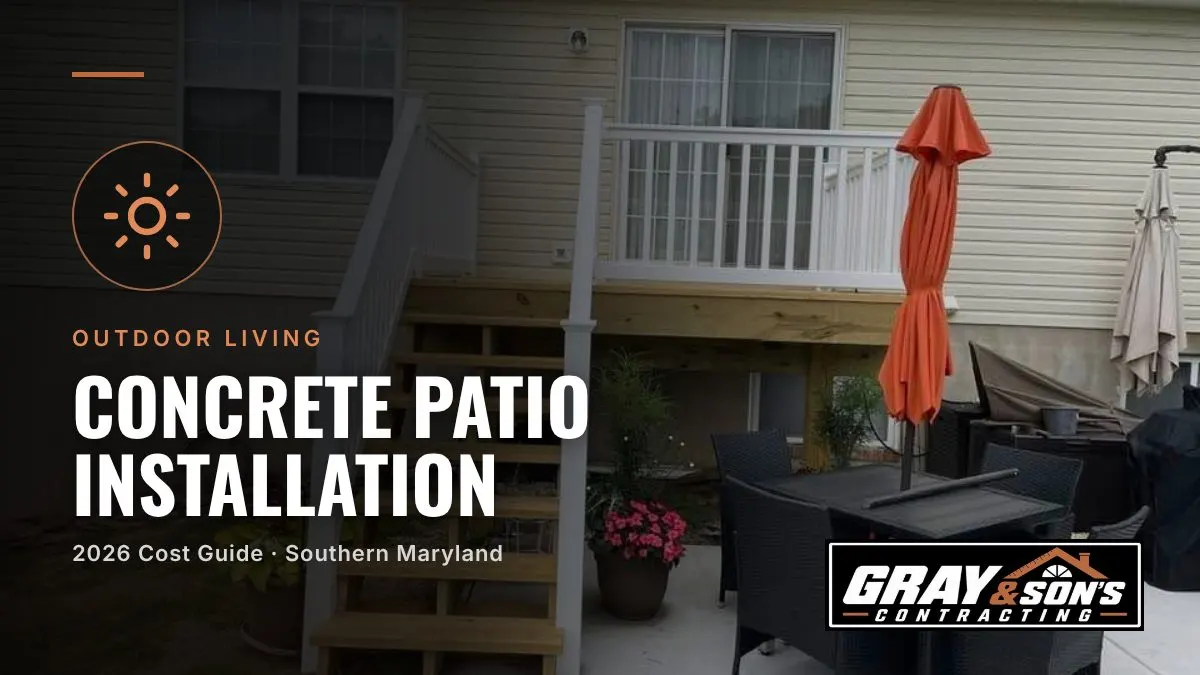
Installing a concrete patio in Southern Maryland costs $2,400 to $8,000 or more in 2026, with most homeowners paying between $3,500 and $6,000 for a standard 300 to 400 square foot patio. The price per square foot ranges from $6 to $20 depending on the finish, a basic broom-finished slab on the low end, a stamped and colored patio with decorative borders on the high end. The final number depends on the finish type, the patio size, the site conditions on your lot, and whether you add features like a built-in fire pit pad, seating walls, or integrated steps.
Concrete is the most popular patio material in Calvert, St. Mary's, and Charles County for practical reasons. It is durable, low maintenance, handles Southern Maryland's freeze-thaw cycles better than most alternatives when properly installed, and it works with the region's clay-heavy soils in ways that some other materials do not. A well-poured concrete patio on properly prepared ground lasts 25 to 50 years with minimal upkeep. It is also the most cost-effective way to create a large, flat outdoor living surface, dollar for dollar, concrete gives you more usable patio area than pavers, natural stone, or any other hardscape material.
Fall is one of the best times of year to pour concrete in Southern Maryland. September and October temperatures, typically 55 to 75 degrees during the day, sit right in the ideal range for concrete curing. The summer's extreme heat and humidity, which can cause concrete to cure too fast and crack, have broken. The winter's freezing temperatures, which can damage fresh concrete before it reaches full strength, are still weeks away. If you are planning a patio project, booking now means your contractor can pour this fall while conditions are optimal, or you lock in a spring slot and use the winter to finalize the design, grade plan, and permit so construction starts the moment the frost clears.
Concrete Patio Cost by Finish Type
The finish you choose is the single biggest factor in your per-square-foot cost. Plain concrete is straightforward to pour and finish. Stamped, colored, and specialty finishes require additional materials, skill, and time, and that shows up in the price.
Basic Poured Concrete (Broom Finish)
A standard broom-finished concrete patio costs $6 to $12 per square foot installed. For a 300 square foot patio, that is $1,800 to $3,600. For a 400 square foot patio, $2,400 to $4,800.
Broom finishing is the standard concrete surface treatment: after the slab is poured and floated smooth, a broom is dragged across the surface to create a lightly textured, slip-resistant finish. It is clean, functional, and durable. This is the same finish used on sidewalks and driveways, it does not pretend to be anything other than concrete, but it looks neat and professional when done well.
The cost range reflects differences in site preparation requirements and slab thickness. A 4-inch slab on flat, well-drained ground with minimal excavation hits the low end. A 5- or 6-inch slab on a sloped lot with clay soil that needs grading, compacted gravel base, and drainage work pushes toward the high end.
Stamped Concrete
Stamped concrete costs $12 to $20 per square foot installed. A 300 square foot stamped patio runs $3,600 to $6,000. A 400 square foot patio runs $4,800 to $8,000.
Stamped concrete replicates the look of natural stone, brick, slate, flagstone, or wood plank using large rubber stamps pressed into the wet concrete surface. The process also typically includes integral color (mixed into the concrete before pouring) and a release agent in a contrasting color that fills the stamped joints, creating realistic depth and variation.
The quality of a stamped concrete patio depends almost entirely on the skill of the crew doing the work. Stamping is time-sensitive, the concrete has to be at exactly the right stage of cure when the stamps go down. Too wet and the pattern distorts. Too dry and the stamps do not impress deeply enough. In Southern Maryland's humid climate, the curing window behaves differently than in drier regions, and an experienced local crew knows how to read the slab and time the stamps. This is not a job for a crew that pours driveways six days a week and stamps patios occasionally.
Popular stamp patterns in the Southern Maryland market include ashlar slate (the most common), random stone, cobblestone, herringbone brick, and wood plank. The pattern choice does not significantly affect cost, the labor and materials are similar across patterns.
Colored or Stained Concrete
Colored concrete costs $8 to $15 per square foot installed. A 300 square foot colored patio runs $2,400 to $4,500. A 400 square foot patio, $3,200 to $6,000.
Concrete can be colored two ways: integral color, where pigment is mixed into the concrete before pouring, or staining, where acid stain or water-based stain is applied to the cured surface. Integral color produces a consistent, through-and-through color that does not wear off. Surface stains produce richer, more varied tones, earth tones, terra cotta, slate gray, dark walnut, but may require reapplication every three to five years to maintain intensity.
Integral color adds $2 to $4 per square foot to the cost of a basic slab. Surface staining on a new slab adds $3 to $6 per square foot. Combining colored concrete with a broom or light texture finish gives you a patio that looks significantly more refined than plain gray concrete at a moderate cost premium.
Exposed Aggregate
Exposed aggregate concrete costs $10 to $18 per square foot installed. A 300 square foot patio runs $3,000 to $5,400. A 400 square foot patio, $4,000 to $7,200.
Exposed aggregate is produced by pouring standard concrete and then removing the top layer of cement paste before it fully cures to reveal the decorative stones, pebbles, or crushed rock embedded in the mix. The result is a textured, natural-looking surface with excellent traction, even when wet, exposed aggregate is one of the least slippery concrete finishes.
The appearance depends on the aggregate used. River pebble produces a smooth, rounded stone surface. Crushed granite or quartz creates a more angular, glittering look. Some contractors in the region use locally sourced aggregates, while others bring in decorative stone for specific colors and textures. The aggregate selection affects cost, standard river pebble is on the low end, specialty decorative aggregates push toward the high end.
Exposed aggregate is a popular choice for pool decks and waterfront patios in communities along the Chesapeake Bay and the Patuxent River, Solomons, Chesapeake Beach, North Beach, Lusby, because of its slip resistance and natural appearance.
Polished Concrete
Polished concrete costs $10 to $18 per square foot installed. A 300 square foot polished patio runs $3,000 to $5,400.
Polished concrete is mechanically ground and polished to a smooth, glossy finish using progressively finer diamond abrasives. It produces a sleek, modern look. Polished concrete is more common on interior floors, covered porches, and sunroom slabs than on fully exposed outdoor patios because the glossy surface can be slippery when wet. If you want the polished look for an outdoor patio, a matte or semi-polished finish with a non-slip sealer is the better choice for safety in Southern Maryland's rain-heavy climate.
Finish Type Cost Comparison Table
| Finish Type | Cost Per Sq Ft (Installed) | 300 Sq Ft Patio | 400 Sq Ft Patio | Best For |
|---|---|---|---|---|
| Basic broom finish | $6 to $12 | $1,800 to $3,600 | $2,400 to $4,800 | Budget-friendly, functional patios |
| Colored / stained | $8 to $15 | $2,400 to $4,500 | $3,200 to $6,000 | Upgraded look without stamp cost |
| Exposed aggregate | $10 to $18 | $3,000 to $5,400 | $4,000 to $7,200 | Pool decks, waterfront, natural look |
| Stamped concrete | $12 to $20 | $3,600 to $6,000 | $4,800 to $8,000 | Decorative, mimics stone or brick |
| Polished concrete | $10 to $18 | $3,000 to $5,400 | $4,000 to $7,200 | Modern, covered or semi-covered areas |
Concrete Patio Cost by Size
Larger patios cost more in total but less per square foot because the fixed costs, site preparation, forming, mobilization, and cleanup, are spread across more area. The concrete truck delivery fee is the same whether you pour 200 or 400 square feet.
| Patio Size | Square Footage | Basic Broom Finish | Stamped Concrete | Colored Concrete |
|---|---|---|---|---|
| 10 x 10 | 100 sq ft | $600 to $1,200 | $1,200 to $2,000 | $800 to $1,500 |
| 10 x 15 | 150 sq ft | $900 to $1,800 | $1,800 to $3,000 | $1,200 to $2,250 |
| 12 x 16 | 192 sq ft | $1,150 to $2,300 | $2,300 to $3,840 | $1,536 to $2,880 |
| 15 x 20 | 300 sq ft | $1,800 to $3,600 | $3,600 to $6,000 | $2,400 to $4,500 |
| 16 x 25 | 400 sq ft | $2,400 to $4,800 | $4,800 to $8,000 | $3,200 to $6,000 |
| 20 x 25 | 500 sq ft | $3,000 to $6,000 | $6,000 to $10,000 | $4,000 to $7,500 |
| 20 x 30 | 600 sq ft | $3,600 to $7,200 | $7,200 to $12,000 | $4,800 to $9,000 |
The most common patio size in Southern Maryland is 300 to 400 square feet, roughly a 15x20 or 16x25 footprint. That gives you room for a dining table with six chairs, a grill area, and space to move around. Smaller patios in the 100 to 200 square foot range work well as landing pads outside a back door, grill stations, or fire pit areas. Larger patios of 500 to 600 square feet typically serve as full outdoor living rooms with distinct zones for dining, cooking, and lounging.
Cost Breakdown: Where the Money Goes
Understanding what you are paying for helps you evaluate whether an estimate is fair and where you might be able to save.
| Component | Percentage of Total | Typical Cost Range | Notes |
|---|---|---|---|
| Concrete materials | 25% to 35% | $3.00 to $5.50 per sq ft | Ready-mix delivery, reinforcement (rebar, wire mesh, fiber) |
| Labor | 30% to 40% | $3.00 to $8.00 per sq ft | Forming, pouring, finishing, stamping if applicable |
| Site preparation | 10% to 20% | $1.00 to $4.00 per sq ft | Excavation, grading, compacted gravel base, drainage |
| Forming and reinforcement | 5% to 10% | $0.75 to $2.00 per sq ft | Lumber forms, stakes, rebar, wire mesh |
| Finishing materials | 0% to 15% | $0.00 to $4.00 per sq ft | Color, release agent, stamps, sealant (decorative only) |
| Permits | Fixed | $150 to $400 | Varies by county and project scope |
| Equipment and mobilization | 3% to 5% | Included in estimate | Trucks, tools, forms, pump truck if needed |
On a typical $5,000 stamped concrete patio project (300 square feet), roughly $1,400 to $1,700 goes to concrete and materials, $1,500 to $2,000 is labor, $700 to $1,000 covers site preparation, and the remainder covers forming, finishing materials, sealant, permits, and overhead.
Concrete Delivery and Volume
Concrete is sold by the cubic yard. One cubic yard fills 81 square feet at 4 inches thick. A 300 square foot patio at 4 inches requires approximately 3.7 cubic yards. At current 2026 Southern Maryland prices, ready-mix concrete runs $160 to $200 per cubic yard delivered, so the raw concrete for a 300 square foot patio costs $590 to $740.
Most concrete suppliers in the region, including plants serving Waldorf, La Plata, Prince Frederick, Leonardtown, and Lexington Park, have a minimum delivery of 1 to 3 cubic yards and charge a short-load fee ($50 to $100 per yard) for orders under the minimum. For small patios, this short-load fee can meaningfully increase the per-square-foot material cost.
Site Preparation Costs
Site preparation is where costs vary most between projects. A flat, well-drained backyard in a Waldorf subdivision where the topsoil has already been graded needs minimal work, strip the sod, compact the soil, lay 4 inches of compacted gravel base, set forms, and pour. That costs $1.00 to $2.00 per square foot for prep.
A sloped lot in Huntingtown or Dunkirk, or a lot with poor drainage in the low-lying areas around Lusby or Piney Point, may need significant grading, soil excavation, a thicker gravel base, French drains or channel drains, and retaining walls or grade transitions. That pushes site prep to $3.00 to $4.00 per square foot or more, and those costs add up fast on a 400 square foot patio.
What Affects Concrete Patio Cost in Southern Maryland
Southern Maryland has specific conditions that directly affect how a concrete patio is designed, built, and priced. A contractor who works in this region regularly accounts for these factors from the start. A contractor coming from outside the area may not.
Clay Soils
The dominant soils in Calvert, St. Mary's, and Charles County, the Mattapex, Sassafras, and Westphalia series, are clay-heavy. Clay soil is the enemy of concrete flatwork if it is not handled properly. Clay expands when it absorbs water and contracts when it dries. This expansion and contraction cycle creates differential movement beneath a concrete slab, which causes cracking, settling, and heaving.
The solution is proper base preparation. On clay soils, a concrete patio must sit on a compacted gravel base, typically 4 to 6 inches of compacted crushed stone or gravel, that serves as a stable, non-expansive layer between the clay and the slab. The gravel base distributes the load evenly and allows water to drain beneath the slab rather than pooling against the underside of the concrete.
On heavily clay lots, especially in areas around Owings, Prince Frederick, and parts of La Plata where the Westphalia clay is particularly dense, the gravel base may need to be 6 to 8 inches thick, and the excavation deeper to accommodate it. This adds $500 to $1,500 to the project compared to the same patio on sandy or loam soil.
Frost Line and Control Joints
Maryland's frost line is 30 inches. While a patio slab does not need footings extending to the frost line the way a deck or addition does (a slab sits on the surface and is designed to move slightly with the ground), the frost line still matters.
Freeze-thaw cycling, water saturating the soil beneath the slab, freezing, expanding, thawing, contracting, is the primary cause of patio cracking and heaving in Southern Maryland. The region typically experiences 30 to 50 freeze-thaw cycles per winter. Every cycle stresses the slab.
The defense is threefold. First, the compacted gravel base provides drainage so water does not pool beneath the slab. Second, the slab must have proper control joints cut at regular intervals, typically every 8 to 12 feet in each direction, or in sections no larger than 120 to 140 square feet, so that when the concrete does crack from thermal stress, it cracks along the control joints where you intended, not randomly across the surface. Third, the slab needs adequate slope (1/4 inch per linear foot minimum) to shed surface water away from the house and off the patio surface.
An experienced concrete contractor in this area knows these numbers cold. A contractor who does not cut control joints at the right spacing or who skimps on the gravel base will hand you a patio that looks great in October and has cracks in March.
Drainage and Grading
Water management is critical for concrete patios in Southern Maryland. The region averages 45 to 48 inches of rainfall annually, and the heavy clay soils drain slowly. If a patio does not shed water properly, you end up with standing water on the surface, erosion around the edges, and moisture problems against the house foundation.
Every concrete patio must slope away from the house at a minimum of 1/4 inch per linear foot, preferably 1/8 to 1/4 inch per foot. On a 20-foot-deep patio, that is 2.5 to 5 inches of fall from the house wall to the far edge. The grading must direct water to a permeable area (lawn, garden bed, gravel drain) rather than toward a neighbor's property, a septic drain field, or a well.
On lots with significant drainage challenges, low-lying properties near the Patuxent River or the Chesapeake Bay, homes with high water tables in areas around Solomons and Broomes Island, or properties with existing grading that directs water toward the house, you may need a French drain, channel drain, or catch basin system integrated into or around the patio. Drainage solutions add $500 to $3,000 depending on complexity.
Chesapeake Bay Critical Area
Properties within 1,000 feet of the Chesapeake Bay or its tidal tributaries, the Patuxent River, the Potomac River, the St. Mary's River, and dozens of tidal creeks, fall under Maryland's Critical Area regulations. A concrete patio adds impervious surface area to the property, which is a central concern under these regulations.
In the Critical Area, the amount of impervious surface (roofs, driveways, patios, sidewalks) allowed on a lot is regulated, and a new patio may require an impervious surface calculation, stormwater management measures, or mitigation such as removing impervious surface elsewhere on the property or installing a rain garden.
The Critical Area review process adds $300 to $1,500 in permitting and engineering fees and can extend the project timeline by four to eight weeks. Not every waterfront property is affected the same way, properties classified as Intensely Developed Areas (IDA) have more flexibility than those in Limited Development Areas (LDA) or Resource Conservation Areas (RCA).
If your property is in the Critical Area, work with a contractor who has experience navigating these requirements in your specific county. The process is different at the Calvert County Department of Planning and Zoning, the Charles County Department of Planning and Growth Management, and the St. Mary's County Department of Land Use and Growth Management.
Accessibility and Truck Access
Concrete is delivered by truck. A fully loaded ready-mix truck weighs 60,000 to 70,000 pounds. The truck needs to get reasonably close to the pour site, ideally within 50 to 75 feet, the length of a standard concrete chute extension. If the truck cannot reach, the concrete must be wheelbarrowed (expensive, slow, and limits the amount that can be poured before the concrete in the truck begins setting) or pumped using a concrete pump truck, which adds $500 to $1,200 to the project.
Many properties in Southern Maryland, especially in older communities and waterfront neighborhoods in Chesapeake Beach, North Beach, Leonardtown, and along the river roads of southern Calvert and St. Mary's County, have narrow driveways, tight access, or soft ground that a heavy truck cannot cross. This is a logistics factor your contractor should assess during the initial site visit.
Concrete Patio vs. Paver Patio: A Detailed Comparison
The other material homeowners most often consider alongside concrete is interlocking pavers. Here is how they compare on the factors that matter in Southern Maryland.
Cost
| Material | Cost Per Sq Ft (Installed) | 300 Sq Ft Patio | 400 Sq Ft Patio |
|---|---|---|---|
| Basic concrete (broom finish) | $6 to $12 | $1,800 to $3,600 | $2,400 to $4,800 |
| Stamped concrete | $12 to $20 | $3,600 to $6,000 | $4,800 to $8,000 |
| Concrete pavers (standard) | $12 to $22 | $3,600 to $6,600 | $4,800 to $8,800 |
| Natural stone pavers | $18 to $35 | $5,400 to $10,500 | $7,200 to $14,000 |
Basic concrete is significantly cheaper than pavers. Stamped concrete and standard pavers are in the same price range, with pavers slightly higher on average due to the additional labor involved in setting each individual paver.
Durability and Maintenance
Concrete is one continuous slab. It does not shift, does not have joints that allow weed growth, and does not develop uneven surfaces from individual units settling at different rates. However, if it cracks, and all concrete eventually develops some cracking, the crack is permanent and visible. Repairing a crack in a stamped or colored patio is difficult to do invisibly.
Pavers are individual units set in sand on a compacted base. They flex independently, which means they handle soil movement better than a rigid slab, significant on Southern Maryland's clay soils. If a section settles or heaves, individual pavers can be removed, the base corrected, and the pavers reset. Pavers do develop weed growth between joints and can shift over time, requiring periodic re-sanding and occasional re-leveling.
Appearance
Stamped concrete can closely replicate the look of natural stone, brick, or flagstone at a lower cost than actual stone pavers. The stamped pattern is continuous and uniform, which some homeowners prefer and others find too perfect, real stone has natural variation that even the best stamp pattern cannot fully replicate.
Pavers offer genuine material variety, real clay brick, natural travertine, tumbled bluestone, Belgian block. The individual units create authentic-looking joints and natural color variation. High-quality pavers are visually superior to stamped concrete for homeowners who prioritize an upscale, natural appearance.
Lifespan
A properly installed concrete patio lasts 25 to 50 years. A properly installed paver patio lasts 25 to 50 years as well. The lifespan is comparable, but the maintenance required to achieve that lifespan differs. Concrete needs periodic sealing (every two to five years for stamped and colored patios). Pavers need periodic re-sanding and occasional re-leveling.
The Bottom Line
Concrete is the better value for homeowners who want a functional, durable patio at the lowest cost. Stamped concrete offers a decorative upgrade at a moderate premium. Pavers are the better choice for homeowners who want the look of natural stone, the ability to repair individual sections, and superior flexibility on clay soils, but at a higher upfront cost.
Patio Features That Add Cost
The base patio, a flat slab with a clean edge, is the starting point. These features turn a basic slab into an outdoor living space, with their typical cost ranges in the Southern Maryland market.
| Feature | Cost Range | Notes |
|---|---|---|
| Fire pit pad (built-in concrete) | $500 to $2,000 | Reinforced, heat-resistant section with proper drainage |
| Seating walls (concrete or block) | $30 to $60 per linear foot | 18-inch height, 12-inch width typical |
| Steps / landing | $300 to $1,500 per set | Depends on rise, width, and finish to match patio |
| Decorative borders | $5 to $15 per linear foot | Contrasting stamp pattern, color, or exposed aggregate |
| Built-in grill pad / outdoor kitchen slab | $800 to $3,000 | Reinforced slab with utility rough-ins |
| Retaining wall (for grade changes) | $25 to $50 per sq ft of wall face | Required on sloped lots, block or poured concrete |
| Drainage system (French drain or channel) | $500 to $3,000 | Catch basins, pipe, gravel, discharge point |
| Concrete curbing / edging | $5 to $10 per linear foot | Finished concrete border to contain mulch beds |
| Stamped concrete walkway to patio | $12 to $20 per sq ft | Matching path from driveway or side yard |
Fire Pit Pads
A concrete fire pit pad is one of the most requested additions in the Southern Maryland market. The pad itself is a reinforced section of the patio, typically 8 to 12 feet in diameter, with a thickened slab (6 inches instead of 4) and additional rebar to handle the concentrated heat and weight of a fire pit or fire ring. The concrete must be finished with a heat-resistant sealer, and the pad needs adequate clearance from the house, property lines, trees, and any overhead structures.
If you are planning a fire pit, building the pad into the patio at the time of construction costs $500 to $1,500. Adding a fire pit pad after the patio is poured, which requires cutting, excavating, pouring a separate slab, and matching the finish, costs $1,500 to $3,000. Plan ahead.
Seating Walls
Low concrete or block seating walls around the patio edge serve double duty as structure and seating. A typical seating wall is 18 inches tall (comfortable sitting height), 12 inches wide, and runs along one or two sides of the patio. At $30 to $60 per linear foot, a 20-foot seating wall adds $600 to $1,200 to the project.
Seating walls are especially practical for patios built on lots with grade changes, the wall retains the soil on the uphill side while providing seating on the patio side. This is a common design on the rolling lots in Huntingtown, Dunkirk, Owings, and the hillside neighborhoods overlooking the rivers.
Steps and Grade Transitions
If the patio connects to a higher or lower area, a walkout basement door, a raised deck, a sloped yard, you need steps or a grade transition. Concrete steps matching the patio finish cost $300 to $1,500 per set depending on the total rise (height), the width of the steps, and the finish. Wide, graceful steps that double as a seating area cost more than narrow utility steps.
Concrete Patio Maintenance Costs
Concrete is low maintenance, but it is not zero maintenance. Here is what to expect over the life of the patio.
All Concrete Patios
- Annual cleaning: $100 to $250 for professional pressure washing, or do it yourself with a rented pressure washer ($50 to $100 per day). Southern Maryland's humidity and tree cover promote mold, mildew, and algae growth on concrete surfaces, especially on the north-facing sides and under overhanging trees. Annual pressure washing keeps the surface clean and slip-free.
- Crack repair: Small hairline cracks are cosmetic and normal. Wider cracks (1/8 inch or more) should be filled with flexible concrete caulk or patching compound. DIY crack repair costs $10 to $50 per crack in materials. Professional crack repair runs $100 to $300 per visit.
- Joint maintenance: Control joints and expansion joints should be checked annually and refilled with backer rod and sealant if the original material has deteriorated. Joint maintenance costs $50 to $200 in materials, or $200 to $500 for professional service.
Stamped and Colored Patios
- Resealing: Stamped and colored concrete patios must be resealed every two to five years to maintain the color intensity, protect the surface from UV fading and moisture penetration, and preserve the non-slip texture. Professional resealing costs $1.00 to $2.50 per square foot, for a 300 square foot patio, that is $300 to $750 per application. DIY resealing (roller-applied acrylic sealer) costs $75 to $200 in materials.
- Color touch-up: High-traffic areas on stamped patios may show wear patterns over time. Color touch-up with a tinted sealer is part of the resealing process.
Long-Term Maintenance Cost Table
| Maintenance Item | Frequency | Cost Per Application | 25-Year Total |
|---|---|---|---|
| Pressure washing | Annual | $100 to $250 | $2,500 to $6,250 |
| Crack repair (as needed) | Every 3 to 5 years | $100 to $300 | $500 to $2,500 |
| Resealing (stamped/colored only) | Every 2 to 5 years | $300 to $750 | $1,500 to $9,375 |
| Joint refilling | Every 5 to 10 years | $200 to $500 | $500 to $2,500 |
A basic broom-finished patio costs approximately $3,000 to $8,750 in maintenance over 25 years. A stamped or colored patio costs $5,000 to $20,000 over 25 years, with resealing being the primary ongoing expense. Even at the high end, concrete patio maintenance costs are a fraction of the annual staining and sealing required for a wood deck.
Does a Concrete Patio Add Home Value?
A well-built concrete patio adds measurable value to a home in Southern Maryland. According to the National Association of Realtors' 2025 Remodeling Impact Report, outdoor living improvements, including patios, return 75 to 90 percent of their cost at resale, depending on the quality of the installation and the local market.
In the Southern Maryland housing market, Calvert, St. Mary's, and Charles County, outdoor living space is a strong selling point. Buyers expect usable backyards, and a concrete patio is the foundation of most outdoor living setups. A $5,000 stamped concrete patio adds an estimated $3,750 to $4,500 to the home's resale value.
The ROI is strongest when the patio is proportional to the home's value. A $4,000 to $6,000 patio on a $300,000 to $450,000 home, the core of the Southern Maryland market in communities like Waldorf, Lexington Park, Prince Frederick, and Huntingtown, is a proportional improvement that buyers recognize as functional value, not over-improvement.
Concrete patios also increase what real estate agents call "showing appeal." A home with a finished patio, a clean outdoor dining area, and a fire pit shows better than a home with a bare grass yard. In a competitive listing environment, that presentation advantage can translate to faster sale times and stronger offers.
How to Hire a Concrete Contractor in Southern Maryland
Get Three or More Written Estimates
Collect at least three detailed, written estimates. Each estimate should itemize: the scope of site preparation (excavation depth, gravel base thickness), slab thickness, reinforcement method (rebar, wire mesh, or fiber), concrete mix specification, finish type, sealer type and number of coats, drainage provisions, and permit costs. Compare what is included, the cheapest estimate often omits items that the others cover, such as the gravel base, the sealer, or the cost of hauling away excavated soil.
Verify the MHIC License
Every contractor performing home improvement work in Maryland must hold an active Maryland Home Improvement Commission (MHIC) license. This is a state law requirement, not optional. Ask for the license number and verify it on the Maryland Department of Labor website. An unlicensed contractor cannot legally enter into a home improvement contract, and their work is not covered by the Maryland Home Improvement Guaranty Fund if something goes wrong.
Ask About Their Concrete Experience Specifically
Concrete work is a specialty. A general contractor who does framing, roofing, and siding may subcontract the concrete to a crew, and the quality of that subcontracted crew is what determines the quality of your patio. Ask who will actually be doing the pour and finishing. Ask how many concrete patios they have installed in the past 12 months. Ask specifically about their experience with stamped concrete if that is what you want, stamping is a skill that some crews do beautifully and others do poorly.
Ask About Local Soil Experience
A contractor who works regularly in Calvert, St. Mary's, and Charles County knows the clay soils, the drainage patterns, the freeze-thaw behavior, and the permit process. Ask how they handle the clay soil conditions on your specific lot. Ask about their standard gravel base thickness and why they use that number. A good answer is specific: "We use 6 inches of compacted CR-6 gravel over geotextile fabric on clay soils because that is what we have found prevents settling in this area." A vague answer, "We put down some gravel", is a warning sign.
Check References and Look at Previous Work
Ask to see patios the contractor installed two to three years ago, not just their most recent project. How a concrete patio holds up after two Southern Maryland winters tells you far more about the quality of the base preparation and the concrete work than how it looks on pour day. Look for cracking patterns, settling, surface wear, and how the sealer has held up on stamped patios.
Understand the Timeline
A concrete patio project typically takes one to three days for construction itself, one day for site prep and forming, one day for the pour and finishing, and (for stamped patios) one day for stamping, detailing, and curing before sealer application. The total timeline from first contact to finished patio is typically three to six weeks, accounting for permitting (one to three weeks), scheduling (varies by season), and a one-to-two-week curing period before the sealer is applied and the patio is ready for furniture and use.
Permit Requirements by County
Calvert County: Patio permits are handled through the Department of Planning and Zoning in Prince Frederick. A basic at-grade patio may fall under a simplified permit process, but any patio involving grade changes, retaining walls, or proximity to the Critical Area will require full plan review. Permit fees typically run $150 to $300.
Charles County: Permits are issued through the Department of Planning and Growth Management in La Plata. Patios connected to other structures or involving significant site work require standard building permits. Lot coverage and impervious surface limits apply.
St. Mary's County: Permits are handled by the Department of Land Use and Growth Management in Leonardtown. Standard residential patio permits are typically straightforward, but properties in growth areas or the Critical Area may require additional review.
In all three counties, confirm with your contractor whether a permit is required for your specific project. Permit requirements can vary based on the patio's size, location on the lot, proximity to property lines and setbacks, and whether the property is in the Critical Area or a floodplain.
Frequently Asked Questions
How much does a concrete patio cost in Southern Maryland? A concrete patio in Southern Maryland costs $2,400 to $8,000 or more in 2026, depending on the size and finish type. A basic 300 square foot broom-finished patio costs $1,800 to $3,600. A 400 square foot stamped concrete patio with color and sealer costs $4,800 to $8,000. Site preparation costs vary with soil conditions and drainage requirements, which can add $500 to $2,000 to the base price on challenging lots.
How long does a concrete patio last? A properly installed concrete patio lasts 25 to 50 years in Southern Maryland's climate. The keys to longevity are a compacted gravel base (critical on the region's clay soils), proper control joint placement, adequate drainage slope away from the house, and periodic maintenance including cleaning and resealing for stamped or colored finishes. Patios without adequate base preparation on clay soils may develop cracking and settling within five to ten years.
Is stamped concrete worth the extra cost? Stamped concrete costs $12 to $20 per square foot compared to $6 to $12 for basic broom finish, roughly double the price. Whether it is worth it depends on your priorities. Stamped concrete delivers the look of natural stone or brick at 40 to 60 percent of the cost of actual stone pavers. It adds curb appeal and resale value. If your patio is visible from the house and will be a primary outdoor living space, the upgrade to stamped concrete is usually money well spent. If the patio is primarily functional, a grill pad, a utility area behind the garage, basic concrete serves the purpose at a lower price.
When is the best time to pour a concrete patio in Southern Maryland? Late spring (May) through early fall (October) is the ideal window. Concrete cures best in temperatures between 50 and 80 degrees Fahrenheit. September and October are particularly good, the extreme heat and humidity of July and August have passed, curing conditions are stable, and contractors are typically less booked than during the peak spring and summer months. Concrete should not be poured when temperatures are expected to drop below 40 degrees within 48 hours of the pour, which rules out most of December through February in this region.
Do I need a permit for a concrete patio? In most cases, yes. Calvert, Charles, and St. Mary's County each have permit requirements for patio construction, especially if the work involves grade changes, retaining walls, drainage modifications, or properties in the Chesapeake Bay Critical Area. A basic at-grade slab on flat ground may have simplified requirements in some jurisdictions, but confirm with your contractor and your county's permit office before starting work. Permit fees are typically $150 to $400.
How thick should a concrete patio be? Standard residential patios are 4 inches thick. Patios that will support heavy loads, a hot tub, a large built-in fire pit, an outdoor kitchen, should be 5 to 6 inches thick in those areas with additional reinforcement. The gravel base beneath the slab should be 4 to 6 inches on well-drained soils and 6 to 8 inches on the heavy clay soils common throughout Southern Maryland.
Can a concrete patio be repaired if it cracks? Yes, but the quality of the repair depends on the finish type. Hairline cracks (less than 1/8 inch) are cosmetic, normal, and can be sealed with flexible concrete caulk. Wider cracks can be routed and filled with a matching patching compound. On basic gray concrete, crack repairs blend well. On stamped or colored concrete, matching the color and texture is more difficult, repairs may be visible, which is why proper base preparation and control joint placement are so important. Severely cracked or settled sections can be removed and re-poured, though this is more expensive than a simple repair.
How does concrete compare to pavers for a patio? Basic concrete ($6 to $12 per square foot) is significantly cheaper than pavers ($12 to $35 per square foot). Stamped concrete ($12 to $20 per square foot) competes directly with standard concrete pavers ($12 to $22 per square foot) on price. Concrete is lower maintenance, but cracks are permanent. Pavers handle clay soil movement better because individual units flex independently, and damaged pavers can be replaced individually. Both materials last 25 to 50 years with proper installation and maintenance. The best choice depends on your budget, aesthetic preference, and how much movement you expect from the soil on your lot.
How soon can I use my new patio after it is poured? Light foot traffic is safe after 24 to 48 hours. Patio furniture can be placed after 3 to 5 days. Heavy items (grills, fire pits, planters) should wait 7 days. The concrete reaches approximately 70 percent of its full strength at 7 days and full design strength at 28 days. Stamped patios need additional curing time before sealer application, typically 14 to 28 days depending on weather conditions. Your contractor will advise on the specific curing schedule for your project.
Ready to build your new patio? Gray & Sons Contracting has 50 years of experience building in Southern Maryland. We understand the soil conditions, drainage requirements, and permit process in Calvert, St. Mary's, and Charles County. We will help you design a concrete patio that fits your home, your outdoor living plans, and your budget. Get a Free Estimate