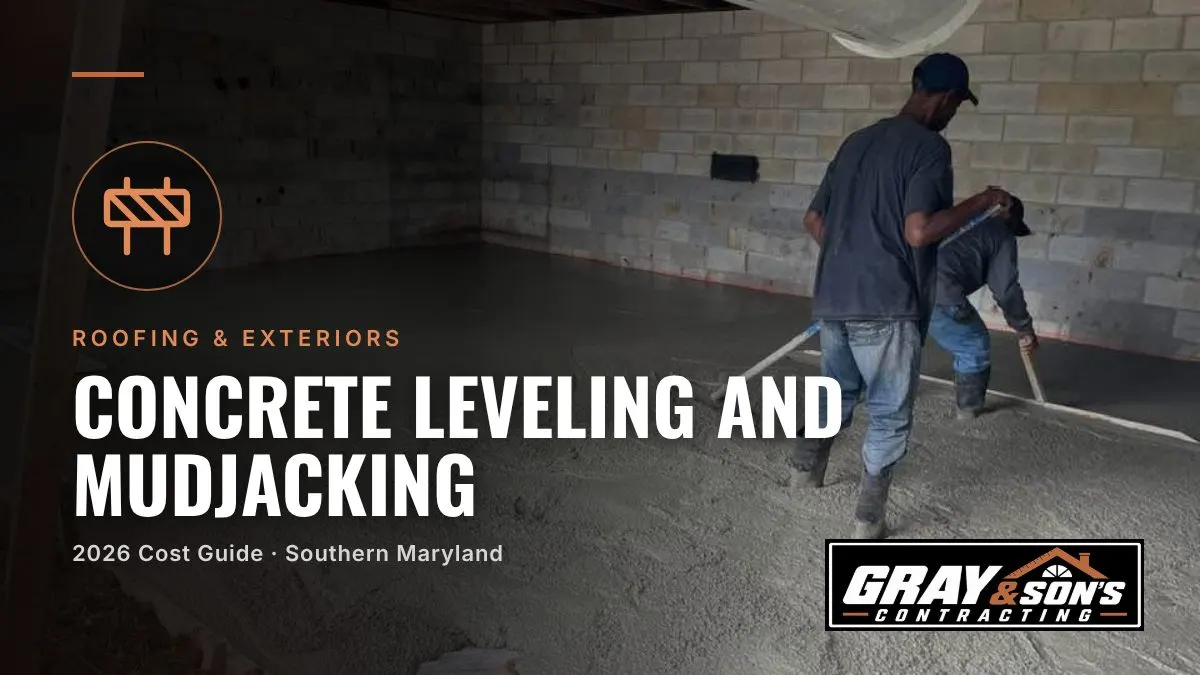
Concrete leveling in Southern Maryland costs $3 to $12 per square foot or $700 to $5,000 total in 2026, depending on the method, the size of the slab, and how far it has settled. Mudjacking, the traditional method of pumping a cement slurry beneath a sunken slab to raise it back to level, runs $4 to $9 per square foot. Polyjacking, which uses expanding polyurethane foam instead of slurry, costs $8 to $25 per square foot. Most homeowners in Calvert, St. Mary's, and Charles County pay $1,200 to $3,500 to level a sunken driveway section, patio, or sidewalk, which is 50 to 70 percent less than tearing out and replacing the concrete.
Fall is the ideal time for concrete leveling in Southern Maryland. The ground is dry from the summer months, daytime temperatures are moderate enough for materials to cure properly, and you address trip hazards before winter ice makes uneven concrete genuinely dangerous. A half-inch lip between sidewalk slabs that is an annoyance in September becomes a slip-and-fall liability in January when it is covered with ice. Southern Maryland winters bring temperatures into the 20s, and the freeze-thaw cycles that follow push settled concrete even further out of alignment. Fixing the problem now, while the soil conditions are stable and the weather is cooperative, saves money and prevents the damage from compounding over winter.
Here is what concrete leveling costs in Southern Maryland, how each method works, when leveling makes sense versus full replacement, and what the clay-heavy soils in this region mean for your concrete.
Concrete Leveling Cost by Method
| Method | Cost Per Sq Ft | Best For | Lifespan |
|---|---|---|---|
| Mudjacking (cement slurry) | $4 to $9 | Driveways, sidewalks, patios, garage floors | 5 to 10 years |
| Polyjacking (polyurethane foam) | $8 to $25 | Pool decks, interior slabs, lightweight applications, problem soils | 10 to 15+ years |
| Self-leveling concrete compound | $2 to $5 | Interior floors with minor unevenness (less than 1.5 inches) | Permanent (surface treatment) |
| Stone slurry grout | $6 to $15 | Large commercial slabs, heavy-load areas | 8 to 12 years |
Minimum job fees apply to all concrete leveling work. Most contractors in Southern Maryland charge a minimum of $300 to $700 regardless of the area being leveled, because the equipment mobilization, material preparation, and crew time for a small job is nearly the same as for a medium one. A single sidewalk slab that needs lifting may only involve 20 square feet of concrete, but the cost will be $300 to $700, not $60 to $180 based on the per-square-foot rate alone.
Mudjacking: $4 to $9 Per Square Foot
Mudjacking, also called slabjacking or pressure grouting, is the original concrete leveling method and remains the most common and most affordable option for exterior slabs in Southern Maryland. The process is straightforward: small holes (typically 1 to 2 inches in diameter) are drilled through the sunken slab at strategic points, and a slurry mixture of Portland cement, sand, water, and sometimes topsoil or limestone is pumped through the holes under pressure. The slurry fills the void beneath the slab and hydraulically lifts it back to its original elevation. Once the slab is level, the holes are patched with concrete and the slab is usable within 24 to 48 hours.
The slurry is heavy, roughly 100 pounds per cubic foot once it sets, and this is both a strength and a limitation. The weight provides a solid, stable base beneath the slab that resists further movement. However, on weak or saturated soils, the additional weight can accelerate future settling. In Southern Maryland's clay soils, which are already prone to compression and movement when saturated, this is a legitimate consideration. For most residential applications, driveways in Waldorf, sidewalks in La Plata, patios in Prince Frederick, the additional weight is not a problem because the void being filled is relatively small and the surrounding soil provides adequate bearing capacity. For slabs on particularly soft or wet ground, or for slabs that have settled significantly (more than 3 to 4 inches), polyjacking may be the better choice.
Mudjacking typically lasts 5 to 10 years before the slab may need re-leveling, depending on the underlying soil conditions. If the soil problem that caused the original settling is addressed, improved drainage, corrected grading, or reduced water infiltration, the repair can last much longer. If the soil continues to wash out or compress, the slab will eventually settle again regardless of the leveling method.
Polyjacking (Polyurethane Foam Injection): $8 to $25 Per Square Foot
Polyjacking uses high-density, closed-cell polyurethane foam instead of cement slurry. The process is similar, holes are drilled through the slab (smaller holes, typically 5/8 inch in diameter), and two-part polyurethane resin is injected beneath the slab through a specialized injection gun. The resin expands within seconds to fill the void and lift the slab, then cures to a rigid, waterproof, lightweight mass within 15 minutes. The slab is usable almost immediately.
Polyjacking costs roughly two to three times more than mudjacking per square foot, but it offers several advantages that make it the preferred method in specific situations. The cured foam weighs only 2 to 4 pounds per cubic foot compared to the slurry's 100 pounds, reducing the load on already-compromised soil. This matters in Southern Maryland, where the clay-heavy soils in Charles and Calvert counties are often the reason the slab settled in the first place, adding 100 pounds per cubic foot of slurry on top of soil that already could not support the slab's weight is counterproductive in some cases. The foam is also waterproof and closed-cell, meaning it does not absorb moisture and will not wash out the way a cement slurry can over time. In areas with high water tables, near the Chesapeake Bay, the Patuxent River, or the many creeks and tributaries in St. Mary's County, this waterproof characteristic is a significant long-term advantage.
Polyjacking is the better choice for interior slabs (basement floors where weight on the soil matters and moisture resistance is critical), pool decks (where the foam's waterproof properties prevent erosion), and any slab on particularly soft or wet soil. It is also faster, most jobs are completed in 1 to 2 hours versus half a day for mudjacking, and the smaller drill holes are less visible after patching.
Self-Leveling Concrete Compound: $2 to $5 Per Square Foot
Self-leveling concrete is not a slab-lifting method, it is a surface treatment for interior floors that are slightly uneven. A polymer-modified cement compound is mixed to a fluid consistency and poured onto the existing floor, where it flows by gravity to fill low spots and create a level surface. It is used to correct minor unevenness (up to about 1.5 inches) in basement floors, garage floors, and interior slabs before installing flooring.
At $2 to $5 per square foot for materials and application, self-leveling compound is the least expensive leveling option, but it is limited to interior applications and minor corrections. It does not lift a sunken slab, it adds material on top to create a level surface. If the floor has settled 2 inches in one area, the compound builds up 2 inches of additional thickness, which may create problems at transitions to adjoining rooms, door thresholds, and stairways. For basement floors in Southern Maryland homes where minor settlement has created uneven surfaces for flooring installation, self-leveling compound is a practical and cost-effective solution.
Stone Slurry Grout: $6 to $15 Per Square Foot
Stone slurry grout, a mixture of crushed stone aggregate and cement injected beneath a slab, is a heavier-duty leveling method used primarily for commercial applications, industrial floors, and slabs that bear significant loads. The stone aggregate provides a more stable, load-bearing base than standard mudjacking slurry and resists compression better over time. For residential applications in Southern Maryland, stone slurry is used occasionally for garage floors that support heavy vehicles or equipment, and for driveway sections that have settled under the weight of delivery trucks or construction equipment. The cost is higher than standard mudjacking but lower than polyjacking, and the durability is comparable to foam injection for heavy-load applications.
Concrete Leveling Cost by Project Type
The total cost of a concrete leveling project depends on the size of the area, the number of slabs involved, and the severity of the settlement. Here is what typical projects cost in Southern Maryland.
| Project | Area (Typical) | Leveling Cost | Full Replacement Cost |
|---|---|---|---|
| Front steps or stoop | 20 to 50 sq ft | $300 to $700 | $800 to $2,500 |
| Sidewalk (1 to 3 sections) | 40 to 120 sq ft | $400 to $2,500 | $1,200 to $5,000 |
| Patio | 100 to 300 sq ft | $600 to $3,800 | $2,000 to $9,000 |
| Garage floor | 200 to 500 sq ft | $1,400 to $9,000 | $3,000 to $12,000 |
| Driveway (settled sections) | 200 to 600 sq ft | $1,800 to $11,300 | $5,000 to $15,000 |
| Pool deck | 200 to 500 sq ft | $1,600 to $10,000 | $4,000 to $14,000 |
| Basement floor | 400 to 1,000 sq ft | $3,200 to $20,000 | $6,000 to $25,000 |
The cost savings of leveling versus replacement are dramatic. A homeowner in Mechanicsville with a settled driveway section might pay $2,000 for mudjacking compared to $8,000 for demolition and replacement. A homeowner in Chesapeake Beach with a pool deck that has sunk on one side might pay $3,500 for polyjacking compared to $10,000 for a new pour. The concrete is not broken, it has simply moved, and leveling moves it back for a fraction of the replacement cost.
Additional Services and Costs
Concrete leveling often requires additional work to address the underlying problems that caused the settling or to restore the appearance of the leveled slab.
| Service | Cost | When Needed |
|---|---|---|
| Crack repair (caulking and sealing) | $250 to $800 | Cracks that developed as the slab settled unevenly, leveling closes some cracks but others need sealing |
| Concrete sealing | $1 to $4 per sq ft | Protects the leveled slab from water penetration and future damage; recommended after leveling |
| Drainage correction | $200 to $1,500 | Regrading, downspout extensions, or a small French drain to redirect water away from the slab, essential when water washout caused the settling |
| Joint caulking | $3 to $6 per linear ft | Sealing the expansion and control joints between slabs to prevent water from penetrating beneath |
| Void detection (ground-penetrating radar) | $200 to $500 | For large or complex projects where the extent of the voids beneath the slab is unknown |
| Tree root removal | $300 to $1,000 | When tree roots have displaced the slab and must be cut before leveling can hold |
Drainage correction deserves special emphasis. If water is washing soil out from beneath the slab, which is one of the most common causes of concrete settling in Southern Maryland, leveling the slab without addressing the water source is a temporary fix. The slab will settle again. A proper leveling project should include an assessment of why the soil washed out or compressed, and the drainage problem should be corrected as part of the project. This might be as simple as extending a downspout ($50 to $200) or as involved as installing a French drain ($1,500 to $6,000) to redirect subsurface water away from the slab.
Why Concrete Settles in Southern Maryland
Southern Maryland is harder on concrete than most regions of the country. The combination of soil composition, water conditions, and climate creates an environment where concrete settling is not unusual, it is expected over time. Understanding why concrete settles here helps you make better decisions about repair methods, prevention, and when leveling makes sense versus replacement.
Clay-Heavy Soils
The Chesapeake Bay watershed soils that underlie Charles and Calvert counties, and much of St. Mary's County, are dominated by marine clay and silty clay loam. These are expansive soils, meaning they absorb water and swell when wet, then release moisture and shrink when dry. This seasonal volume change creates a cycle of heaving and settling beneath concrete slabs. When the clay swells after heavy rain in spring, it pushes upward against the slab. When it dries and shrinks in summer, it pulls away and creates voids beneath the slab. Over years, this cycle loosens the contact between the slab and the soil, creates air pockets that the slab eventually drops into, and results in the uneven, settled concrete surfaces that are common throughout the region.
The clay problem is compounded by construction practices. Many of the driveways, sidewalks, and patios in Waldorf, La Plata, and the older residential communities throughout the tri-county area were poured over fill dirt that was not properly compacted. Fill that is loose-dumped (placed without mechanical compaction) continues to settle for years after placement as the soil particles gradually consolidate under the weight of the concrete above. A driveway poured on 12 inches of uncompacted fill over native clay may appear fine for 3 to 5 years, then begin settling as the fill reaches its final density, leaving the concrete unsupported in spots.
High Water Table and Washout
Areas near the Chesapeake Bay, the Patuxent River, the Potomac River, and the numerous creeks and tributaries throughout the region contend with high water tables that fluctuate with rainfall and tides. When the water table rises, it saturates the soil beneath concrete slabs from below, softening the bearing capacity and washing fine particles out of the soil matrix. When the water table drops, it leaves behind voids where those particles used to be. Over time, this erosion undermines the support beneath the slab and the concrete settles into the resulting voids.
This washout process is accelerated by surface water that penetrates beneath slabs through cracks, open joints, and the edges of the concrete. A downspout that discharges next to a patio slab, a sidewalk that sits at the bottom of a slope, or a driveway with no edge containment, all of these allow surface water to flow beneath the concrete, erode the supporting soil, and create the voids that lead to settling. Properties in low-lying areas of Lusby, Solomons, Hollywood, and the waterfront communities along the Bay and rivers are particularly susceptible to this type of damage.
Freeze-Thaw Cycles
Southern Maryland's winter climate, with regular freezes into the 20s followed by daytime warming, creates 15 to 25 freeze-thaw cycles per season. Each cycle expands moisture in the soil beneath and around concrete slabs. Frozen soil heaves upward, lifting the slab. When the soil thaws, it settles, but not always back to its original position. Over successive cycles, this frost-heave process gradually displaces concrete slabs, widens existing cracks, and creates uneven surfaces. The damage is cumulative and accelerates over time as gaps created by earlier cycles allow more water to penetrate, which produces more ice, which creates bigger gaps.
A slab that is already slightly settled holds water in the low spot, and that standing water freezes during winter. The ice expands, pushes the slab edges apart, and when spring arrives the slab has settled further and cracked wider than it was the previous fall. This is why addressing concrete settling in the fall, before winter freeze-thaw cycles compound the problem, saves money compared to waiting until spring.
Organic Decomposition
A less obvious cause of concrete settling in Southern Maryland is the decomposition of organic material beneath the slab. When a lot is cleared for construction, tree stumps, root masses, and organic debris are sometimes buried during grading rather than removed. Over 5 to 15 years, that organic material decomposes, leaving voids that the concrete above settles into. This is a common issue in subdivisions built in wooded areas, the developer cleared the trees but left the stumps, graded fill over them, and poured concrete on top. The resulting settling is often localized and irregular, appearing as a depression in one area of the slab while the surrounding concrete remains level.
Three Sample Projects in Southern Maryland
Project 1: Settled Driveway in Waldorf
The situation: a homeowner in a 2004-built subdivision in Waldorf has a concrete driveway where two of the four panels have settled approximately 1.5 inches below the adjacent panels, creating a visible lip and a trip hazard at the garage apron. The driveway was poured on fill dirt that has since compacted, and the settled sections have several hairline cracks. The driveway is approximately 20 feet wide by 40 feet long, with the two settled panels each measuring roughly 10 by 10 feet (200 square feet total settled area).
The repair: mudjacking the two settled panels back to level, repairing the cracks, and sealing the joints.
| Item | Cost |
|---|---|
| Mudjacking, 200 sq ft at $6 per sq ft | $1,200 |
| Drill hole patching (8 holes) | Included |
| Crack repair, 3 cracks, caulk and seal | $350 |
| Joint caulking, 60 linear feet at $4 per ft | $240 |
| Concrete sealer, 200 sq ft at $2 per sq ft | $400 |
| Total | $2,190 |
Versus replacement: tearing out and replacing the two settled panels (200 square feet of concrete demolition, base re-grading, and a new 4-inch pour) would cost $2,400 to $3,600. The mudjacking repair saves approximately $500 to $1,400 and is completed in one day versus 3 to 5 days for replacement. The existing concrete is structurally sound, it has simply moved, and leveling it back into position is the practical, cost-effective solution.
Project 2: Pool Deck in Lusby
The situation: a homeowner near Chesapeake Ranch Estates in Lusby has a concrete pool deck that has settled unevenly around the deep end of the pool. The settlement ranges from 1 inch to 2.5 inches across approximately 300 square feet of the 800-square-foot deck. The settled area slopes toward the pool, creating a drainage problem (deck wash runs into the pool rather than away from it) and a trip hazard. The property is near the Chesapeake Bay with a relatively high water table, and the soil beneath the deck is a sandy clay mix that is prone to washout.
The repair: polyjacking (polyurethane foam injection) is recommended over mudjacking because of the high water table and wet soil conditions. The foam is waterproof and lightweight, it will not add load to the already-compromised soil and will not absorb moisture and break down over time the way a cement slurry could in this environment.
| Item | Cost |
|---|---|
| Polyjacking (foam injection), 300 sq ft at $14 per sq ft | $4,200 |
| Drill hole patching (12 holes) | Included |
| Crack repair, 5 cracks | $500 |
| Concrete sealer, 300 sq ft at $2.50 per sq ft | $750 |
| Drainage correction, regrade 20 ft of deck edge, add 2 channel drains | $800 |
| Total | $6,250 |
Versus replacement: demolishing and replacing 300 square feet of pool deck, including the careful work around the pool coping and the plumbing penetrations, would cost $5,500 to $9,000. The polyjacking repair costs less than the midpoint of replacement, preserves the existing deck surface (which matches the unaffected areas), and is completed in one day with no cure time, the deck is walkable within hours, not the 5 to 7 days a new pour requires.
Project 3: Garage Floor and Front Walkway in Leonardtown
The situation: a homeowner in Leonardtown has two separate settling problems. The garage floor (approximately 400 square feet) has settled along the left side, dropping 1 to 2 inches below the right side and creating a visible slope. The concrete front walkway (approximately 80 square feet over 4 sections) has two sections that have heaved upward from frost cycles and one section that has sunk, creating an uneven, zigzag surface from the driveway to the front door. The home was built in the 1980s on a concrete block foundation, and the soil is the marine clay typical of St. Mary's County.
The repair: mudjacking for the garage floor (interior slab where weight is less of a concern and cost savings are significant) and mudjacking for the walkway sections. The heaved walkway sections need to be ground down after the sunken section is raised, leveling is a combination of lifting the low spots and grinding the high spots.
| Item | Cost |
|---|---|
| Mudjacking, garage floor, 400 sq ft at $5.50 per sq ft | $2,200 |
| Mudjacking, walkway, 80 sq ft (minimum job fee applies) | $500 |
| Concrete grinding, 2 heaved walkway sections | $350 |
| Drill hole patching (14 holes total) | Included |
| Crack repair, garage floor, 2 cracks | $300 |
| Joint caulking, garage floor, 40 linear ft at $4 per ft | $160 |
| Concrete sealer, garage floor, 400 sq ft at $1.50 per sq ft | $600 |
| Total | $4,110 |
Versus replacement: replacing the garage floor alone, demolition, hauling, base prep, a new 4-inch pour with wire mesh, and finishing, would cost $4,000 to $6,000. Replacing the walkway would add $1,600 to $3,000. The combined replacement cost of $5,600 to $9,000 is roughly double the leveling cost, and the replacement would take the garage out of service for 7 to 10 days while the new concrete cures.
Leveling vs. Full Replacement: When to Choose Each
Concrete leveling is not always the right answer. It is a cost-effective repair for concrete that has moved but is otherwise structurally intact. When the concrete itself has failed, badly cracked, crumbling, spalled, or broken into pieces, leveling a damaged slab puts it back in position but does not fix the damage. Here is how to decide.
| Condition | Level It | Replace It |
|---|---|---|
| Slab has settled evenly (one side lower than the other) | Yes | No |
| Slab has settled with hairline cracks | Yes (repair cracks after leveling) | No |
| Slab has settled with wide structural cracks (over 1/2 inch) | Maybe (assess the slab integrity first) | Probably |
| Slab is broken into multiple pieces | No | Yes |
| Slab surface is spalling or flaking | Level first only if settling is the main problem; surface repair or overlay after | Yes, if surface damage is severe |
| Slab has settled more than 4 to 6 inches | Case-by-case (may need multiple lifts) | Often the better option |
| Slab has been previously leveled and has settled again | Maybe (address the cause first) | Consider if it's the third time |
| Slab is less than 3 inches thick | No (too thin to drill without cracking) | Yes |
| Tree roots caused the displacement | Only after removing or rerouting the roots | Only after removing or rerouting the roots |
| Drainage was the cause and has not been corrected | Not until drainage is fixed | Not until drainage is fixed |
The cost comparison: full concrete replacement costs $6 to $15 per square foot in Southern Maryland, including demolition, hauling, base preparation, a new pour, and finishing. Mudjacking costs $4 to $9 per square foot with no demolition, no hauling, and no cure time. The savings are 40 to 70 percent on the leveling cost alone, plus the avoided downtime, a leveled slab is usable in 24 to 48 hours (immediately for polyjacking), while a replaced slab needs 5 to 7 days of cure time before it can bear weight and 28 days before it reaches full strength. For a driveway that is the only access to a garage, that cure time means a week of parking in the street.
Permit Requirements in Southern Maryland
Concrete leveling is a repair, not new construction, and in most cases does not require a building permit. However, permit requirements vary by county, and certain situations trigger permit or inspection requirements.
Calvert County
Permits are handled through the Calvert County Department of Planning and Zoning. Standard concrete leveling of existing slabs (driveways, sidewalks, patios, garage floors) does not require a permit. If the leveling project is part of a larger scope of work that includes new concrete, grading changes, or drainage modifications that alter stormwater flow, a grading permit may be required. Properties within the Chesapeake Bay Critical Area (within 1,000 feet of tidal waters or tidal wetlands), which includes much of the shoreline in Lusby, Chesapeake Beach, North Beach, and Solomons, may require additional review if the project involves any changes to impervious surfaces or drainage patterns. Contact Planning and Zoning at (410) 535-1600 or visit the county offices in Prince Frederick to confirm requirements for your specific property.
Charles County
Permits are handled through the Charles County Department of Planning and Growth Management. Concrete leveling of existing slabs is generally exempt from permit requirements. New concrete work, including slab replacement, that exceeds certain size thresholds or that changes drainage patterns may require a grading or site development permit. Properties in the Critical Area along the Potomac River frontage require review through the county's Critical Area program before any site work. Contact Planning and Growth Management at (301) 645-0692 or visit the county offices in La Plata.
St. Mary's County
Permits are handled through the St. Mary's County Department of Land Use and Growth Management. As in the other counties, concrete leveling of existing slabs does not typically require a permit. New concrete installation, significant grading changes, or stormwater modifications may trigger permit requirements. The county has Critical Area designations along the Potomac River, St. Mary's River, and Chesapeake Bay frontage, properties in these areas should confirm compliance before any exterior work that could affect drainage or impervious cover. Contact Land Use and Growth Management at (301) 475-4200, ext. 1500, or visit the county offices in Leonardtown.
In all three counties, sidewalk and driveway work that affects a public right-of-way, for example, leveling a sidewalk section within the county or SHA right-of-way, may require a right-of-way permit from the Maryland State Highway Administration or the county roads department, even though the leveling itself does not need a building permit.
How the Leveling Process Works
Understanding the concrete leveling process helps you evaluate contractor proposals, ask the right questions, and know what to expect on the day of the work.
Step 1: Assessment and Layout
The contractor inspects the settled concrete, measures the displacement with a level and straightedge, identifies the areas that need lifting, and determines the number and placement of injection holes. For mudjacking, holes are typically spaced 3 to 6 feet apart in a grid pattern across the settled area. For polyjacking, holes are smaller and may be spaced more closely for precision lifting.
A good contractor also assesses why the concrete settled, soil washout, drainage problems, fill settlement, tree roots, or frost heave, and discusses whether additional work (drainage correction, root removal, joint sealing) is needed to prevent recurrence. If the contractor drills holes and pumps material without discussing the cause, the repair is addressing the symptom, not the problem.
Step 2: Drilling
Holes are drilled through the concrete slab at the marked locations. Mudjacking holes are 1 to 2 inches in diameter. Polyjacking holes are 5/8 inch in diameter. The drilling is done with a rotary hammer drill and takes 1 to 2 minutes per hole. Dust and debris are vacuumed from each hole.
Step 3: Injection and Lifting
For mudjacking, a pump truck mixes the cement slurry and pumps it through a hose and injection nozzle into each hole. The slurry flows beneath the slab, fills the void, and as pressure builds, lifts the slab upward. The contractor monitors the lift with a level, adjusting the injection volume and pressure to raise the slab evenly and precisely. Over-pumping can crack the slab, so the process is done slowly and carefully, typically lifting in 1/4-inch increments.
For polyjacking, the two-part polyurethane resin is injected through a specialized gun. The resin expands within 10 to 15 seconds, filling the void and lifting the slab. The expansion is controlled by the volume of resin injected. Because the foam sets within minutes, the contractor can inject, observe the lift, and adjust in rapid succession, making polyjacking more precise than mudjacking for fine adjustments.
Step 4: Patching and Finishing
Once the slab is level, the injection holes are patched with a concrete or hydraulic cement mix, smoothed flush with the slab surface, and allowed to cure. The patches are functional immediately and blend with the surrounding concrete over time as they weather. Crack repairs, joint caulking, and sealing are done after the slab is leveled and the patches are set.
Step 5: Cleanup and Curing
The work area is cleaned of any spilled slurry or foam, and the slab is ready for use. Mudjacked slabs should not bear heavy loads (vehicle traffic) for 24 to 48 hours while the slurry cures. Polyjacked slabs are usable immediately, the foam is fully cured within 15 to 30 minutes. Sealed slabs should remain dry for 24 hours to allow the sealer to cure.
What to Look for in a Concrete Leveling Contractor
Concrete leveling is a specialized trade. Not every concrete contractor performs leveling work, and the quality of the result depends heavily on the operator's skill and the equipment used. Here is how to evaluate contractors for this work.
Experience with leveling specifically. Pouring new concrete and leveling existing concrete are different skills using different equipment. A contractor who primarily pours new concrete and offers leveling as a side service is not the same as a contractor who levels concrete daily and has the specialized pumping equipment, injection tools, and experience to do it precisely. Ask how many leveling jobs they have completed in the past year and ask for references from similar projects.
Equipment matters. Mudjacking requires a pump truck with calibrated pressure controls. Polyjacking requires a specialized injection rig with heated hoses (the resin must be at a specific temperature for proper expansion) and precision metering equipment. Contractors with their own trucks and rigs (versus rented equipment) are generally more experienced and more capable of handling the adjustments needed during the job.
Get three written quotes. Each quote should specify the method (mudjacking or polyjacking), the number and location of injection holes, the material being used, the expected lift amount, the warranty, and the total cost. Compare the detail in the quotes, a one-line quote that says "level driveway, $2,000" tells you nothing about what the contractor plans to do or what is included.
Ask about the warranty. A reputable leveling contractor warranties the work for 1 to 3 years, meaning if the slab settles again within that period, they will re-level it at no cost. Some polyjacking contractors offer longer warranties (5 to 10 years) because the foam is more durable than slurry in most conditions. Get the warranty in writing and understand what it covers (re-settling) and what it does not (new cracks, damage from tree roots, settling caused by events unrelated to the leveling work).
Verify the MHIC license. Any contractor performing home improvement work in Maryland must hold a valid Maryland Home Improvement Commission license. Ask for the MHIC number and verify it through the Maryland Department of Labor.
Ask about the cause. A contractor who assesses the settling, explains why it happened, and recommends addressing the underlying cause (drainage, grading, roots) along with the leveling is providing a complete solution. A contractor who says "we'll pump it up" without investigating the cause is providing a temporary fix that may last only until the cause produces the same effect again.
Related Concrete and Drainage Projects
Concrete settling is often connected to broader drainage and structural issues. If you are addressing settled concrete, consider whether related problems need attention at the same time.
Driveway repair and resurfacing: if your driveway has both settled sections and surface damage (cracking, spalling, alligator cracking in asphalt), leveling the settled sections is only part of the solution. The surface damage needs separate repair, and in some cases a full resurface or replacement is more cost-effective than leveling plus extensive surface repair.
Foundation repair: concrete settling around a foundation, a settled garage slab, a sunken basement floor, or a patio that has pulled away from the house, can indicate foundation settlement or soil problems that extend beyond the slab itself. If the house is showing signs of foundation movement (cracking in walls, sticking doors and windows, sloping interior floors), address the foundation problem first. Leveling a garage floor while the foundation it abuts is still settling is a wasted effort.
French drain installation: if water washout beneath the slab caused the settling, a French drain or other subsurface drainage system may be needed to redirect water away from the area before leveling can provide a lasting fix. A French drain installed along the uphill side of a settled patio or driveway intercepts the water that was undermining the slab and carries it to a discharge point away from the concrete.
Frequently Asked Questions
How much does mudjacking cost in Southern Maryland? Mudjacking costs $4 to $9 per square foot in Calvert, St. Mary's, and Charles County. Most residential projects cost $700 to $3,500 total, depending on the area being leveled. A minimum job fee of $300 to $700 applies to small projects regardless of the square footage. Mudjacking is 50 to 70 percent less expensive than tearing out and replacing the settled concrete.
What is the difference between mudjacking and polyjacking? Mudjacking pumps a heavy cement-and-sand slurry beneath the slab. Polyjacking pumps lightweight polyurethane foam. Both lift the slab back to level, but they differ in weight (slurry is heavy, foam is light), curing time (slurry needs 24 to 48 hours, foam cures in minutes), waterproofing (foam is waterproof, slurry is not), and cost (foam costs two to three times more per square foot). Polyjacking is the better choice for wet environments, interior slabs, and problem soils where the additional weight of mudjacking slurry could cause further settling.
How long does concrete leveling last? Mudjacking typically lasts 5 to 10 years. Polyjacking typically lasts 10 to 15 years or longer. The actual lifespan depends on whether the underlying cause of the settling (drainage problems, soil conditions, tree roots) was addressed. If the cause is corrected, both methods can last the remaining life of the slab. If the cause remains, the slab will eventually settle again regardless of the leveling method.
Can you level concrete in winter? Mudjacking should not be done when temperatures are consistently below 40 degrees because the cement slurry needs above-freezing temperatures to cure. Polyjacking can be performed in colder temperatures because the foam cures through a chemical reaction, not evaporation, and generates its own heat during expansion. However, the best time for concrete leveling in Southern Maryland is fall, the ground is dry, temperatures are moderate, and you address the problem before winter freeze-thaw cycles make it worse.
Is concrete leveling a permanent fix? Concrete leveling is a long-lasting repair but not always a permanent one. If the soil conditions that caused the settling remain unchanged, ongoing water erosion, expanding clay, decomposing organic material, the slab may settle again over time. Addressing the root cause (improving drainage, correcting grading, removing tree roots) significantly extends the life of the repair. Many leveled slabs remain stable for the remaining useful life of the concrete.
Will the drill holes be visible? Yes, but they are small and become less noticeable over time. Mudjacking holes (1 to 2 inches) are patched with concrete and are visible as small circles that weather to blend with the surrounding slab within a year or two. Polyjacking holes (5/8 inch) are smaller and less conspicuous. Neither type of hole affects the structural integrity of the slab.
Can I mudjack my own concrete? No, not practically. Mudjacking requires a specialized pump truck, calibrated injection equipment, and the skill to control the lift without cracking the slab. Over-pumping cracks the concrete; under-pumping leaves the slab uneven. This is specialized trade work, not a DIY project. Self-leveling compound for minor interior floor corrections is the one leveling method that a capable homeowner can handle.
Does concrete leveling affect my home's resale value? Settled, uneven concrete reduces curb appeal and raises red flags during home inspections. Trip hazards can become liability issues. A properly leveled and sealed driveway, walkway, or patio restores the appearance and function of the concrete without the cost of full replacement. Leveling is a cost-effective way to address a cosmetic and safety issue before listing a home.
Should I level or replace my settled concrete? Level it if the concrete is structurally sound (not broken, crumbling, or severely cracked) and has settled less than 4 to 6 inches. Replace it if the concrete is broken into pieces, is severely deteriorated, has been leveled multiple times already, or if the surface damage is extensive enough that the appearance will be poor even after leveling. When in doubt, get assessments for both, a reputable contractor will tell you honestly whether leveling will produce a good result or whether replacement is the better investment.
Concrete settling around your home? Gray & Sons Contracting has been serving Southern Maryland homeowners for 50 years. We will assess your settled concrete, determine why it moved, and recommend the most cost-effective repair, whether that is mudjacking, polyjacking, or replacement. We work throughout Calvert, St. Mary's, and Charles County, from Waldorf to Leonardtown to Lusby. Get a Free Estimate