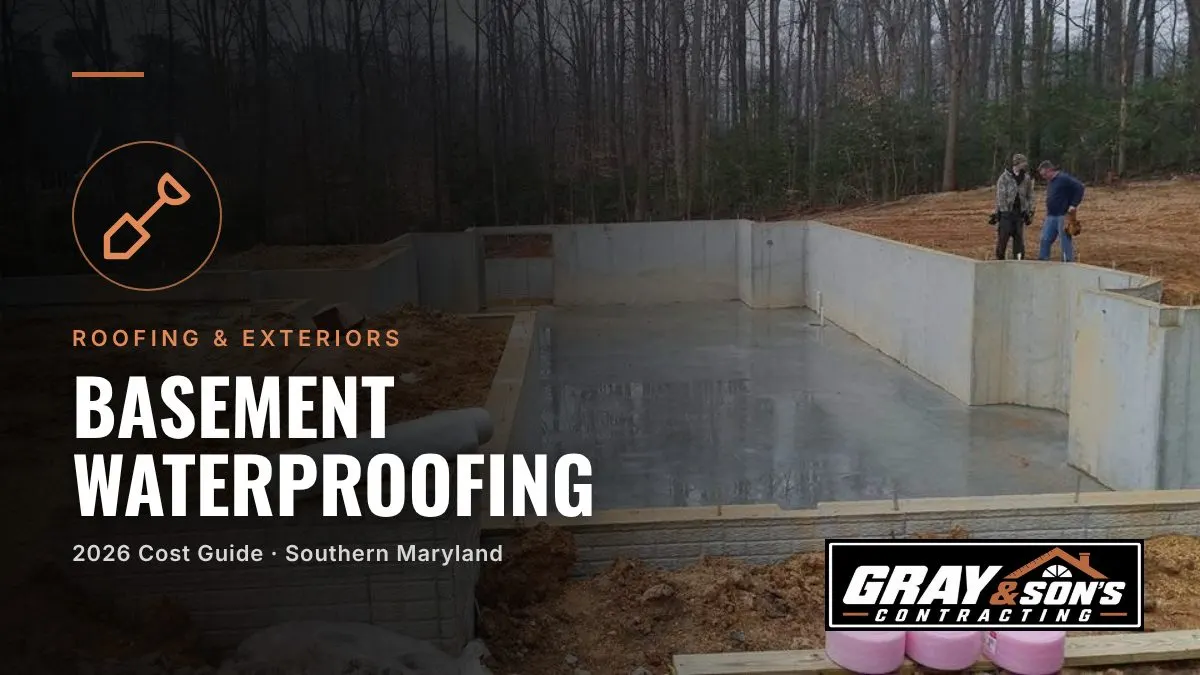
Basement waterproofing in Southern Maryland costs $2,000 to $15,000 in 2026, with most homeowners in Calvert, St. Mary's, and Charles County paying $3,500 to $8,000 for a comprehensive interior drainage system with a sump pump. Simple crack repairs start at $250 to $800 per crack. Exterior waterproofing, digging down to the footer and applying a waterproof membrane and drainage board to the outside of the foundation, runs $8,000 to $20,000 or more depending on the home's footprint and the depth of excavation required.
If you own a home in Southern Maryland, you are in one of the wettest and most water-intrusion-prone regions on the East Coast. The tri-county area sits on the Coastal Plain, which means the soil under and around your foundation is predominantly clay, dense, heavy clay that absorbs water slowly, drains poorly, and expands when wet. When it rains (and Southern Maryland gets 45 to 50 inches of rain per year), that clay soil saturates, swells, and presses against your foundation walls with hydrostatic pressure, the force of water pushing against a surface. That pressure pushes water through every crack, joint, and pore in the concrete or block. Add the proximity to the Chesapeake Bay, the Patuxent River, and the Potomac, where the water table sits high and where groundwater levels rise further after every storm, and you have a region where basement water problems are not a matter of if but when.
A wet basement is not just an inconvenience. It destroys stored belongings, ruins finished spaces, promotes mold growth (which starts within 24 to 48 hours of sustained moisture), attracts insects and pests, and reduces your home's value. A home inspection that flags water intrusion or active moisture in the basement is one of the most common deal-killers in a Southern Maryland real estate transaction. Waterproofing is not just a comfort investment, it protects the structural integrity of the house and preserves its resale value.
Here is what basement waterproofing costs in Southern Maryland, what each method involves, how to choose the right approach for your situation, and what to watch out for.
Basement Waterproofing Cost by Method
| Method | Cost Range | Best For |
|---|---|---|
| Crack injection (epoxy or polyurethane) | $250 to $800 per crack | Single, non-structural hairline cracks with occasional seepage |
| Interior waterproof coating (sealant paint) | $500 to $2,500 | Minor dampness on walls, cosmetic moisture control (not a structural solution) |
| Interior French drain system | $2,500 to $8,000 | Active water intrusion through floor-wall joints, multiple seepage points |
| Sump pump installation | $800 to $3,000 | Collecting and removing water gathered by a drain system or standing water |
| Interior French drain + sump pump (the standard system) | $3,500 to $10,000 | The most common and effective interior solution for ongoing water intrusion |
| Exterior waterproofing (membrane + drain tile) | $8,000 to $20,000+ | Severe water intrusion, structural concerns, new construction |
| Exterior French drain only (no membrane) | $3,000 to $8,000 | Redirecting surface and shallow groundwater away from the foundation |
| Grading and drainage correction | $1,000 to $5,000 | Surface water flowing toward the house due to negative grading |
| Window well drains | $500 to $2,000 per well | Water entering through basement window wells |
| Full system (interior drain + sump + exterior membrane) | $12,000 to $25,000+ | Comprehensive protection for severe, multi-source water problems |
What Drives the Price
The size of the basement is the primary cost variable for interior drain systems. Interior French drains are priced per linear foot, typically $40 to $90 per linear foot installed in Southern Maryland. A 1,000-square-foot basement with a perimeter of roughly 130 linear feet costs $5,200 to $11,700 for a full perimeter drain. Many basements do not need a full perimeter system, water enters from one or two walls, and draining just those walls cuts the cost by 40 to 60 percent.
Foundation type affects cost. Poured concrete foundations are easier and cheaper to work with than concrete block (CMU) foundations. Block foundations have hollow cores that fill with water and weep through every mortar joint, they often require the block cores to be drilled and drained into the interior French drain, which adds $5 to $15 per linear foot. Older homes in Southern Maryland, particularly those built before 1980, commonly have block foundations that are more porous and more prone to water intrusion than poured concrete.
Depth to the footer affects exterior waterproofing cost. Excavating down to the foundation footer to apply an exterior membrane requires digging a trench the full depth of the foundation, typically 6 to 8 feet in Southern Maryland homes with full basements. The deeper the footer, the more soil must be moved, and the more expensive the excavation. Homes built into hillsides or with walkout basements may have foundation walls that vary in height, complicating the excavation.
Access matters for exterior work. A foundation wall with a patio, a deck, walkways, landscaping, an HVAC unit, or other structures against it costs more to excavate because those structures must be removed and replaced. A foundation wall on a flat, open lawn with nothing against it is the simplest and cheapest to excavate.
Interior Basement Waterproofing: What It Is and What It Costs
Interior waterproofing does not stop water from entering the foundation, it manages water after it enters, collecting it and removing it before it damages the basement. This is the most common approach in Southern Maryland because it is less expensive than exterior waterproofing, less disruptive to landscaping and outdoor structures, and effective for the vast majority of residential water intrusion problems.
Interior French Drain System: $2,500 to $8,000
An interior French drain (also called a perimeter drain, drain tile, or water management system) is a channel cut into the basement floor along the interior perimeter of the foundation wall. The channel is lined with perforated pipe set in gravel, covered with a filter fabric, and capped with new concrete. Water that seeps through the foundation wall or through the floor-wall joint falls into the channel, flows through the perforated pipe by gravity, and drains to a sump pit, where a sump pump ejects it to the exterior.
The installation process:
- The contractor marks the perimeter where the drain will run (typically 6 to 12 inches from the foundation wall).
- A concrete saw cuts the basement floor along the marked line, creating a channel roughly 12 inches wide and 12 to 16 inches deep.
- The concrete and soil are removed. The channel is excavated down to, or slightly below, the bottom of the foundation footer.
- Perforated PVC or corrugated pipe (typically 4-inch diameter) is laid in the channel, set on a bed of washed gravel.
- More gravel is placed around and over the pipe.
- A drainage board or dimple mat is placed against the foundation wall to direct water from the wall surface into the channel. In block foundations, weep holes are drilled into the bottom course of block to drain the hollow cores.
- The channel is capped with new concrete, finished flush with the existing floor.
- The drain pipe runs by gravity to a sump pit in the lowest corner of the basement.
What affects the cost:
| Factor | Impact |
|---|---|
| Linear feet of drain | $40 to $90 per linear foot (the primary cost driver) |
| Full perimeter vs. partial perimeter | Partial (2 walls) saves 40 to 60% |
| Block foundation with weep holes | Adds $5 to $15 per linear foot |
| Concrete floor thickness | Thicker floors cost more to cut |
| Obstacles (HVAC equipment, water heater, support posts) | Adds routing complexity and cost |
| Sump pit and pump (see below) | Typically included in system quotes |
| Vapor barrier on walls | Adds $1 to $3 per square foot of wall |
Sump Pump: $800 to $3,000
A sump pump is the mechanical heart of any interior waterproofing system. It sits in a sump pit (a hole in the basement floor, typically 18 to 24 inches in diameter and 24 to 30 inches deep, lined with a perforated or solid basin) and pumps collected water to the exterior through a discharge pipe.
Sump pump types and costs:
| Type | Cost Installed | Notes |
|---|---|---|
| Pedestal sump pump | $800 to $1,200 | Motor sits above the pit on a pedestal. Easier to service, louder, and less powerful. Suitable for light to moderate water volume. |
| Submersible sump pump | $1,000 to $2,000 | Motor sits inside the pit, submerged. Quieter, more powerful, handles higher volume. The standard for most waterproofing systems. |
| Battery backup sump pump | $300 to $800 (add-on) | A secondary pump with a battery that activates during power outages. Essential in Southern Maryland, the storms that bring the heaviest rain are the same storms that knock out power. |
| Water-powered backup pump | $500 to $1,000 (add-on) | Uses municipal water pressure to create suction that pumps water out. Runs indefinitely during outages (no battery to die). Requires municipal water supply, does not work on well water. |
| Combination primary + battery backup | $1,500 to $3,000 | A dual-pump system: primary submersible handles normal operation, battery backup takes over during outages. The recommended configuration for any Southern Maryland home with an interior drain system. |
Battery backup is not optional in Southern Maryland. The heaviest water intrusion happens during storms, the same storms that cause power outages. A sump pump without battery backup fails exactly when it is needed most. A basement that floods during a power outage while the sump pump sits idle is one of the most common and most preventable water damage events in this area. The $300 to $800 for a battery backup system is cheap insurance against a $5,000 to $20,000 basement flood cleanup.
Discharge line considerations. The sump pump discharge pipe carries water from the pit to the exterior. The discharge should terminate at least 10 feet from the foundation (farther is better) and should direct water away from the house and away from neighboring properties. In Southern Maryland's clay soil, water discharged too close to the foundation simply soaks into the clay and migrates right back to the foundation wall, cycling through the same system indefinitely and running the pump constantly.
A check valve on the discharge line ($30 to $100) prevents water in the pipe from flowing back into the pit when the pump cycles off. Without it, the pump runs more frequently and wears out faster.
Interior Waterproof Coatings and Sealants: $500 to $2,500
Interior waterproof coatings (sometimes called waterproof paint or basement sealant) are applied directly to the interior surface of the basement wall. They are the cheapest form of waterproofing and the least effective.
What they are: cementitious coatings, crystalline waterproofing compounds, or elastomeric paints that form a water-resistant barrier on the wall surface. Some products (crystalline compounds like Xypex and Krystol) actually penetrate into the concrete and form crystals that block the capillaries through which water migrates, these are more effective than surface coatings alone, but they are not a substitute for drainage.
What they do: reduce moisture migration through concrete walls (dampness, efflorescence, minor seepage). They are reasonable for walls that feel damp or show white mineral deposits (efflorescence) but are not actively leaking.
What they do not do: resist hydrostatic pressure. Water under pressure, which is what Southern Maryland clay soil produces during and after rain, will eventually push through, around, or behind any coating applied to the interior surface. A coating on a wall that has active water intrusion will blister, peel, and fail. The water does not stop, it just finds a new path.
The honest assessment: interior coatings are a reasonable first step for minor dampness on walls that are not actively leaking. They are not a waterproofing solution for a basement with active water intrusion, and any company that sells interior coating alone as a solution for a leaking basement in Southern Maryland is selling a product that will fail.
Crack Injection: $250 to $800 Per Crack
Foundation cracks are the most common entry point for water in poured concrete basements. As concrete cures, it shrinks, and that shrinkage creates hairline cracks, typically vertical cracks near the center of long wall spans or near corners and openings. These cracks are normal and are not structural, but they are paths for water.
Epoxy injection ($250 to $500 per crack) fills the crack with a rigid epoxy that bonds the concrete together and seals the crack from the inside out. Epoxy repairs are structural, they restore the tensile strength of the concrete across the crack. They work best on cracks that are stable (not actively moving or widening).
Polyurethane foam injection ($300 to $800 per crack) fills the crack with an expanding polyurethane foam that is flexible and waterproof. Polyurethane is the better choice for cracks that are actively leaking (the foam can be injected against flowing water) and for cracks that may continue to move slightly with seasonal expansion and contraction. It does not restore structural strength, it just seals.
When crack injection alone is enough: a single, isolated, non-structural hairline crack in a poured concrete wall that seeps during heavy rain can often be fixed permanently with injection. The fix addresses the entry point, and if the overall drainage around the house is adequate, no further waterproofing may be needed.
When crack injection is not enough: if you have multiple cracks, cracks along the floor-wall joint, step cracks in a block foundation, water entering from multiple sources, or chronic dampness on the walls, crack injection treats individual symptoms while the underlying moisture problem continues. Injection is one tool in the waterproofing toolkit, not a substitute for drainage.
Exterior Basement Waterproofing: $8,000 to $20,000+
Exterior waterproofing is the only method that stops water from reaching the foundation in the first place. Everything else manages water after it has already entered the foundation wall. Exterior waterproofing is more expensive, more disruptive, and more permanent.
What Exterior Waterproofing Involves
-
Excavation. A trench is dug around the exterior of the foundation, down to the footer, typically 6 to 8 feet deep, 3 to 4 feet wide. This is the expensive part. Excavation in Southern Maryland's clay soil is slow, heavy work. The clay clings to equipment, does not dump cleanly, and must be stockpiled and backfilled.
-
Foundation wall preparation. The exposed foundation wall is cleaned, and any cracks or deterioration are repaired. Loose mortar in block foundations is repointed.
-
Waterproof membrane. A waterproof membrane is applied to the exterior of the foundation wall from the footer to above grade. Common materials include rubberized asphalt (peel-and-stick membrane), liquid-applied rubber or polymer coatings, and bentonite clay panels. The membrane creates a continuous waterproof barrier on the outside of the wall.
-
Drainage board. A rigid or semi-rigid drainage board (dimple board) is placed over the membrane. The drainage board serves two purposes: it protects the membrane from damage during backfill, and it creates a channel for water to flow down the wall to the footer drain rather than pooling against the membrane.
-
Footer drain (exterior French drain). A perforated pipe set in gravel at the base of the footer collects water that drains down the wall and groundwater from the surrounding soil. The pipe runs by gravity to a sump pit (if it connects to an interior sump) or to a daylight outlet (a point downhill from the house where the pipe exits to the surface and the water drains away by gravity).
-
Backfill. The trench is backfilled with gravel (for the first 12 to 18 inches above the drain pipe, to maintain drainage) and then with the excavated soil.
Exterior Waterproofing Cost Breakdown
| Component | Cost |
|---|---|
| Excavation (per linear foot) | $50 to $120 |
| Waterproof membrane (material and labor) | $10 to $25 per square foot of wall |
| Drainage board | $3 to $8 per square foot |
| Footer drain pipe and gravel | $15 to $35 per linear foot |
| Backfill and grading | Typically included |
| Permits and inspection | $100 to $300 |
| Landscaping repair | $500 to $3,000 (depends on what was removed) |
A typical Southern Maryland home with a 1,200-square-foot basement (roughly 140 linear feet of perimeter) waterproofed on three walls (100 linear feet, excluding the wall with the best drainage or access constraints) costs $10,000 to $18,000 for exterior waterproofing.
When Exterior Waterproofing Is Worth the Cost
Exterior waterproofing costs two to three times what an interior system costs. It is worth the premium when:
- The foundation has structural cracks or deterioration that need repair from the outside. Interior systems cannot repair the exterior surface of the foundation.
- The home has a stone or rubble foundation (common in older homes). Stone foundations are too irregular for interior drain systems to work well, and the mortar joints are too numerous and too weak to seal from the inside.
- You are building new or adding an addition. Waterproofing new construction from the exterior during the build, when the foundation is already exposed, costs a fraction of what it costs to excavate later. This is the one time exterior waterproofing is unambiguously cheaper than interior.
- Interior waterproofing has failed or is impractical. A finished basement with expensive finishes that you do not want to tear up may be better served by exterior waterproofing, which does not disturb the interior.
- The water problem is severe and coming from multiple directions. A home with water entering from the walls, the floor-wall joint, and through the floor itself has a water table problem that exterior drainage addresses more completely than interior drainage alone.
The Southern Maryland Water Problem: Why Your Basement Leaks
Understanding why basements leak in this region helps you choose the right fix and avoid spending money on the wrong one.
Clay Soil and Hydrostatic Pressure
Southern Maryland sits on the Atlantic Coastal Plain, and the dominant soil type is Monmouth, Matawan, and Nanjemoy formation clay, heavy, dense, slow-draining clay that holds water like a sponge. When rain falls, the top few inches of soil absorb water quickly, but the clay below drains at a fraction of the rate. Water pools on top of the clay layer, saturates the soil around your foundation, and builds hydrostatic pressure against the basement walls and floor.
Hydrostatic pressure is the force that pushes water through concrete. Concrete is not waterproof, it is porous, and water under pressure migrates through the pores, cracks, joints, and any imperfection in the wall or floor. The floor-wall joint (the cold joint where the basement floor meets the foundation wall) is particularly vulnerable because it is not a monolithic pour, the wall and the floor were poured at different times, and the joint between them is never fully bonded. This is why the most common place for water to appear in a Southern Maryland basement is along the base of the walls where the floor meets the wall.
High Water Table
Many areas of Calvert, St. Mary's, and Charles County have a seasonally high water table, the level of groundwater below the surface rises during the wet months (typically October through April) and falls during the dry months. Homes in low-lying areas, near rivers and creeks, or near the Bay can have a water table that rises to within a few feet of the basement floor during the wet season. When the water table rises above the level of the basement floor, hydrostatic pressure pushes water up through the floor itself, not just through the walls. This is the scenario where a sump pump is critical.
Negative Grading and Poor Drainage
Many water problems that seem like foundation failures are actually drainage failures. If the ground around the house slopes toward the foundation rather than away from it (negative grading), rainwater flows toward the house, saturates the soil against the foundation, and enters the basement. Similarly, gutter downspouts that dump water at the base of the foundation are pumping water directly into the problem zone.
Correcting the grading ($1,000 to $5,000) and extending the downspouts ($50 to $200 per downspout) is the cheapest waterproofing fix available, and in some cases, it is the only fix needed. Before committing to a $5,000 to $15,000 interior or exterior waterproofing system, confirm that the grading and gutters are not the primary cause of the water intrusion. A good contractor checks this first.
Storm Runoff and Impervious Surfaces
Driveways, patios, sidewalks, and other impervious surfaces adjacent to the house direct storm runoff toward the foundation if they are not properly graded. A concrete patio that slopes toward the house is a ramp that delivers rainwater directly to the foundation wall. Similarly, the neighbor's driveway uphill from your house may be directing runoff onto your property and against your foundation.
Interior vs. Exterior: How to Choose
| Factor | Interior System | Exterior System |
|---|---|---|
| Cost | $3,500 to $10,000 | $8,000 to $20,000+ |
| Disruption to the interior | Yes, floor cut, dust, equipment in the basement for 2 to 4 days | No, all work is outside |
| Disruption to landscaping | None | Significant, excavation destroys everything within 4 to 6 feet of the house |
| Effectiveness at managing water | Excellent, collects and removes water that enters | Excellent, prevents water from reaching the wall |
| Addresses structural foundation issues | No | Yes |
| Protects the exterior of the foundation from deterioration | No | Yes |
| Works with finished basements | Requires removing finishes along the perimeter | No interior disruption |
| Typical warranty | 10 years to lifetime (transferable) | 10 years to lifetime (transferable) |
| Installation time | 2 to 4 days | 5 to 10 days |
For most Southern Maryland homeowners with an unfinished or partially finished basement and active water intrusion through the walls or floor-wall joint, an interior French drain system with a sump pump is the right answer. It costs less, causes less disruption, and is effective for the vast majority of residential water problems. The system does not stop water from entering the concrete, it catches the water immediately and removes it before it reaches the living space.
Exterior waterproofing is the right answer when the foundation itself needs repair, the home is being built or having an addition, interior systems have failed, or the homeowner wants the most comprehensive protection available regardless of cost.
The combination approach, exterior waterproofing on the most problematic wall (usually the uphill side of the house) plus an interior drain system on the remaining walls, gives comprehensive protection at a moderate cost. This is a practical middle ground for homes with one wall that takes the brunt of the water and other walls with lighter seepage.
What to Expect During Installation
Interior Drain System (2 to 4 Days)
Day 1: The crew arrives, marks the drain path, and sets up dust containment (plastic sheeting over doorways and HVAC vents). A concrete saw cuts the floor along the perimeter. The cut section of concrete and the underlying soil are removed by hand and by machine and hauled out. The sump pit is excavated.
Day 2: Perforated drain pipe is laid in the channel on a gravel bed. The sump basin is installed. Weep holes are drilled in block foundations. A drainage mat or dimple board is applied to the wall. The channel is backfilled with gravel.
Day 3: The channel is capped with new concrete and the sump pump is installed, wired, and tested. The discharge pipe is routed to the exterior. Cleanup and dust removal.
Day 4 (if needed): Final concrete finishing, testing the system with water to verify flow, final cleanup.
You can stay in the house during the work. The basement is inaccessible during installation, but the rest of the house is livable. Dust is the primary inconvenience, concrete cutting generates fine silica dust, and even with containment, some dust migrates. Seal off HVAC returns in the basement before the work begins.
Exterior Waterproofing (5 to 10 Days)
The work is entirely outside, so there is no interior disruption, but the exterior disruption is significant. Landscaping, walkways, patios, HVAC equipment, and anything else within 4 to 6 feet of the foundation wall being waterproofed must be removed or relocated. The trench itself is 6 to 8 feet deep, which requires shoring or sloping for safety (OSHA requires trench protection at 5 feet). Expect heavy equipment, noise, and a large pile of excavated soil on the lawn for the duration.
Common Scams and Red Flags
Basement waterproofing attracts a disproportionate number of predatory companies because water problems create urgency and homeowners are often unfamiliar with the solutions. Protect yourself.
"We can waterproof your basement for $500." No, they cannot. If a company is quoting $500 for basement waterproofing, they are selling interior sealant paint and calling it waterproofing. It is not. Interior paint does not stop water under pressure, and it will fail.
"This proprietary system is better than a French drain." Every effective interior waterproofing system is fundamentally the same thing: a channel in the floor, a perforated pipe, gravel, and a sump pump. Some companies brand it with a proprietary name and charge a premium. The brand name does not change the physics. Evaluate the system on its components, warranty, and the company's track record, not its name.
"You need full perimeter drainage." Maybe. But many basements leak from one or two walls, not all four. A company that quotes a full perimeter system without assessing which walls are actually affected may be overselling. A good contractor identifies the water entry points and recommends drainage where it is needed.
"Act now, this price expires Friday." Pressure tactics. A company confident in its work and pricing does not need to manufacture urgency. Get multiple quotes. Any quote that expires in 48 hours is designed to prevent you from comparing prices.
No written warranty. Any basement waterproofing company that does not offer a written, transferable warranty on the system is not standing behind the work. Standard warranties in the industry are 10 years to lifetime on the drainage system and 3 to 5 years on the sump pump. The warranty should be transferable to the next owner, a non-transferable warranty hurts your resale value.
Maintenance After Waterproofing
A waterproofing system is not install-and-forget. Minimal maintenance keeps it working.
Sump pump testing. Pour a bucket of water into the sump pit every 3 months to confirm the pump activates, runs, and shuts off. Check the discharge line for blockages, a frozen or clogged discharge line causes the pit to overflow. In winter, make sure the discharge outlet is clear of ice and snow.
Battery backup testing. Unplug the primary pump and pour water into the pit to confirm the battery backup activates. Check the battery charge level, most battery backup systems have an indicator light or alarm. Replace the battery every 3 to 5 years (or when the indicator says to). Batteries lose capacity over time, and a 5-year-old battery may not run the pump long enough to get through a 6-hour power outage.
Gutters and downspouts. Keep gutters clean (twice a year in Southern Maryland, once in late fall after the leaves drop and once in spring) and keep downspout extensions in place. A single disconnected downspout dumping water at the foundation can overwhelm an interior drain system during a heavy rain.
Grading. Check the grading around the house annually. Soil settles over time, especially in the backfill zone after exterior waterproofing. Negative grading that develops after the work is done undermines the investment.
Dehumidification. A waterproofing system removes liquid water but does not control humidity. Southern Maryland basements need a dehumidifier running from May through October to keep relative humidity below 50 percent and prevent mold growth. A whole-house or crawl space dehumidifier ($800 to $2,500 installed) with a drain line to the sump pit is the hands-off solution. A portable dehumidifier ($200 to $500) works for smaller spaces but requires emptying the tank or running a drain hose.
Frequently Asked Questions
How much does it cost to waterproof a basement in Southern Maryland? Most homeowners pay $3,500 to $8,000 for an interior French drain system with a sump pump. Simple crack repairs cost $250 to $800 per crack. Exterior waterproofing costs $8,000 to $20,000 or more. The total cost depends on the size of the basement, the number of walls that need drainage, the foundation type, and whether the work is interior, exterior, or both.
Does interior waterproofing really work? Yes. An interior French drain system with a properly sized sump pump is the industry standard for residential basement waterproofing and is effective for the vast majority of water intrusion problems. It does not stop water from entering the concrete, it catches and removes water before it reaches the living space. It is the recommended approach by the majority of waterproofing contractors, including in high-water-table areas like Southern Maryland.
How long does basement waterproofing last? An interior drain system lasts the life of the home, the pipe and gravel do not degrade. The sump pump is the one component with a limited lifespan: 7 to 10 years for a quality submersible pump. Plan to replace the pump once per decade. Exterior waterproof membranes last 25 to 50+ years depending on the material. Crack injections are permanent as long as the crack does not widen from new structural movement.
Will waterproofing increase my home's value? Yes. A dry basement with a documented waterproofing system and a transferable warranty is a selling point. A wet basement or a basement with signs of water damage (staining, efflorescence, mold, musty odor) is a red flag that costs you negotiating leverage and can kill a sale. In Southern Maryland's market, where buyers and inspectors specifically look for water issues, a waterproofing system pays for itself in preserved value.
Can I waterproof my basement myself? Minor work, applying sealant paint to damp walls, extending downspouts, improving grading, is reasonable DIY. Installing an interior French drain system is not a DIY project. It requires cutting concrete, excavating below the footer, properly grading the drain pipe, installing the sump basin and pump, and routing the discharge. Done incorrectly, the drain does not flow properly, the sump pit fills with sediment, or the system fails during the first heavy rain. This is a job for a professional.
Do I need a permit for basement waterproofing? Interior waterproofing (drain systems and sump pumps) typically does not require a permit in Calvert, St. Mary's, or Charles County. Exterior waterproofing that involves significant excavation may require a grading permit or a sediment and erosion control plan, particularly if the property is in the Chesapeake Bay Critical Area. Ask your contractor, a reputable company handles permits as part of the project.
What about waterproofing a crawl space? Crawl space waterproofing is a different process, typically encapsulation with a heavy-duty vapor barrier, sealed vents, drainage, and a dehumidifier. We have a separate cost guide on crawl space encapsulation on this site that covers that in detail.
Should I waterproof before finishing my basement? Absolutely. Finishing a basement without first addressing any water intrusion is building on top of a problem. Drywall, carpet, framing, and insulation installed in a basement with unresolved water issues will be damaged by moisture and will grow mold. Waterproof first, confirm the system works through at least one heavy rain season, then finish.
Basement getting wet, or planning a finish and want to do it right? Gray & Sons Contracting has been keeping Southern Maryland homes dry for 50 years. We will find where the water is coming from, recommend the right fix for your foundation, and back it with a warranty. Get a Free Estimate